

This guide breaks down exactly how professional accounts payable and receivable services work, why growing businesses choose to outsource these functions, and what that decision means for your bottom line. At Optima Office, we know running a business means constantly balancing what you owe and what you’re owed. When it comes to most small and mid-sized companies, that balance is harder to maintain than it looks.
Did you know that over 50% of businesses wait more than 60 days for customers to pay their invoices? Delays like this can leave even profitable companies unable to cover payroll or meet payment deadlines. Accounts payable and accounts receivable services are the financial backbone of any business that buys on credit or sells on credit, which is nearly every business operating today.
Basically, accounts payable (AP) covers the money your company owes to vendors and suppliers, while accounts receivable (AR) covers the money owed to you by customers. Outsourced AP and AR services handle both sides of that equation. From managing invoices, processing payments, reconciling statements, and keeping your cash flow moving in the right direction.
A quick breakdown of what AP and AR services cover:
Accounts Payable Services
- Supplier setup and maintenance
- Purchase order processing and three-way matching
- Invoice and payment processing
- Expense claim processing
- Supplier statement reconciliation
- Vendor helpdesk support
Accounts Receivable Services
- Customer setup and maintenance
- Professional invoice generation
- Receipts reconciliation
- Collections management and follow-up
- Credit check reporting
- Stakeholder and aging report generation
If your business is struggling with delayed invoicing, long collection cycles, or a finance team stretched too thin to keep up with transaction volume, outsourcing these functions is worth a serious look. Currently, research consistently shows that effective AR management can improve cash flow by up to 15%. And, outsourcing AP processes can also help reduce the time and cost burden by as much as 80%.
The sections below walk through every dimension of AP and AR outsourcing. From the core mechanics and strategic benefits to compliance considerations, key performance metrics, and how to know when your business is ready to make the move.
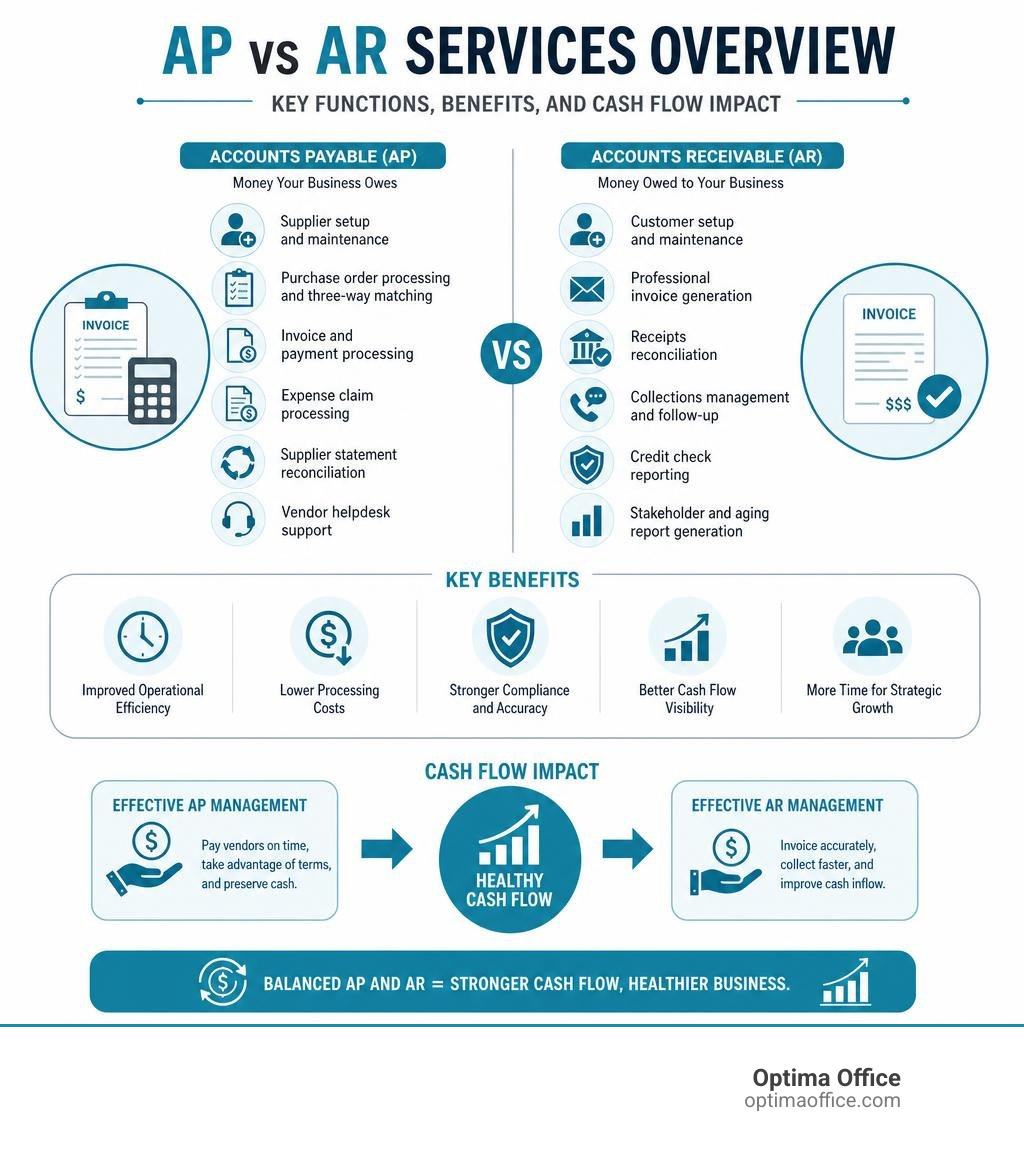
Optimizing Cash Flow with Accounts Payable and Receivable Services
To keep your business healthy, you must look beyond simple profitability and focus on active cash flow management. Although your business might show a strong profit on paper, it can still run into severe liquidity issues if cash is trapped in unpaid customer invoices. Conversely, paying vendors too early can deplete your working capital before new revenue arrives. Maintaining a healthy financial profile requires a delicate, daily balancing act between cash inflows and outflows.

The Core Components of Accounts Payable and Receivable Services
Comprehensive accounts payable and receivable services manage the entire lifecycle of your transaction workflows. On the accounts payable side, this includes precise invoice processing, expense coding, and strategic payment scheduling to ensure you never miss early payment discounts or incur late fees. On the accounts receivable side, the services cover professional billing, customer setup, credit checks, and structured collections to accelerate cash inflows.
By centralizing these functions, you establish a predictable, repeatable routine for handling transactions. Additionally, these specialists ensure that invoices are dispatched immediately after delivery and that incoming payments are matched to open accounts without delay. This level of operational discipline ensures that your balance sheet remains accurate and up to date at all times.
Key Differences Between Payables and Receivables
While both functions are vital to managing your liquidity, they sit on opposite sides of your balance sheet and represent very different operational goals. Accounts receivable represents money owed to your business by customers, making it a current asset that you want to collect as quickly as possible. On the other hand, accounts payable represents money you owe to suppliers, which is classified as a current liability that you want to manage strategically to preserve cash.
To manage these high-volume transactions without cluttering your general ledger, specialized accounting teams utilize dedicated subledgers. These subledgers record detailed, individual transactions for each customer and vendor before compiling the totals into the general ledger.
| Feature | Accounts Payable (AP) | Accounts Receivable (AR) |
|---|---|---|
| Balance Sheet Category | Current Liability | Current Asset |
| Primary Goal | Optimize payment timing & maintain vendor trust | Accelerate cash collection & reduce bad debt |
| Key Transactions | Supplier invoice processing, vendor payments, expense coding | Customer billing, payment tracking, collections |
| Primary Metric | Days Payable Outstanding (DPO) | Days Sales Outstanding (DSO) |
| Subledger Focus | Individual vendor accounts and payment records | Individual customer accounts and outstanding balances |
The Strategic Benefits of Outsourcing AP and AR Functions
For many growing organizations, managing these complex financial workflows in-house becomes an operational bottleneck. Outsourcing your AP and AR functions to a dedicated team delivers immediate cost reduction and significant time savings. Instead of hiring, training, and managing internal staff, you gain instant access to experienced professionals who specialize in transaction management.

This operational shift also leads to massive error minimization by eliminating manual data entry mistakes and duplicate payments. Furthermore, outsourced solutions offer unmatched scalability, allowing your financial support to expand seamlessly as your transaction volume grows. This means you can scale your business operations up or down without the stress of constant hiring or layoffs.
Accelerating the Order-to-Cash Cycle
The speed at which you convert sales into actual cash is a critical indicator of your operational efficiency. Outsourced AR specialists focus heavily on increasing your invoicing speed, ensuring that bills are generated and sent the moment a service is completed or a product is shipped. They implement a polite yet highly structured collections process to follow up on outstanding balances before they become overdue.
In this case, a proactive approach directly reduces your Days Sales Outstanding (DSO) and lowers your overall bad debt ratio. Real-time payment tracking allows you to spot payment delays early and address customer disputes before they create any cash flow problems for your business. Keeping this cycle tight ensures that your hard-earned revenue is sitting in your bank account, ready to support business growth.
Streamlining the Procure-to-Pay Process
On the payables side, outsourcing transforms how your business interacts with vendors and manages cash outflows. Professional AP services establish strict controls, utilizing formal purchase orders and rigorous three-way matching to verify that every invoice matches the original order and the actual goods received. This process prevents overpayments, identifies vendor errors, and ensures total transaction transparency.
By managing your Days Payable Outstanding (DPO) strategically, outsourced teams help you hold onto cash longer without damaging vendor trust. They identify and capture early payment discounts when it makes financial sense, while ensuring standard payments are scheduled to avoid late penalties. Additionally, customized expense coding ensures that every transaction is categorized accurately for seamless financial reporting.

Overcoming In-House Financial Management Challenges
Many businesses struggle with in-house financial management. This is typically due to ongoing talent shortages and the high cost of recruiting experienced accounting professionals. When internal teams are overworked, they often fall back on slow, manual entry processes and disorganized spreadsheet chaos. This lack of standardization increases the risk of accounting errors, missed payments, and delayed financial reporting.
Furthermore, manual systems expose businesses to escalating security risks and internal fraud. However, without a clear separation of duties, it is incredibly difficult to implement the internal controls necessary to protect your business assets. Outsourcing your financial operations introduces enterprise-grade fraud prevention and secure cloud systems that safeguard your sensitive financial information.
Compliance, GAAP Financial Reporting, and Labor Regulations in 2026
Operating a business in 2026 requires navigating an incredibly complex web of accounting standards and strict labor laws. Maintaining total compliance is vital for protecting your business from costly audits, legal disputes, and regulatory penalties. On the financial side, meeting the standards of GAAP financial reporting and keeping up with 2026 accounting regulatory changes requires dedicated, expert oversight.
A critical area of focus during any financial review is the proper accounting for subsequent events. These are transactions or events that occur after the balance sheet date but before the financial statements are officially issued. To ensure your records are accurate, your team must perform a thorough subsequent events review and execute precise audit procedures for subsequent events to identify any items requiring disclosure.
Your financial team must have a clear, documented subsequent events policy to handle these situations. Under GAAP, these occurrences are split into two categories:
- Recognized subsequent events (Type 1): Events that provide additional evidence about conditions that existed at the balance sheet date, which require adjustments to the financial statements.
- Unrecognized subsequent events (Type 2): Events that provide evidence about conditions that arose after the balance sheet date, which do not require adjustments but do require formal disclosure.
To pass a subsequent events audit, you must document clear examples of subsequent events in your disclosures. For instance, Type 1 subsequent event examples include the settlement of a lawsuit that existed at year-end, while Type 2 subsequent event examples might include a major fire destroying a warehouse after the balance sheet date.
Whether you are following FASB subsequent events guidelines, GAAP subsequent events standards, or IFRS subsequent events rules, having an expert team handle your post-balance-sheet events disclosure and establish clear procedures to identify subsequent events is essential.
Beyond accounting, business owners in Southern California must also manage complex labor compliance. For example, failing to adhere to California bathroom break laws or OSHA bathroom break requirements can result in severe fines. HR departments must understand bathroom break laws, specifically bathroom break laws in California and the rules governing them.
Staying compliant means understanding California bathroom laws for employees, California labor law for bathroom breaks, and California restroom break laws.
Furthermore, you must ensure your managers respect labor laws regarding bathroom breaks, OSHA regulations for bathroom breaks, and OSHA rules on bathroom breaks to maintain a safe, fair workplace. Knowing the exact rules for restroom breaks at work in California and accommodating ADA bathroom breaks is a standard requirement for local employers.
Nevertheless, wage and hour compliance is equally critical. Employers must navigate the complex four-hour rule for exempt employees alongside hourly wage standards. This includes understanding the four-hour minimum shift and the specific four-hour minimum shift in California. Failing to comply with the California four-hour minimum shift law can lead to costly class-action lawsuits.
Your leadership team must be fully trained on the four-hour rule for employees, the FLSA four-hour rule, the four-hour rule wage law, and general four-hour rule labor laws. This will ensure your payroll practices remain completely compliant.
FAQs About AP and AR Outsourcing
When is it best to outsource our AP and AR?
You should consider outsourcing when monthly transaction volume begins to overwhelm the internal team, leading to processing bottlenecks and delayed reporting. If you are experiencing constant staffing struggles, high employee turnover, or find yourself regularly paying vendors late, it is time to look for an external partner. Outsourcing AP and AR also benefits businesses looking to scale their operations quickly without the overhead of hiring full-time internal staff.
How Do Outsourced Providers Ensure Data Security?
Reputable outsourcing providers protect your sensitive financial data by utilizing secure, ISO 27001-compliant data centers and advanced data encryption protocols. They implement strict role-based access controls, ensuring that only authorized personnel can view specific financial records. Moreover, they also utilize secure VPN connections, multi-factor authentication, and continuous system monitoring to prevent unauthorized access and data breaches.
What KPIs Measure the Success of Outsourced AP/AR?
When it comes to measuring the success of your outsourced financial services, you should track key metrics like Days Sales Outstanding (DSO) for collections and Days Payable Outstanding (DPO) for vendor payments. Particularly, you should monitor processing accuracy rates, invoice cycle times, and your overall collection effectiveness index. A successful outsourcing partner will provide transparent, real-time dashboards that allow you to track these metrics consistently.
Transform Your Back Office into a Growth Engine
At Optima Office, we believe that your accounting department should be a strategic asset, not an administrative burden. We provide a highly customized mix of fractional CFO, controller, bookkeeping, and HR advisory services. Our unique brand promise allows you to gain the expertise of a complete finance and HR department for a fraction of the cost of hiring full-time internal staff.
With our rapid team deployment model, we can place the right financial or HR professionals into your business in just 3 to 5 days. Our proprietary five-point system ensures that every professional we place is a perfect match for your company’s unique culture and operational needs. Consider letting us handle the complexities of your back office so you can focus on maximizing profits, minimizing operational risk, and driving enterprise growth.
Ready to optimize your financial operations and secure your cash flow? Optima’s outsourced accounting services are just a phone call away. Contact our team today to schedule your complimentary financial consultation.