


Small business cash flow problems are the single most cited factor in small business failure, with 82% of businesses that fail pointing to cash flow as a key contributing cause. Even profitable companies can find themselves unable to meet payroll, pay vendors, or cover basic operating expenses. Not because the business model is broken, but because of a timing mismatch between when money comes in and when bills come due.
Running a business with a healthy revenue line but an empty bank account is more common than most owners realize, and far more dangerous. For millions of small business owners, CEOs, and heads of HR across the country, the gap between money earned and money available is where companies quietly begin to fail. Managing this timing mismatch is critical to keeping your operations running smoothly and avoiding sudden insolvency.
This guide walks you through exactly how to close that gap. It includes five practical steps designed for business leaders who need real solutions.
Overview of the most common small business cash flow problems and what causes them:
| Cash Flow Problem | Key Stat |
|---|---|
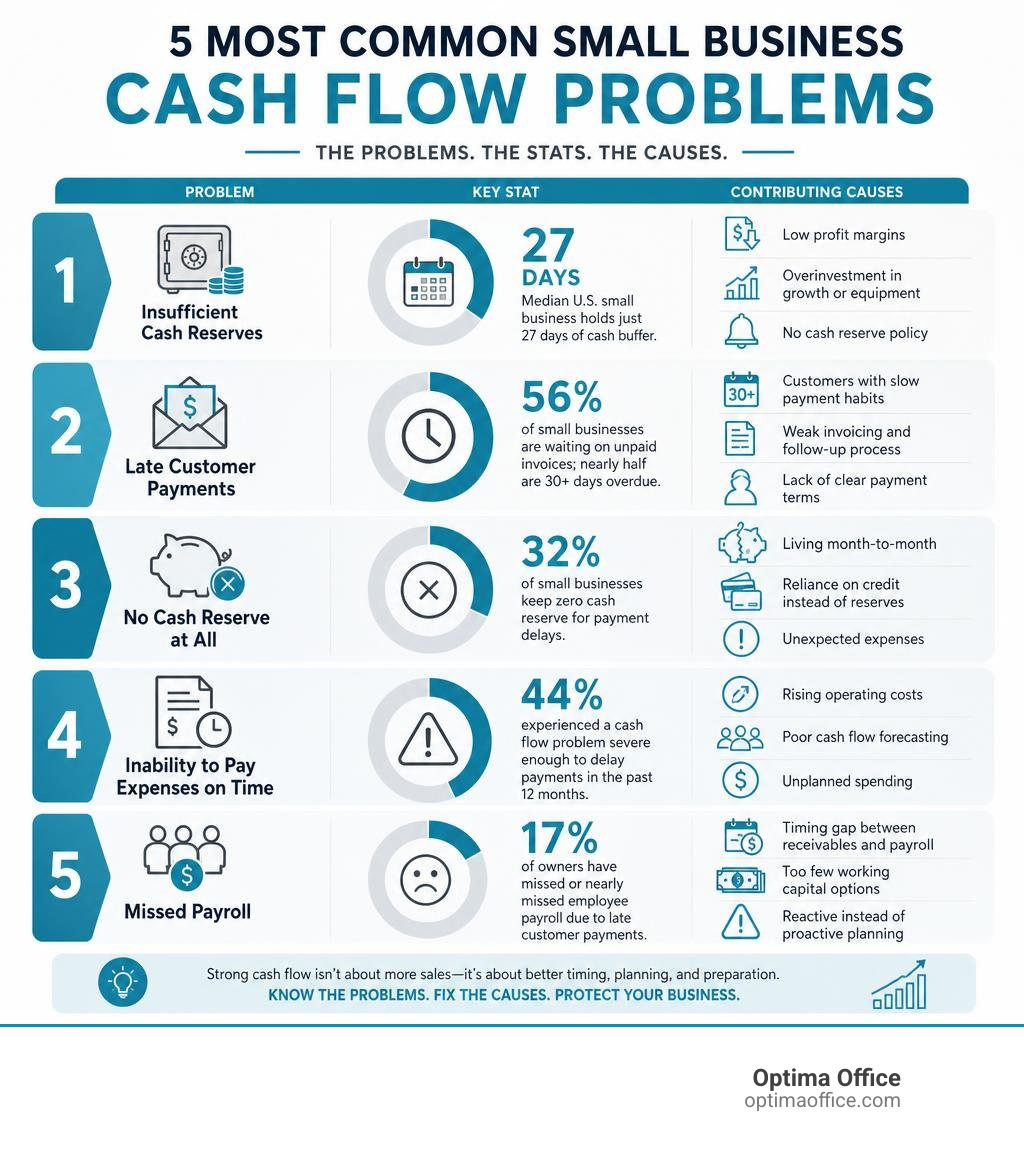
| Insufficient cash reserves | Median U.S. small business holds just 27 days of cash buffer |
| Late customer payments | 56% of small businesses are waiting on unpaid invoices; nearly half are 30+ days overdue |
| No cash reserve at all | 32% of small businesses keep zero cash reserve for payment delays |
| Inability to pay expenses on time | 44% experienced a cash flow problem severe enough to delay payments in the past 12 months |
| Missed payroll | 17% of owners have missed or nearly missed employee payroll due to late customer payments |
| Startup failure from running out of cash | 38% of startups fail because they exhaust their cash |
| Cash flow as top business concern | 31% of small business owners named it their #1 concern in Q1 2026 |
The picture these numbers paint is stark. Most small businesses are operating with less than a month of financial runway. A single slow-paying client, an unexpected equipment repair, or a seasonal revenue dip can tip a business from stable to crisis in a matter of weeks. And as of Q1 2026, cash flow pressure has surpassed inflation as the top concern for small business owners. It’s a signal that this is not a fringe problem, but a structural one affecting the majority of businesses at every stage of growth.
What makes this especially difficult is that cash flow problems are often invisible until they become urgent. A business can show strong revenue on paper and win new contracts. However, it may still find itself scrambling to make payroll, because the cash simply has not arrived yet. That gap between the income statement and the bank account is where small businesses get into serious trouble.
This guide walks you through exactly how to close that gap. Below are five practical steps designed for business owners, CEOs, and financial leaders who need real solutions, not just theory.
Managing a small business today is an exhilarating journey, but it requires navigating incredibly tight financial boundaries. The reality of operating in competitive hubs like San Diego means that overhead, payroll, and regulatory costs are consistently high. When we look at how most local companies manage their working capital, we find that the buffer protecting them from sudden economic shifts is dangerously thin.
According to financial industry data, the median U.S. small business operates with a cash buffer of just 27 days. This means that if all incoming revenue ground to a halt tomorrow, the average business would run completely out of money in less than four weeks. For the bottom 25% of small businesses, that runway is even shorter, leaving them with 13 days or fewer of cash on hand.
This lack of financial breathing room explains why 44% of small businesses experienced a cash flow problem severe enough to prevent them from paying their standard operating expenses on time over the past 12 months.
With cash flow pressures ranking as the number one concern for 31% of business owners in Q1 2026, it is clear that survival relies on proactive liquidity management. Relying on paper profitability is no longer a viable defense. Without a structured approach to cash reserves, even a highly successful business can find itself facing insolvency due to minor operational delays.
Why Cash Flow is the Lifeblood of Operations
There is a fundamental difference between earning a profit and having cash in the bank. Profit is an accounting metric that measures revenue minus expenses over a specific period, often including transactions where no money has actually changed hands yet. Cash flow, on the other hand, represents the physical movement of dollars into and out of your business accounts.
When a company experiences a timing mismatch, it means they are recognized as highly profitable on paper while simultaneously struggling to buy inventory or pay employees. For example, if we secure a major contract and immediately incur labor and material costs to deliver the project, we must pay those expenses today. If the client operates on a 60-day payment cycle, we must find a way to fund our operations for two full months before seeing a single dollar of revenue.
This timing gap is where otherwise healthy organizations run out of working capital and fail.
The Statistics Behind Cash Buffer Shortages
The systemic nature of cash shortages becomes obvious when we analyze the average timeline for collections. Nationally, the average invoice payment delay sits at 17.3 days past the agreed due date. When we combine this delay with an average Days Sales Outstanding (DSO) of 42 days, we see that the typical business waits nearly two months to collect cash from the moment a sale is completed.
These delays vary significantly by industry, creating distinct levels of risk across different sectors:
| Industry Sector | Average Days Sales Outstanding (DSO) | Median Cash Reserves (Days) |
|---|---|---|
| Restaurants & Food Service | Immediate (POS) | 11 Days |
| Retail | 28 Days | 19 Days |
| Construction & Subcontracting | 58 Days | 20 Days |
| Manufacturing | 67 Days | 22 Days |
| Professional Services | 45 Days | 38 Days |
This table highlights the structural challenges businesses face. A construction subcontractor or manufacturer must fund labor, raw materials, and overhead for over 50 days before receiving payment, yet they hold only about three weeks of cash reserves. This structural imbalance makes them highly vulnerable to sudden customer payment delays.
The Root Causes of Small Business Cash Flow Problems
To permanently solve cash flow issues, we must first diagnose the underlying vulnerabilities that create them. Cash flow disruptions affect an overwhelming 88% of small businesses. This means almost every owner will face a liquidity crunch at some point. These crises rarely stem from a single bad decision. Instead, they are the result of compounding operational inefficiencies, high overhead costs, and a lack of forward-looking financial visibility.
These issues are often amplified by rising fixed overhead expenses, such as commercial rent increases and higher wage requirements. When fixed costs rise while collection cycles slow down, a business’s cash engine begins to stall. Identifying these triggers early is the only way to prevent a minor cash squeeze from turning into a business-ending event.
How Late Payments Trigger Cash Flow Problems
Late customer payments are the primary catalyst for small business cash flow problems. When we extend credit terms to clients, we are essentially acting as an interest-free lender. If a client delays payment beyond the agreed terms, they are holding onto capital that our business needs to survive.
Currently, 56% of small businesses are waiting on cash from unpaid invoices, and nearly half of those invoices are more than 30 days overdue. The operational impact of these delays is severe: 29% of small business owners have been forced to delay paying their own salaries, and 17% have missed or nearly missed employee payroll because a customer paid late.
Carrying $100,000 in unpaid accounts receivable past its due date costs a business thousands of dollars annually in borrowing fees and lost opportunities, making efficient collection processes a necessity rather than an afterthought.
The Role of Poor Cash Flow Forecasting
Many business owners manage their finances by looking backward. They review last month’s profit and loss statement or check their current bank balance to make spending decisions. This reactive approach is a major driver of cash flow crises. Backward-looking statements only show where your money was, not where it is going.
Without a forward-looking cash flow forecasting system, leaders cannot see upcoming cash deficits. For instance, a business might look at a healthy bank balance on Monday and decide to purchase new equipment, completely forgetting that quarterly tax payments, a bi-weekly payroll cycle, and a major insurance premium are all due the following week. Accrual-based accounting can mask these impending shortages, which is why we must track the actual timing of cash movements rather than just booked revenue.
Seasonal Fluctuations and Rapid Growth Vulnerabilities
While slow sales are an obvious threat, rapid business growth can be equally dangerous to your cash position. This counterintuitive challenge is known as the “growing broke” phenomenon. When a business scales quickly, it must immediately invest in additional staff, inventory, equipment, and marketing to support that growth. If the revenue from these new customers takes 30 to 90 days to collect, the business can easily exhaust its cash reserves trying to keep up with its own success.
Client concentration introduces another layer of risk. If a business relies on a single client for more than 30% of its total revenue, its financial stability is entirely dependent on that client’s payment behavior. If that key customer experiences their own financial difficulties, delays an invoice, or terminates the contract, the business faces an immediate and potentially catastrophic cash flow crisis.

How to Solve Cash Flow Problems in 5 Easy Steps
Restoring financial health to your business does not require overly complex financial engineering. It requires establishing consistent daily habits, using modern financial tools, and executing a structured plan. By focusing on the timing of your cash inflows and outflows, you can build a highly resilient business that is insulated from market volatility.
Below is our proven five-step framework designed to eliminate cash flow anxiety, optimize your working capital, and establish a permanent financial safety net for your organization.
Step 1: Accelerate Your Accounts Receivable
The fastest way to improve your cash position is to speed up your incoming revenue. If your collection cycle relies on manual paper invoicing or waiting for physical checks to arrive in the mail, you are unnecessarily delaying your cash access. Transitioning to a modern, digitally-enabled invoicing system can dramatically reduce these delays.
Data shows that digital invoices are paid 174% faster than traditional invoicing methods, reducing the average payment window from 18 days down to just 7 days. To accelerate your accounts receivable, implement these three practices immediately:
- Offer Early Payment Incentives: Provide a small discount, such as 2% off the total invoice if paid within 10 days (2/10 Net 30), to encourage prompt payments.
- Require Upfront Deposits: For service-based contracts or large customized orders, require a 25% to 50% deposit before work begins to cover initial labor and material costs.
- Automate Follow-Ups: Use automated software to send friendly payment reminders 5 days before an invoice is due, on the due date, and immediately once it becomes overdue.
Step 2: Manage Accounts Payable Strategically
While your goal is to collect cash as quickly as possible, you should manage your outgoing payments with equal discipline. Managing payables strategically does not mean avoiding your financial obligations or damaging relationships with your suppliers. Instead, it means utilizing the full payment window available to you to keep cash in your account longer.
If a vendor offers Net-30 terms, pay them on day 30, not day 5. This simple shift ensures that you retain use of your capital for the maximum allowable time. Additionally, take a proactive approach to your top suppliers by negotiating extended payment terms. You can do this moving from Net-30 to Net-45 or Net-60 terms. Many vendors are willing to grant these extensions to reliable, long-term partners because they value payment consistency over immediate collection.
Step 3: Implement a 13-Week Rolling Forecast
A 13-week rolling cash flow forecast is the single most effective tool for preventing financial surprises. This specific timeframe represents a full business quarter. It provides enough visibility to spot upcoming cash deficits while maintaining a high level of accuracy. Unlike annual budgets, a rolling forecast must be updated weekly to remain useful.
To build an effective forecast, map out your cash inflows based on the actual dates you expect clients to pay. Instead of the billing dates on your invoices. Next, list all your fixed and variable cash outflows. This should include payroll, rent, taxes, and vendor payments, on their exact due dates. By updating this model every Monday morning, you can identify cash shortages weeks before they occur. This will give you ample time to defer non-essential expenses or draw on a line of credit proactively.
Step 4: Optimize Inventory and Overhead Costs
Tying up excess cash in physical inventory or un-utilized business services is a common way to drain your working capital. Every dollar sitting on a warehouse shelf or spent on an unused software license is a dollar that cannot be used to meet payroll or pay critical bills.
To free up this trapped cash, conduct a thorough audit of your operations:
- Adopt Just-In-Time (JIT) Inventory: Coordinate with your suppliers to order materials only as they are needed for production, reducing your storage costs and freeing up cash.
- Audit Subscriptions and Software: Review all recurring business expenses monthly to identify and cancel duplicate software platforms, unused licenses, or forgotten subscriptions.
- Negotiate Fixed Expenses: Review your commercial leases, insurance policies, and vendor contracts annually to identify opportunities for renegotiation or cost savings.
Step 5: Establish a Dedicated Cash Reserve and Credit Line
The ultimate defense against cash flow instability is a healthy cash reserve. Financial experts recommend maintaining a liquid cash reserve equal to 3 to 6 months of fixed operating expenses. If your business experiences seasonal revenue drops or has high client concentration, you should aim for 6 to 12 months of reserves. Keep these funds in a separate high-yield business savings account. This way you can earn 4.0% to 5.0% APY, so they remain liquid but insulated from daily operating temptations.
In addition to cash reserves, secure a business line of credit before you actually need it. Banks are far more likely to approve credit applications when your financial statements are strong and your cash balances are healthy. But a line of credit should serve as a temporary bridge to cover short-term timing gaps. However, it should not as a permanent source of operating capital.
FAQS About Managing Cash Flow
What is the difference between profit and cash flow?
Profit is an accounting calculation showing revenue minus expenses during a specific period, recorded on an accrual basis. Cash flow is the actual movement of money into and out of your bank accounts. A business can be highly profitable on paper because it secured a large contract. But, it can still go bankrupt if it lacks the actual cash to pay its immediate bills before that contract revenue is collected.
How much cash reserve should a small business hold in 2026?
In 2026, most small businesses should maintain a cash reserve equal to 3 to 6 months of operating expenses. This reserve should be kept in a dedicated savings account separate from your primary operating account. For businesses with highly seasonal sales cycles or significant customer concentration, a buffer of 6 to 12 months is highly recommended.
What tools are most effective for tracking cash flow?
The most effective approach combines automated accounting software (like QuickBooks or Xero) with dedicated accounts receivable automation tools to speed up collections. For forecasting, a rolling 13-week spreadsheet or specialized cash flow forecasting software provides the real-time visibility needed to make proactive business decisions.
Avoid Cash Flow Problems and Secure Your Financial Future
Resolving complex small business cash flow problems requires specialized expertise and consistent operational discipline. Many growing companies reach a stage where their financial needs outpace the capabilities of a standard bookkeeper. However, they lack the resources to hire a full-time, executive-level financial team.
At Optima Office, we solve this exact challenge by providing a highly customized mix of fractional CFO, controller, bookkeeping, and HR advisory services. Based in San Diego and serving businesses throughout the U.S., our unique value proposition is to rapidly deploy a dedicated financial team within 3 to 5 days. Utilizing our proprietary five-point system, we ensure the perfect operational and cultural fit for your organization.
With our fractional accounting model, you gain the strategic oversight of an experienced CFO and the precise execution of a professional accounting department for a fraction of the cost of a single full-time internal hire. We help you implement rolling forecasts, automate your accounts receivable, and optimize your working capital. This way you can focus on scaling your business with complete peace of mind.
Ready to eliminate the stress of cash problems and optimize your business performance? Contact our team today to schedule your complimentary consultation.