

The procedures to identify subsequent events are a critical and often underestimated part of the financial reporting and audit process. For business owners, CEOs, and financial leaders at growing companies, understanding what these procedures involve can mean the difference between financial statements that hold up under scrutiny and ones that expose your organization to restatements.
Implementing these procedures ensures your organization remains compliant and maintains high financial integrity. By establishing a clear process, you can protect your business from unexpected reporting risks and regulatory findings.
An overview of the core procedures used to identify subsequent events:
- Inquire of management about contingent liabilities, capital changes, unusual transactions, and any events occurring after the balance sheet date.
- Review meeting minutes from board, governance, and shareholder meetings held after the period end.
- Obtain legal confirmations by contacting the entity’s legal counsel about pending or new litigation and claims.
- Read interim financial statements and other post-period financial data to spot unusual adjustments or transactions.
- Review the capital budget and other operational data to identify major commitments or asset changes occurring after year-end.
- Obtain written representations from management confirming that all known subsequent events have been disclosed.
These steps cover the window between the balance sheet date and the date the auditor’s report is issued. This period can span anywhere from a few weeks to several months depending on the organization and its filing requirements.
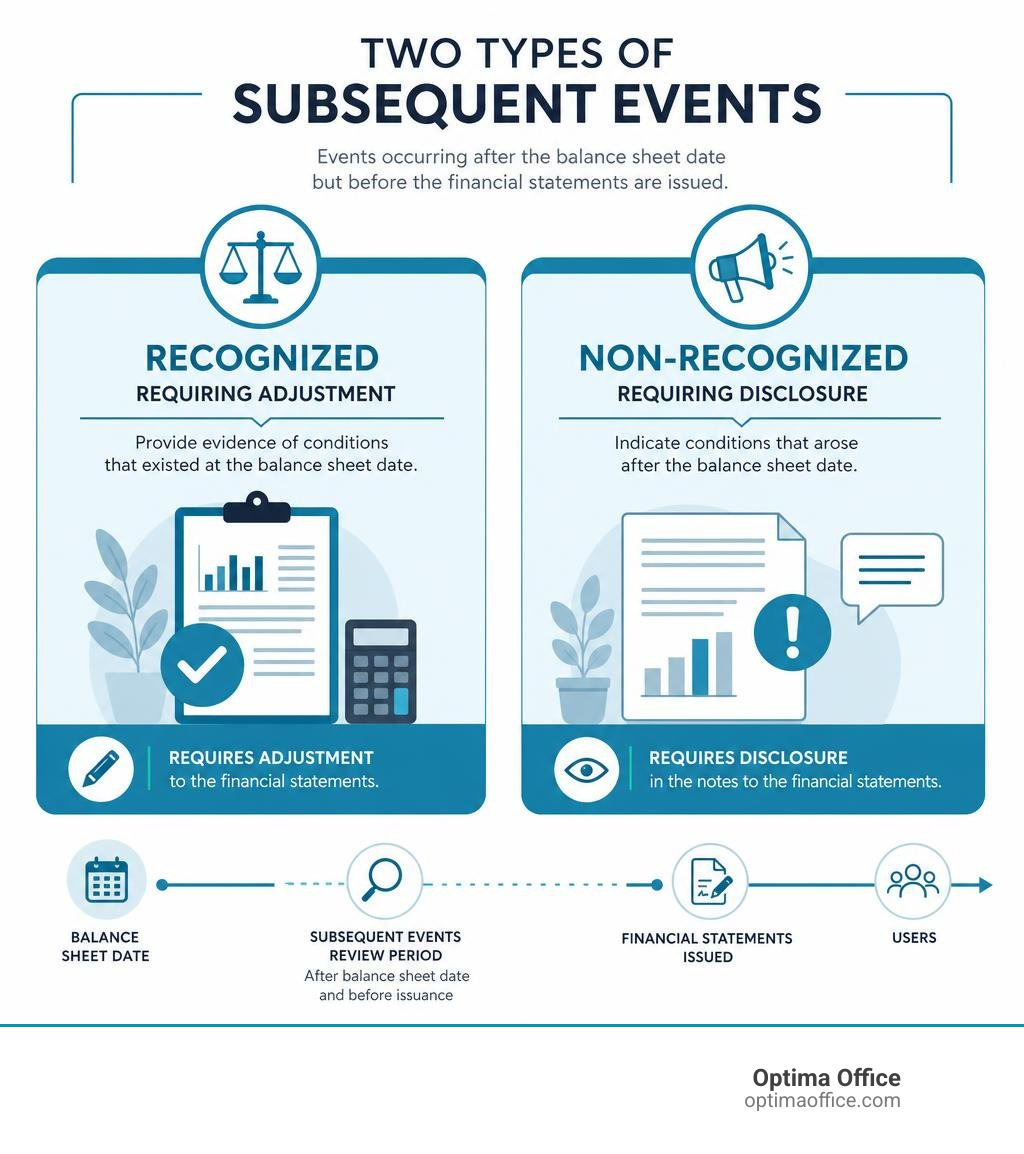
Subsequent events fall into two categories. There are those that require an adjustment to the financial statements because they reflect conditions that already existed at the balance sheet date. And, there are those that require only footnote disclosure because they represent entirely new conditions that arose after that date. Getting this classification right demands both a clear process and sound professional judgment.
For small to mid-sized businesses, especially those without dedicated financial controller services, this is an area where gaps in process can quietly create significant financial reporting risk. Whether you are preparing for an external audit, closing the books after a complex fiscal year, or navigating an unexpected event like a lawsuit settlement or a major customer going under, knowing exactly what to look for and when to look for it is essential.
Understanding Subsequent Events and Their Financial Impact
When we close out a fiscal year, the financial statements represent a snapshot of a company’s financial position at a single point in time. However, business does not stop moving when the clock strikes midnight on December 31. Transactions keep processing, lawsuits settle, and economic conditions shift. This is where accounting for subsequent events becomes vital. These occurrences can drastically alter how stakeholders interpret our financial health and make strategic decisions.
Both management and auditors must look beyond the balance sheet date to ensure financial statement accuracy. If we ignore significant happenings that occur before the statements are widely distributed, we risk presenting a misleading picture of our financial health. This process is governed by strict guidelines under both U.S. GAAP subsequent-event guidance, specifically ASC 855, and IFRS subsequent-event guidance, specifically IAS 10.
These frameworks ensure that any development that alters the underlying value of our assets or liabilities is properly accounted for or disclosed.
The goal of evaluating these occurrences is to protect user decision-making. Lenders, investors, and internal leadership rely on these statements to allocate capital and assess risk. Under FASB subsequent-event guidance, we must carefully categorize each post-close occurrence to determine whether it warrants a direct change to our financial figures or whether a descriptive footnote will suffice.
Recognized Subsequent Events (Type 1)
These are known as recognized subsequent events, often referred to as Type 1 events. They provide additional evidence about conditions that existed at the balance sheet date. Because the root cause of the event was already in play before the reporting period ended, we are required to make direct accounting adjustments to our financial statements.
A classic example of a Type 1 event is a lawsuit settlement that occurs after the balance sheet date but before the financial statements are issued. If the litigation was already pending at year-end, the post-close settlement simply provides concrete evidence of the actual liability value that existed on December 31. In this scenario, we must adjust our accrued liabilities and expenses to match the final settlement amount.
Another common Type 1 subsequent-event example involves a major customer declaring bankruptcy shortly after the balance sheet date. If the customer’s financial health was already deteriorating before year-end, this bankruptcy confirms that our accounts receivable asset was impaired at the balance sheet date. Consequently, we must record an adjusting entry to increase our allowance for doubtful accounts and write down the receivable.
Non-Recognized Subsequent Events (Type 2)
On the flip side, we have non-recognized subsequent events, which are categorized as Type 2 events. These occurrences arise from post-balance-sheet conditions that did not exist when the reporting period closed. Because they represent entirely new economic realities, they do not require direct accounting adjustments to the historical financial statements.
Instead, Type 2 events require detailed footnote disclosures if they are material enough that their omission would make the financial statements misleading. A perfect example is a fire, flood, or natural disaster that destroys a manufacturing facility three weeks after the fiscal year ends. While this is a devastating financial blow, the facility was completely intact on December 31, meaning the historical balance sheet remains accurate.
Other Type 2 subsequent-event examples include issuing new bond debt, entering into a major business merger, or experiencing a sudden drop in the market value of our investments. For these situations, we must provide a clear post-balance-sheet event disclosure that explains the nature of the event and provides an estimate of its financial effect. If we cannot estimate the impact, we must explicitly state that in our footnotes.
Core Procedures to Identify Subsequent Events
To protect the integrity of our financial reporting, we must establish a structured subsequent-events review process. This is not about running a second full-scale audit on the subsequent period, but rather executing targeted procedures designed to catch material changes. Both management and external auditors rely on these steps to ensure no critical details fall through the cracks before the books are finalized.
Executing a thorough subsequent-events audit requires a blend of inquiry, analytical review, and document inspection. These procedures should cover the entire subsequent period, stretching from the balance sheet date to the date of the auditor’s report. By keeping our eyes open during this window, we can confidently identify both adjusting and non-adjusting events.

Standard Procedures to Identify Subsequent Events
Our standard audit procedures for subsequent events begin with a comprehensive risk assessment. We must understand how our management team identifies and tracks significant events after the fiscal year closes. This involves evaluating our internal controls to ensure we have a reliable mechanism for flagging unusual post-period transactions.
Once we understand the control environment, we execute specific substantive procedures. These include reviewing general ledger activity for the subsequent period, checking cash receipts for large collections on old receivables, and reviewing major credit memos issued after year-end. Furthermore, these steps help us verify whether our cutoffs were accurate and whether any assets were impaired.
Documenting Procedures to Identify Subsequent Events
Every step we take during our review must be meticulously documented in our audit workpapers. This documentation serves as the official audit evidence proving that we exercised due professional care. We must record whom we spoke with, which documents we reviewed, and the conclusions we reached.
Our audit schedules should clearly outline the scope of our testing, including the specific transaction thresholds we used to flag post-balance-sheet items. Additionally, we must obtain written management representations. This is a formal letter in which company leadership officially confirms that it has disclosed all material subsequent events to the audit team.
Inquiries of Management and Governance
Direct management inquiry is one of our most powerful tools. We regularly meet with key executives, including the CEO, controller, and CFO, to discuss post-period activity. Furthermore, we ask targeted questions about any changes in our capital structure, the status of contingent liabilities, and any unusual accounting adjustments.
Also, we inquire about whether there have been any significant changes in our subsequent-events policy or whether new related-party transactions have occurred. These conversations often reveal operational shifts. For instance, there’s plans to sell a business segment or acquire a major asset that haven’t hit the general ledger.
Review of Meeting Minutes and Legal Confirmations
To verify the information gathered during management inquiries, we must read the meeting minutes of shareholders, directors, and governance committees. These minutes provide an official paper trail of the strategic decisions made after the balance sheet date. If the board discussed a pending merger or authorized a new debt issuance in February, the minutes will show it.
Simultaneously, we send legal confirmation letters to our external legal counsel. These attorney letters ask our lawyers to evaluate the status of pending litigation and any unasserted claims. If a court ruling occurs after year-end that confirms our liability, this legal feedback gives us the exact evidence we need to make a Type 1 adjustment.
Analysis of Interim Financial Statements
Analyzing the latest interim financial statements is another essential step. We compare the post-close monthly financials against our year-end data to spot any unusual trends or sudden drops in revenue. For example, if our January or February financials show an unexpected spike in expenses, it could point to an unrecorded year-end liability.
We also perform targeted cutoff testing on journal entries, cash receipts, and disbursements made close to the reporting cutoff. This helps us ensure that transactions were recorded in the correct fiscal year. If we spot a massive credit memo issued in January, we must investigate whether the associated revenue should have been reversed in our December statements.
Businesses that need clearer post-close reporting can use Optima Insights to improve visibility into financial activity and unusual variances.

Evaluating and Classifying Post-Balance-Sheet Events
Once we identify a post-balance-sheet event, the next challenge is determining its proper accounting treatment. This requires us to apply significant professional judgment. We must ask ourselves a fundamental question: Did the underlying condition causing this event exist at the balance sheet date, or did it arise entirely afterward?
This evaluation can become complex, especially when multiple factors are at play. For example, if a customer goes out of business in February, we must look at its financial health before December 31. If it was already struggling with severe cash flow issues at year-end, it is a Type 1 recognized event. If it was perfectly healthy but its main warehouse burned down in January, it is a Type 2 non-recognized event.
We must also evaluate whether any subsequent events raise questions about our ability to continue as a going concern. If a major regulatory change or a catastrophic event occurs after year-end that threatens our operational viability, we may need to completely change our basis of accounting from historical cost to the liquidation basis.
To help visualize how we classify these occurrences, here is a quick comparison table:
| Event Type | Financial Statement Impact | Disclosure Requirement | Common Examples |
|---|---|---|---|
| Recognized (Type 1) | Direct adjustment to the financial statement numbers. | Footnote disclosure may accompany the adjustment to explain context. | Settlement of pre-existing litigation; customer bankruptcy due to pre-existing financial distress; discovery of pre-period fraud. |
| Non-Recognized (Type 2) | No change to the historical financial statement numbers. | Detailed footnote disclosure explaining the event and its estimated financial impact. | Destruction of a plant by fire or flood; issuance of new debt or equity; major business acquisition or merger. |
Auditor Responsibilities and Regulatory Differences
As auditors, our formal responsibility to perform active procedures to identify subsequent events is bound by specific dates. This active review period runs from the balance sheet date up to the auditor’s report date. Once we sign the audit report, our obligation to actively look for new events ends. However, we must still respond if material facts are brought to our attention before the statements are officially issued.
The specific timeline for evaluating subsequent events varies depending on the regulatory status of the reporting entity. Under gaap subsequent events standards, we must identify whether the company is an SEC filer, a conduit bond obligor, or a non-SEC filer. This distinction dictates the exact length of our evaluation period.

For SEC filers and conduit bond obligors, subsequent events must be evaluated through the exact date the financial statements are issued. For non-SEC filers, the evaluation period runs through the date the financial statements are “available to be issued.” Furthermore, financial statements are considered available for issuance when they are complete in a GAAP-compliant format and all necessary approvals have been secured.
Facts Discovered Before Financial Statement Issuance
In the event we become aware of a material fact after our report date but before the financial statements are widely distributed, we must take immediate action. Our team will discuss the matter with management and determine whether the financial statements need to be amended. If management agrees to update the figures or add a footnote disclosure, we have two choices for dating our audit report.
For one, we can either update our entire audit report to a newer date, which extends our liability for all subsequent events up to that new date. Or two, we can use dual dating. For dual dating, it looks like this: “February 15, 2026, except for Note X, as to which the date is March 5, 2026.” This technique allows us to limit our responsibility for events occurring after our original report date solely to the specific event disclosed in Note X.
Actions When Management Refuses to Amend Statements
In rare and unfortunate situations, we may encounter a client refusal. This happens when management refuses to adjust the financial statements or add necessary disclosures for a material subsequent event. If this happens, we cannot simply stand by and let misleading financial statements be issued to the public.
Our first step is to formally notify the company’s board of directors and audit committee. If management still refuses to act, we must take immediate steps to prevent reliance on our audit report. This includes withdrawing our audit report, notifying appropriate regulatory bodies, such as the SEC for public companies, and taking steps to inform known users of the financial statements that our report can no longer be trusted.
FAQs About Subsequent Events
What Is the Difference Between a Recognized and Non-Recognized Subsequent Event?
A recognized, or Type 1, subsequent event provides additional evidence about conditions that already existed at the balance sheet date. Plus, it requires a direct adjustment to the financial statement numbers.
A non-recognized, or Type 2, subsequent event represents conditions that arose entirely after the balance sheet date. However, it requires only a footnote disclosure rather than direct financial adjustments.
How Long Is the Subsequent-Events Evaluation Period?
The evaluation period depends on the entity’s regulatory status. All SEC filers and conduit bond obligors must evaluate subsequent events through the date the financial statements are issued.
All non-SEC filers evaluate subsequent events through the date the financial statements are complete and available to be issued.
What Happens if a Material Subsequent Event Is Discovered After the Audit Report Is Signed?
If a material event is discovered after the report date but before issuance, the auditor must discuss it with management to determine whether an amendment is required.
If the statements are amended, the auditor can either dual-date the report to limit responsibility to that specific event. Or, they can update the entire report date, which extends the auditor’s subsequent-events responsibility.
Mastering Your Post-Balance-Sheet Review Process
Navigating the complexities of accounting for subsequent events requires a robust, proactive approach to financial management. For small and mid-sized businesses, keeping up with these rigorous standards while managing daily operations can be incredibly challenging. This is where having the right financial leadership makes all the difference.
Optima Office specializes in providing fractional CFOs, controllers, bookkeepers, and HR advisory services tailored to your unique business needs. We can quickly conduct a comprehensive accounting cleanup, establish strong internal controls, and ensure your business achieves complete audit readiness.
With our proprietary five-point system, we guarantee rapid team deployment within 3 to 5 days, matching you with professionals who fit both your technical needs and your company culture.
By partnering with us, you gain access to a complete, highly customized finance and HR department. And, all for a fraction of the cost of hiring full-time internal staff. We help you systematically implement procedures to identify subsequent events. Additionally, we’ll protect you from reporting errors and give you the peace of mind that your financial statements are accurate, compliant, and ready for any audit.
Learn more about Optima Office’s outsourced accounting services. If you have any questions, please contact us today and we’ll have an accounting professional reach out to you asap.