
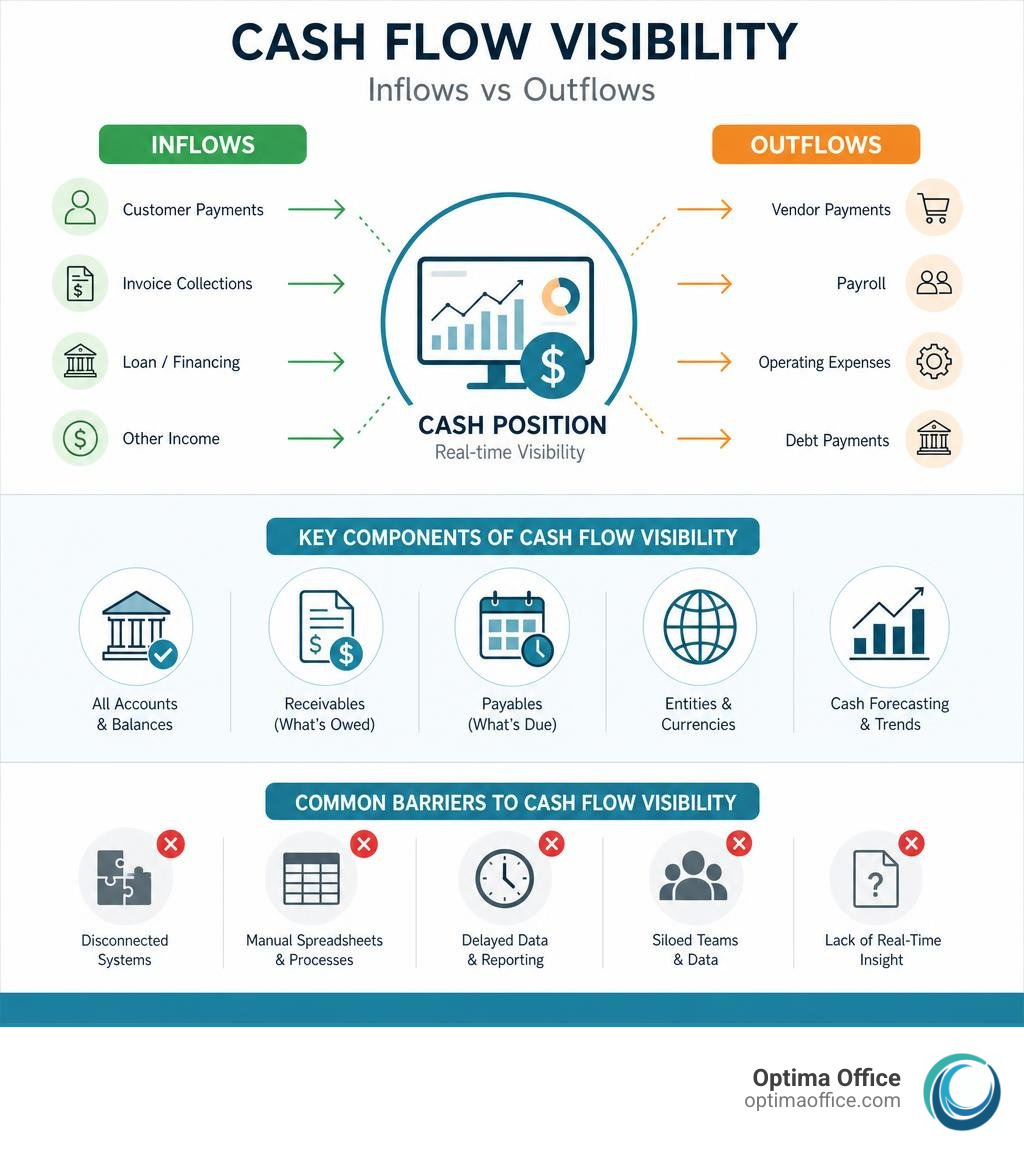
Cash flow visibility is your organization’s ability to clearly see, in real time, where every dollar is coming from, where it is going, and when across every account, entity, and currency you operate in. For business owners, CEOs, and heads of HR, this clarity is what actually determines whether you can make payroll next month and sustain operations.
Without it, even a highly profitable company on paper can easily run out of cash and face sudden insolvency. Establishing this oversight is the single most important step you can take to secure your company’s financial future. Here is a fast-reference summary to answer the core question:
What is Cash Flow Visibility?
- The real-time ability to track all cash inflows and outflows across your business
- Knowing your current bank balances, outstanding receivables, and upcoming payables at any given moment
- Understanding the timing of cash movements, not just the amounts
- Having a consolidated view across all accounts, subsidiaries, and banking relationships
- The foundation for forecasting, risk management, and confident financial decision-making
Revenue tells you what you earned. Cash flow visibility tells you whether you can actually operate — today, next week, and 90 days from now. A business can show strong top-line revenue on paper while simultaneously running out of cash to cover payroll. This is because customers are paying late and expenses are not waiting.
According to a Deloitte Global Treasury Survey, 58% of respondents ranked visibility into global operations, cash, and financial risk exposures as their single biggest financial challenge. That statistic reflects something most business owners already feel intuitively: the numbers exist somewhere in your systems, but getting a clear, unified, real-time picture of them is surprisingly hard.
For small and mid-sized businesses — especially those in professional services, healthcare, nonprofits, and manufacturing — the problem is often not a lack of financial data. It is that the data lives in disconnected systems: your ERP records transactions, your bank portal shows balances, your AR team tracks invoices in spreadsheets. Plus, nobody has a single consolidated view that reflects what is actually happening right now. And, by the time a report gets compiled and shared, it’s already outdated.
This guide walks you through exactly what cash flow visibility means, why it matters more than most business owners realize, and the practical steps you can take to achieve it — without overhauling your entire financial infrastructure.
Why Cash Flow Visibility Matters More Than Revenue
Many business leaders fall into the trap of focusing entirely on top-line revenue growth. While high sales figures look excellent on a pitch deck, they do not guarantee operational survival. In the current economic landscape of July 2026, where capital is expensive and market dynamics shift rapidly, cash is the ultimate arbiter of business health. You cannot pay your employees or your vendors with “revenue” that is still sitting in accounts receivable.

Without deep visibility into your cash runway and working capital, you are essentially operating in the dark. A sudden delay in a major client’s payment cycle can trigger a cascading liquidity crisis, forcing you to make reactive, high-stress decisions like taking out expensive short-term loans or pausing critical operations.
In contrast, having clear oversight of your cash allows you to confidently plan for the future, allocate resources strategically, and make proactive decisions rather than constantly fighting financial fires.
The Core Components of Cash Flow Visibility
To establish a reliable financial picture, we must look at cash through three distinct operational lenses:
- Operating Activities: This represents the daily heartbeat of your business. It includes cash inflows from sales and outflows for rent, utilities, inventory, vendor payments, and payroll. Operating activities typically have the largest and most immediate impact on your cash position.
- Investing Activities: This tracks cash used for long-term growth, such as purchasing equipment, physical property, or investing in capital assets that will yield returns down the road.
- Financing Activities: This includes inflows from loans or equity investments, as well as outflows for debt servicing, repayments, and owner distributions.
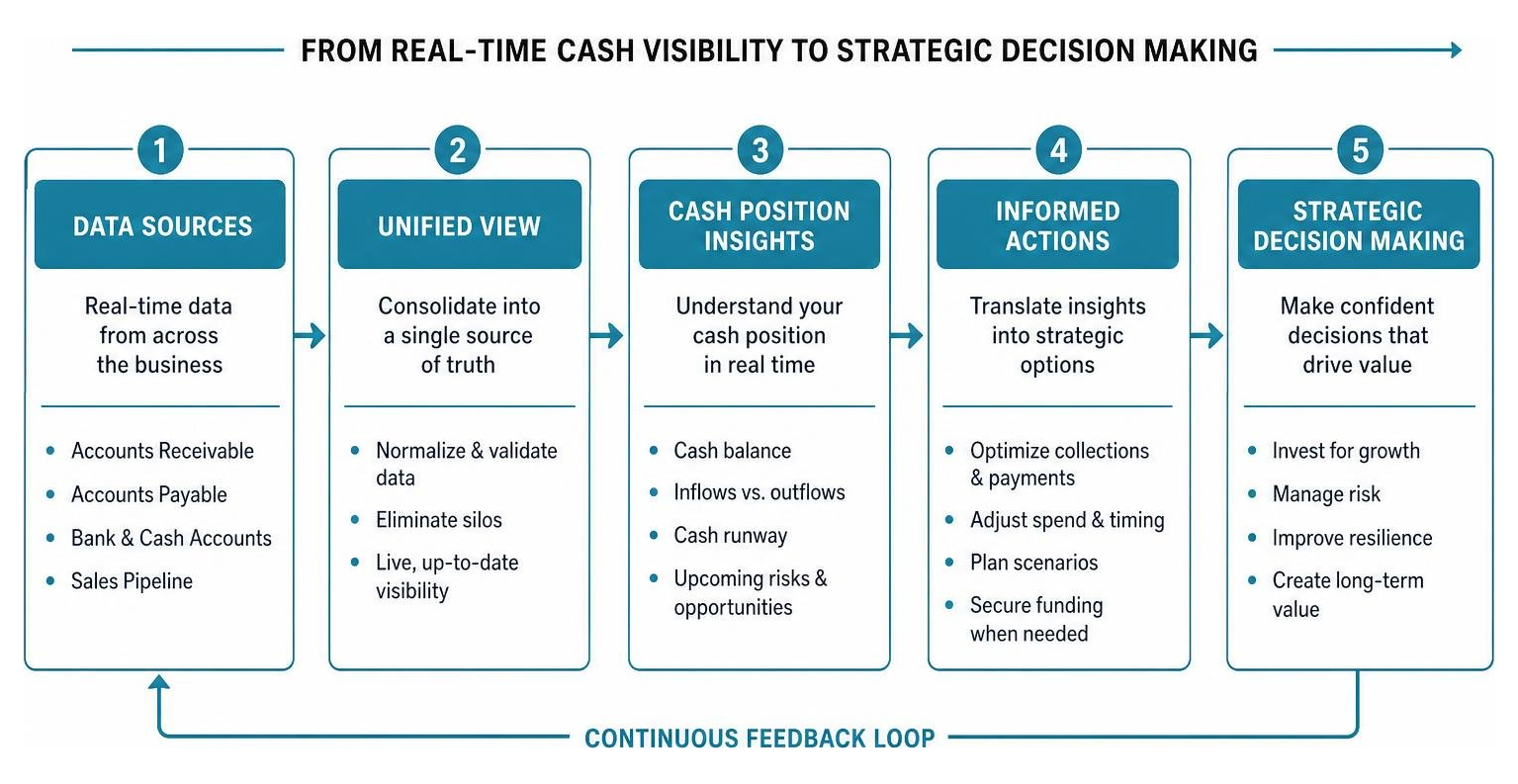
Achieving true visibility means pulling real-time data from all three of these areas into a single, unified view. When you can see how these activities interact day by day, you can accurately measure your actual cash runway.
Overcoming Barriers to Cash Flow Visibility
If maintaining clear visibility is so critical, why do so many organizations struggle with it? The answer usually lies in systemic operational friction.
First, data silos prevent a unified view. Your accounts receivable information lives in your ERP. While your customer communication history is buried in email threads, and your sales pipeline is locked in your CRM.
Second, inflexible legacy software and an overreliance on manual spreadsheets create massive delays. Many finance teams spend days every month manually copying and pasting transaction data into Excel. Also, by the time these reports are completed and delivered to leadership, the data is already several days old. In a fast-moving business environment, making decisions based on week-old data is a recipe for unexpected shortfalls.
The Critical Difference Between Cash Flow and Revenue
To manage a business successfully, you must distinguish between paper profits and actual liquidity. Revenue is an accounting concept that records a sale when the transaction occurs, regardless of when the money actually lands in your bank account. Cash flow, on the other hand, is the physical movement of money into and out of your business.
This difference creates timing gaps. For example, if you land a major contract worth $100,000 in July 2026, your revenue report will show a massive spike. However, if your contract terms allow the client 60 days to pay, and you must immediately hire contractors and purchase materials to deliver the project, your cash flow will be highly negative for the next two months. If you do not have the cash reserves to bridge that timing gap, your highly profitable contract could ironically drive you out of business.
Understanding the difference between direct and indirect methods of tracking this movement is essential for executive decision-making:
| Feature | Direct Cash Flow Planning | Indirect Cash Flow Planning |
|---|---|---|
| Data Source | Actual daily transactions (invoices, bills, bank actuals) | Financial statement assumptions (net income, depreciation) |
| Time Horizon | Short-term (typically 30 to 90 days) | Long-term (annual or multi-year) |
| Level of Detail | High (granular, invoice-level tracking) | Aggregated (period-based summaries) |
| Primary Use Case | Managing daily liquidity, payroll, and AP/AR cycles | Strategic capital planning and investor reporting |
Key Benefits of Real-Time Liquidity Tracking
When you transition from historical, month-end reporting to real-time liquidity tracking, the way you run your business changes fundamentally. Instead of looking in the rearview mirror to see how much money you spent last month, you gain a clear view of the road ahead.
This level of insight provides three major advantages:
- Proactive Risk Mitigation: Real-time visibility acts as an early warning system. It allows you to spot customer concentration risks, identify overdue collections before they become write-offs, and flag upcoming cash deficits weeks before they happen.
- Confident Strategic Planning: When you know your exact cash position, you can time capital expenditures, strategic hires, and inventory purchases perfectly. You no longer have to guess whether you can afford to expand; you will have the data to prove it.
- Resilient Crisis Management: Economic uncertainty and unexpected disruptions are inevitable. During market downturns, businesses with real-time visibility can immediately stress-test different scenarios, adjust their spending, and preserve their cash runway to ensure business continuity.
Practical Steps to Improve Your Financial Oversight
Improving your financial oversight does not require a massive, multi-year software implementation. It starts with refining your internal processes and establishing a culture of financial transparency.
We recommend beginning with a comprehensive audit if you’re experiencing cash flow problems. Review your historical transaction patterns, map out your typical billing cycles, and identify where bottlenecks tend to occur. Ensure your finance, sales, and operations teams are actively collaborating. Sales teams need to understand how payment terms impact liquidity, and finance teams need visibility into the pipeline to project future inflows accurately.
Rationalizing Bank Accounts and Partners
One of the fastest physical ways to improve visibility is to simplify your banking footprint. Research shows that 40% of corporations are actively trying to streamline their banking partners and accounts.
When your cash is scattered across multiple financial institutions, regional accounts, and subsidiaries, calculating your daily cash position becomes an administrative nightmare. It requires logging into multiple portals, downloading statements, and manually reconciling balances.
By consolidating your accounts into a smaller, highly integrated group of banking partners, you dramatically reduce administrative overhead. This will make it much easier to implement automated cash concentration strategies, where excess funds are swept daily into a central account to maximize interest or pay down debt.
Integrating Finance and HR Metrics
An often-overlooked blind spot in cash flow planning is the disconnect between finance and human resources. Human capital is typically the largest operating expense for any business. Yet payroll and HR metrics are rarely integrated into daily liquidity models.
For example, high employee turnover is incredibly expensive, but those costs are often buried in general operating expenses rather than tracked as a direct cash drain. By integrating HR metrics with financial planning, you can track the real-time cash impact of recruiting, onboarding, and training.
Furthermore, having clear cash visibility allows you to plan payroll obligations with absolute precision, ensuring you always have sufficient liquidity to support your team without keeping excessive, non-earning cash sitting idle in checking accounts.
The Role of Technology and AI in Modern Forecasting
To scale your business without scaling your administrative headcount, you must leverage modern financial technology. Centralized cash management platforms and automated treasury tools can connect directly to your bank accounts, ERPs, and payroll systems via APIs to create a single source of truth.
For businesses operating across multiple entities, currencies, or regions, these platforms are game-changers. They automatically consolidate balances, translate foreign currencies in real time, and eliminate the manual data entry that leads to costly errors.
Moving Beyond Static Spreadsheets
Although spreadsheets are wonderful tools for basic modeling, they are fundamentally unsuited for dynamic, short-term cash management. A spreadsheet is a static snapshot of a specific moment in time; the moment a transaction occurs, your spreadsheet is outdated.
Transitioning to an automated, rolling 13-week cash forecast allows your business to operate with live data. Automated systems pull open invoices, pending bills, and historical payment patterns to build a forward-looking model that updates continuously. This reduces the time your finance team spends building reports and increases the time they spend analyzing trends and advising leadership.
Leveraging AI for Predictive Analytics
Artificial intelligence and machine learning are transforming how businesses predict future liquidity. Rather than simply assuming customers will pay exactly on the invoice due date, AI-powered analytics analyze historical payment behavior to predict exactly when a specific client is likely to pay.
This predictive foresight allows you to identify potential receivables bottlenecks weeks in advance. It also enables advanced scenario testing. With the click of a button, you can model the cash impact of a 10% drop in sales, a delayed product launch, or a shift in vendor payment terms. This allows you to protect your runway and make decisions with absolute confidence.
FAQs about Cash Flow Visibility & Forecasting
What is the difference between direct and indirect cash flow forecasting?
Direct cash flow forecasting is built from the bottom up using actual, transaction-level data. It looks at open invoices, upcoming bills, and current bank balances to project cash movements day by day. This makes it highly accurate and actionable for short-term liquidity management (typically 30 to 90 days).
Indirect forecasting is built from the top down, starting with net income from your profit and loss statement and adjusting for non-cash transactions (like depreciation) and working capital changes. This is typically period-based (monthly or quarterly) and is best suited for long-term strategic planning and investor reporting.
How often should a business update its cash flow forecast?
For optimal control, a business should maintain a rolling cash flow forecast that is reviewed weekly and updated automatically on a daily basis. Dynamic market conditions and rapid operational changes mean that a monthly review is no longer sufficient to prevent liquidity shortfalls. Regular, incremental updates ensure that your leadership team is always working with fresh, reliable data.
Why can’t my standard ERP manage short-term cash visibility?
These standard ERP systems are designed to be systems of record. They excel at recording historical transactions and maintaining general ledger accuracy. However, they lack the predictive, forward-looking tools required for active cash management.
Most ERPs do not integrate real-time bank balances, nor do they support dynamic scenario testing or automated collection forecasting without heavy, expensive custom programming. To achieve true visibility, businesses typically need to layer a dedicated cash management or business intelligence tool over their existing ERP.
Achieve Financial Clarity with Optima Office
Establishing real-time cash flow visibility is a journey that requires the right blend of technology, process optimization, and financial expertise. Many growing businesses need this high-level financial oversight. However, they often lack the resources or the budget to hire a full-time, in-house finance team.
We solve this problem by providing a highly customized, integrated mix of fractional CFO, controller, bookkeeping, and HR advisory services. Optima is based in San Diego, we help businesses across California and the U.S. with professional accounting services. From design, implementation, and management of modern cash visibility strategies that maximize profits and minimize operational risk.
Our unique five-point system ensures we match your business with the exact financial and HR professionals who fit your company culture and industry needs. With our rapid team deployment model, we can have dedicated experts integrated into your operations within 3 to 5 days.
Whether you need to streamline your accounting processes, implement advanced forecasting tools, or align your human resources with your financial goals, we are here to support your growth. For any questions or to speak with an expert, please contact us today.