

Understanding burn rate and cash runway is one of the most critical financial skills any business owner, CEO, or founder can develop, and one of the most commonly mismanaged. Nearly 29% of startups fail simply because they run out of cash. While 82% of small businesses cite poor cash flow management as a root cause of failure. Those are not abstract statistics.
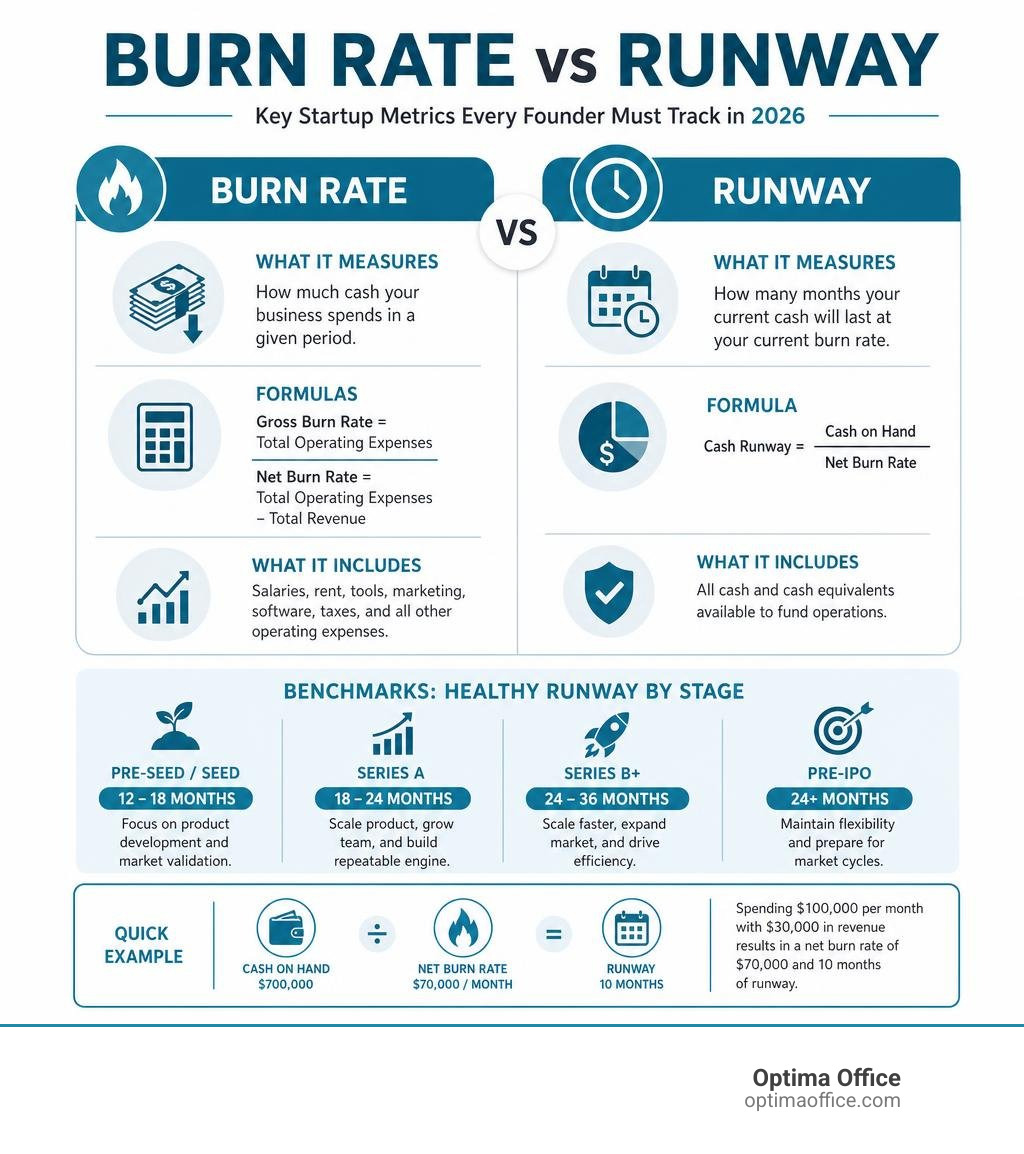
They represent companies that had real products, real teams, and real customers. However, they lost track of how fast they were spending and how much time they had left. Before diving into the guide, here’s what these two metrics mean and how they differ:
Burn Rate and Runway: An Overview
| Term | What It Measures | Formula |
|---|---|---|
| Gross Burn Rate | Total monthly cash spent, regardless of revenue | All monthly operating expenses |
| Net Burn Rate | Monthly cash lost after accounting for revenue | Monthly expenses minus monthly revenue |
| Cash Runway | How many months until cash runs out | Cash on hand ÷ monthly net burn rate |
Example: A company spending $100,000 per month with $30,000 in monthly revenue has a net burn rate of $70,000. With $700,000 in the bank, that gives them exactly 10 months of runway.
Burn rate tells you how fast the clock is ticking. Cash runway tells you how much time is left on it. Together, they shape nearly every major decision a growth-stage business makes: from when to hire, to when to raise capital, to whether the company can realistically reach profitability before the money runs out.
What makes these metrics especially tricky is that founders and business owners frequently overestimate their runway. Optimistic revenue projections, unplanned expenses, and a failure to update calculations as conditions change can make a business feel financially safer than it actually is. In 2026, with fundraising timelines stretching longer than ever and investors placing greater scrutiny on capital efficiency, getting these numbers right is not optional; it is foundational.
This guide walks you through exactly how to calculate both metrics, what healthy benchmarks look like by stage, and what strategies actually work to extend your runway without sacrificing the growth you need.
Understanding Burn Rate and Cash Runway
To avoid cash flow problems and manage all effectively, you must first establish a clear distinction between our primary cash metrics. Many founders use these terms interchangeably in casual conversation, but doing so in a board meeting or during a fundraise can severely damage your credibility.
Your cash reserves represent the literal fuel in your tank. However, looking at your bank account balance in isolation is like looking at a fuel gauge without knowing your fuel efficiency or how fast you are driving.
Here is a breakdown of how gross and net burn rate differ, and how they interact with your overall cash reserves:
| Metric | Focus | Key Question Answered | Impact of Revenue |
|---|---|---|---|
| Gross Burn Rate | Operational cost structure | “How much does it cost to keep our doors open every month?” | Completely ignores revenue |
| Net Burn Rate | Capital consumption | “How much cash are we actually losing each month?” | Directly offset by cash collections |
What Is Gross Burn Rate vs. Net Burn Rate?
Gross burn rate measures the total cash outflows from your business over a given month. It includes every single dollar that leaves your bank account: payroll, rent, software subscriptions, marketing spend, inventory purchases, and even debt service. If your business generated zero dollars in revenue this month, your gross burn rate would represent your total cash loss.
Net burn rate, on the other hand, accounts for the cash inflows coming into your business. To find your net burn rate, you subtract your monthly cash receipts from your gross burn rate. This is the figure that tells you how much cash your business actually consumes each month. If your gross burn is $150,000 and you collect $50,000 from customers, your net burn is $100,000.
Why Both Metrics Matter for Startup Success
While net burn rate is the number we use to calculate runway, gross burn rate is equally important for assessing your company’s underlying risk. A high gross burn rate means you have a heavy operational cost structure. If your revenue suddenly drops, due to a lost enterprise client or a sudden market shift, your net burn rate will instantly spike toward your gross burn rate, rapidly shortening your runway.
Understanding both metrics allows us to evaluate the true financial health of our operations. It helps us avoid the common trap of relying on volatile, short-term revenue spikes to justify unsustainable overhead costs.

How to Calculate Burn Rate and Runway in 5 Steps
Calculating your financial metrics should not require a massive, confusing spreadsheet that only updates once a quarter. We advocate for a simple, repeatable five-step process that gives you real-time visibility into your cash position.
Step 1: Determine Your True Cash Balance
Your runway calculation is only as accurate as the cash balance you plug into the formula. To find your true cash balance, look at your actual liquid cash on hand across all operating bank accounts and cash equivalents. These can be found in high-yield savings or short-term treasury accounts.
Do not include outstanding accounts receivable (AR), uncommitted investment pipeline, or undrawn lines of credit. While those funds may arrive eventually, they are not liquid cash today. If a crisis hits tomorrow, you cannot pay payroll with a promise of future payment.
Step 2: Calculate Your Monthly Gross Burn
Gather your cash flow statements or bank statements from the last three to six months. Add up all cash outflows for each month to find your monthly gross burn.
Be sure to look at actual cash spent, not recognized expenses on an accrual basis. Your payroll, software renewals, and marketing campaigns must be tracked based on when the cash actually left your account.
Step 3: Calculate Your Monthly Net Burn
Subtract your monthly cash inflows (actual cash received from customers, not recognized revenue or booked contracts) from your monthly gross burn.
We highly recommend using a three-month trailing average for this calculation. Irregular cash collections or annual software renewals can cause single-month spikes that distort your true monthly net burn. Averaging the last three months smooths out these variations.
Step 4: Apply the Cash Runway Formula
Now, divide your true cash balance by your monthly net burn rate.
Cash Runway (Months) = True Cash Balance ÷ Monthly Net Burn Rate
For example, if you have $1,200,000 in cash and your trailing three-month net burn average is $80,000 per month, your runway is 15 months. If your business is already profitable and your cash inflows consistently exceed your outflows, your net burn is negative, meaning your runway is theoretically infinite.
Step 5: Build a Rolling Cash Flow Forecast
A static runway calculation assumes your spending and revenue will remain perfectly flat, which is rarely the case for a growing company. To turn this calculation into a strategic tool, build a rolling cash flow forecast that looks 12 to 24 months into the future.
This model should account for planned hires, seasonal revenue changes, and upcoming capital expenditures. By performing sensitivity analyses, such as modeling a “downside” scenario where sales are 30% lower than expected, you can identify exactly when your cash cushion might become dangerously thin.

Healthy Benchmarks for Startups
What constitutes a “good” burn rate or runway changes constantly based on macroeconomic conditions. As the 2026 fundraising landscape remains highly focused on capital efficiency and sustainable unit economics rather than growth at all costs.
Evaluating Your Burn Rate and Runway by Stage
The expectations for your cash cushion scale alongside your funding stage. Here are the typical ranges we see across the market today:
- Pre-Seed / Bootstrapped: Typically operating on a lean net burn of $30,000 to $80,000 per month. At this stage, you should aim for at least 12 to 18 months of runway to give you enough time to find product-market fit.
- Seed Stage: Average monthly net burn ranges from $100,000 to $250,000. Startups at this stage need 18 to 24 months of runway, as the median time to transition from Seed to Series A has stretched to over two years.
- Series A: Typical net burn sits between $400,000 and $1,000,000 per month. Investors expect Series A companies to maintain 20 to 28 months of runway to execute their growth plans.
- Series B and Beyond: Companies at this level often burn $800,000 to over $1.5 million monthly. They generally target 24 to 36 months of runway, focusing heavily on reaching self-sustainability.

How Investors Analyze Your Burn Rate and Cash Runway
During due diligence, investors do not just look at your current cash runway; they evaluate your cash consumption patterns. They want to see that your spending is aligned with key operational milestones.
If you are burning $200,000 a month but your customer acquisition costs are rising and your revenue growth is flat, it signals that your business model is inefficient. Having a clear, defensible forecast that proves you can reach your next major milestone with your existing cash gives you massive leverage in valuation negotiations.
The Burn Multiple: A Key Metric for Capital Efficiency
In 2026, venture capitalists rely heavily on the burn multiple to evaluate how efficiently a startup generates growth. The burn multiple measures how much cash a company burns for every dollar of net new Annual Recurring Revenue (ARR) it generates.
Burn Multiple = Net Burn ÷ Net New ARR
A burn multiple under 1.0x is considered exceptional, indicating that you are generating more than a dollar of ARR for every dollar you spend. A multiple between 1.0x and 1.5x is strong, while anything above 2.0x suggests that your growth is too expensive and your operational efficiency needs immediate attention.
Strategic Ways to Extend Your Financial Runway
If your rolling forecast shows that your runway is dropping below the healthy threshold, you must act proactively. Waiting until you have less than six months of cash left to make adjustments is a recipe for disaster.
Fixed vs. Variable Expense Optimization
The fastest way to curb your net burn is to audit your operational expenses. We recommend categorizing your costs into fixed and variable buckets to see where you can make immediate cuts:
- Audit Your Tech Stack: SaaS sprawl is a silent runway killer. We frequently find that companies are paying for duplicate tools or unused seat licenses. Consolidating your software platforms can quickly save thousands of dollars a month.
- Hiring Adjustments: Because payroll typically accounts for 60% to 70% of a startup’s gross burn, managing headcount is critical. Before executing painful layoffs, consider pausing non-essential hires or transitioning specialized, full-time roles into flexible contractor arrangements.
- Vendor Renegotiations: Reach out to your key vendors to renegotiate payment terms. Shifting from monthly payments to annual upfront contracts can sometimes secure significant discounts, though you must balance this against your immediate cash needs.
Revenue-Side and Financing Strategies
Extending your runway is not just about cutting costs. You can also optimize your revenue collection and leverage alternative financing options:
- Incentivize Annual Prepayments: Offer your existing customers a 10% to 15% discount if they transition from monthly billing to annual upfront payments. This injects immediate, non-dilutive cash directly into your bank account.
- Optimize Pricing Models: Review your pricing structure to ensure you are not undercharging for your value. Even small pricing adjustments or the introduction of usage-based overage fees can quickly improve your cash inflows.
- Explore Venture Debt: If you have a solid path to revenue or recently closed an equity round, venture debt can provide a non-dilutive capital buffer to extend your runway by several months.
Common Mistakes in Tracking Cash Runway Metrics
Even experienced founders can fall into dangerous traps when monitoring their financial health. Recognizing these common pitfalls early can save your business from a sudden cash crisis.
Treating Runway as a Static Number
One of the biggest mistakes we see is treating runway as a static calculation on a spreadsheet. A founder might calculate 18 months of runway in January and assume they are safe until next year.
However, as you hire new employees, ramp up marketing campaigns, or experience seasonal sales dips, your actual burn rate changes constantly. Your cash runway is a dynamic variable that must be recalculated and reviewed at least once a month.
Misinterpreting Gross vs. Net Burn
Another frequent point of confusion is calculating burn rate using recognized revenue from an accrual-based income statement rather than actual cash received. Under GAAP rules, you might recognize a $120,000 contract evenly at $10,000 per month.
But if that client does not actually pay their invoice for 90 days, your bank account does not reflect that cash. Always calculate your burn rate and runway using actual cash inflows and outflows from your bank statements, not your book revenue.
FAQs About Cash Runway & Burn Rate
What Is a Good Burn Multiple?
In the current market, a burn multiple below 1.5x is considered healthy for an early-stage company. If your burn multiple is under 1.0x, your capital efficiency is excellent, which will make your company highly attractive to investors during your next fundraising round.
When Should a Startup Start Fundraising?
You should begin building relationships with potential investors when you have 12 months of runway remaining, and launch your formal fundraising outreach at 9 months. This ensures you have a comfortable cash buffer of at least 3 to 6 months when you close the round, preserving your negotiating leverage.
What Does Default Alive Mean?
Coined by Paul Graham, “default alive” means that your company’s current revenue growth trajectory and spending habits will allow you to reach profitability before you run out of cash. If you are “default dead,” you will run out of money unless you make immediate operational cuts or raise additional capital.
Secure Your Financial Future with Strategic Leadership
Managing your cash flow, optimizing your cost structure, and navigating the complexities of fundraising requires deep financial expertise. But, most growing companies do not have the budget to hire a full-time, executive-level Chief Financial Officer.
That is where we come in. Optima Office provides outsourced accounting, fractional CFO, controller, bookkeeping, and HR advisory services tailored specifically to the needs of growing businesses. Our unique value proposition is our rapid team deployment; we can place the right professionals in your business within 3 to 5 days.
Using our proprietary five-point system, we ensure that you get the perfect operational and cultural fit for your team. We provide you with the exact blend of senior financial leadership and back-office support you need. This allows you to maximize profits, minimize risk, and drive sustainable growth without the overhead of full-time executive salaries.
If you are ready to gain complete clarity over your financial future, contact us today to learn how our fractional leadership can support your business.