

California employee break laws are among the most detailed and strictly enforced in the entire country, making meal and break compliance a top priority for businesses. If you fail to adhere to these strict regulations, it can result in costly lawsuits, steep penalties, and damage to your reputation.
Understanding these specific employee break law requirements for meal and rest periods is essential to protecting your business and supporting your workforce.
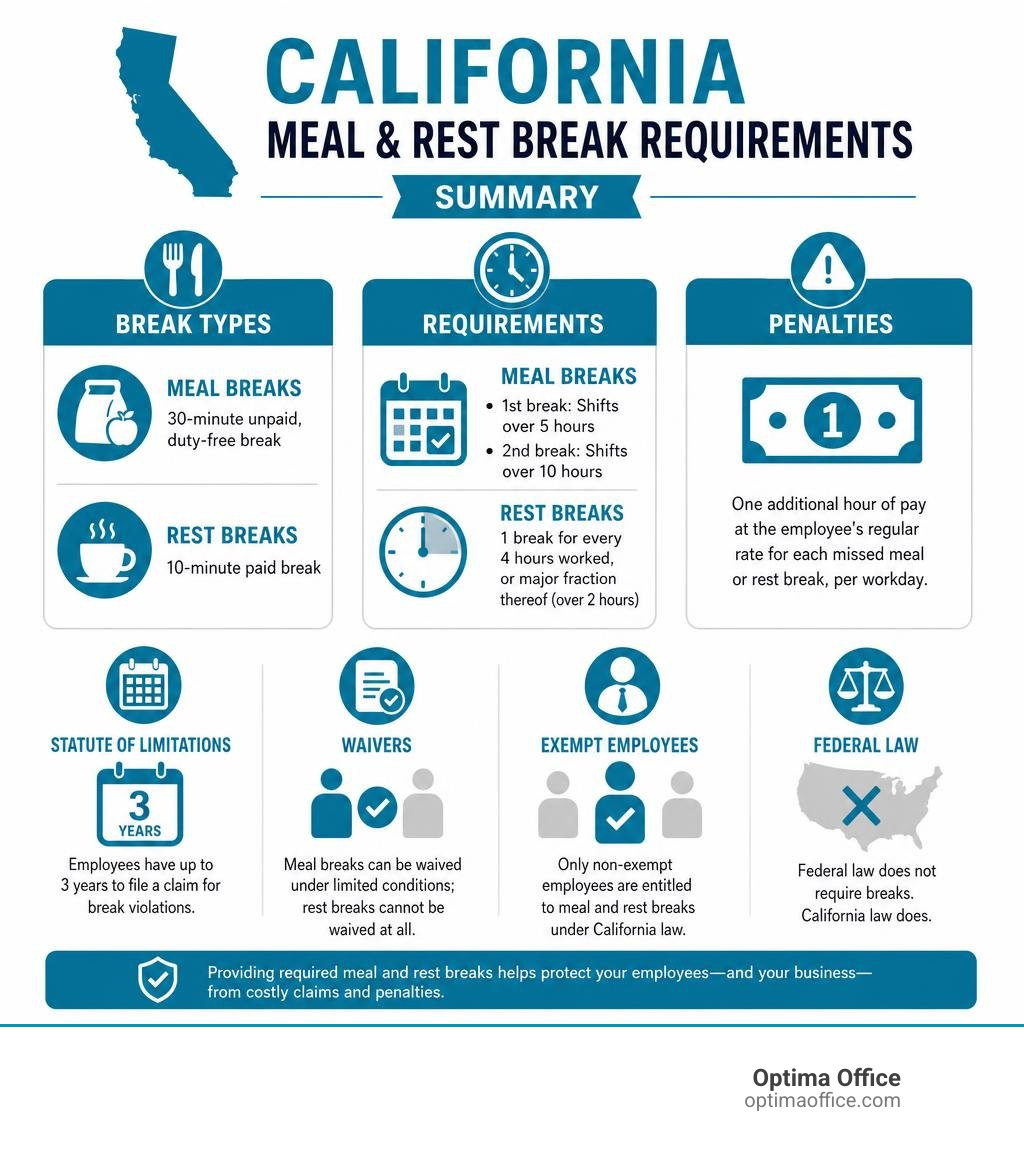
A summary of California’s employee break laws:
- Meal breaks: A 30-minute unpaid, duty-free meal break for shifts over 5 hours; a second 30-minute meal break for shifts over 10 hours
- Rest breaks: A paid 10-minute rest break for every 4 hours worked, or major fraction thereof (anything over 2 hours)
- Penalty for violations: One additional hour of pay at the employee’s regular rate for each missed meal or rest break, per workday
- Statute of limitations: Employees have up to 3 years to file a claim for break violations
- Waivers: Meal breaks can be waived under limited conditions; rest breaks cannot be waived at all
- Exempt employees: Only non-exempt employees are entitled to meal and rest breaks under California law
California’s break laws go well beyond what federal law requires. In fact, federal law does not mandate any breaks at all. That gap creates a significant compliance burden for employers operating in the state. This is particularly evident for many SMBs that don’t have dedicated HR leadership staying on top of these shifting requirements.
Meal and rest break compliance in California remains one of the most litigated areas of employment law. These California break laws make it a real financial and legal risk for companies of every size and industry.
For business owners and HR heads managing lean teams, understanding these break rules isn’t just a legal checkbox. However, it’s a core part of protecting your organization from wage claims, PAGA lawsuits, and costly penalties that can accumulate quickly.
Key Provisions of California Employee Break Laws
Under the strict frameworks of the California Labor Code and Industrial Welfare Commission (IWC) Wage Orders, non-exempt employees must be provided with both meal and rest periods. A fundamental aspect of these regulations is that breaks must be entirely “duty-free.” This means you cannot ask employees to remain on call, answer quick phone calls, or monitor their workstations during their designated break times.
To satisfy these legal obligations, an employer must completely relieve the employee of all duties and relinquish control over their activities. According to landmark rulings by the California Supreme Court, you must provide a reasonable opportunity for uninterrupted breaks. And, they must not impede, discourage, or pressure employees to skip them.
However, as long as you make the breaks available and do not interfere, you’re not legally required to police employees to ensure they do not perform any voluntary work.
Off-Duty vs. On-Duty Meal Periods
While the law strongly favors off-duty, unpaid meal breaks, California permits “on-duty” meal periods under incredibly narrow circumstances. On-duty meal breaks are treated as hours worked, meaning it must be paid at the employee’s regular rate of pay. However, these breaks are only legally defensible if the nature of the work actually prevents the employee from being relieved of all duty. For example, a lone security guard working a remote night shift or a sole operator at an isolated kiosk.
To implement an on-duty meal period, you must establish a written agreement between the company and the employee. This agreement must clearly state that the employee can revoke their consent to the on-duty arrangement in writing at any time. Because the state heavily scrutinizes these agreements, we highly recommend consulting with experienced HR professionals before implementing them to avoid severe wage-and-hour penalties.
California Meal Break Requirements and Waiver Conditions

Meal Period Timing Under California Employee Break Laws
Timing is everything when it comes to meal and rest break compliance with California law break laws. For any shift lasting longer than 5 hours, a non-exempt employee is entitled to an uninterrupted 30-minute unpaid meal break. This first meal period must begin no later than the end of the employee’s fifth hour of work.
Plus, if an employee’s workday extends beyond 10 hours, they are legally entitled to a second uninterrupted 30-minute meal break. This second meal period must start no later than the end of the tenth hour of work. Failing to hit these exact windows, even by a few minutes, constitutes a technical violation and triggers premium pay obligations.
When Can Employees Waive Meal Breaks?
In certain situations, employees may prefer to skip their meal breaks to finish their shifts earlier. But, you must strictly adhere to legal limits when allowing this. For shifts that don’t exceed 6 hours, the first meal break can be waived by mutual consent by the employer and the employee. If the shift is longer than 6 hours, the first meal break cannot be waived under any circumstances. This is even if the employee prefers to work through it.
The second meal break can only be waived if the total daily shift does not exceed 12 hours. Yet if the first meal break of the day was fully taken, there’s mutual written consent. We always advise documenting these waivers with clear, signed agreements rather than relying on verbal handshakes. It’s also critical to note that rest breaks can never be waived. Plus, employers must never permit employees to combine meal and rest periods to leave work early.
Rest Break Rules and California Bathroom Break Laws

Restroom Breaks at Work in California
Beyond standard rest periods, you must also understand how California bathroom break laws protect our team members. For current bathroom break laws in California, restroom visits are treated as a basic necessity and are separate from scheduled rest breaks. This means employers cannot force employees to use their designated 10-minute rest breaks for restroom visits. Nor, can they restrict restroom access to specific times of the day.
According to California restroom break laws, employers must provide clean, secure, and easily accessible facilities separate from toilet-only stalls. Implementing rigid policies that limit the frequency or duration of restroom visits is a quick way to violate California labor laws.
Furthermore, California bathroom laws for employees mandate that any time spent using the restroom must be fully paid. In addition, restroom breaks at work in California must be reasonably accommodated without fear of retaliation or disciplinary action.
OSHA Regulations for Bathroom Breaks and ADA Accommodations
Federal and state safety regulators also play a significant role in defining how you handle workplace facilities. Under OSHA bathroom break requirements, employers must allow employees to leave their work areas to use the restroom when needed to prevent health issues. These labor laws regarding bathroom breaks are strictly enforced. Failing to follow OSHA regulations for bathroom breaks or OSHA rules on bathroom breaks can result in heavy civil citations.
Additionally, you must consider ADA bathroom breaks when managing employees with chronic illnesses or temporary medical conditions. Under the Americans with Disabilities Act, certain medical conditions require employers to provide more frequent or longer restroom breaks as a reasonable accommodation.
In California, outdoor workers also require specialized attention. Employers must allow them to take cool-down breaks in the shade for at least 5 minutes to prevent heat illness. Particularly when temperatures rise considerably during our warm summer months.
Exemptions, Industry Carve-Outs, and the 4-Hour Rule for Exempt Employees
The 4-Hour Rule for Exempt Employees and Minimum Shifts
A common source of confusion for California business owners is how the 4-hour rule for exempt employees interacts with state wage laws. For instance, exempt salaried employees are paid to get the job done. They’re not paid for the specific hours that they sit at a desk.
Therefore, if an exempt employee works a partial day (even if it is less than 4 hours), you can’t dock their salary for that day without risking their exempt status.
For our non-exempt workforce, California’s reporting time pay rules apply instead. If a non-exempt employee is scheduled for a shift and reports to work but is sent home early, California rules require us to pay them for at least half of their scheduled shift (usually between 2 and 4 hours).
Staying compliant with these reporting and salary-basis rules is essential to avoiding costly misclassification claims.
Industry-Specific Break Exceptions
While standard break rules apply to most Southern California businesses, several industries have unique exceptions codified under the law. For instance, direct-care employees working in healthcare, including hospitals and clinics, may have different meal-period waiver rules under California Labor Code Section 512.1. Similarly, commercial drivers, construction companies, and public utility employees are often subject to different rules if they’re covered by a valid collective bargaining agreement.
For these unionized workforces, collective bargaining agreements can override statutory meal and rest break rules, provided the contracts meet strict state guidelines. These agreements must outline specific provisions for wages, hours, working conditions, and an alternative dispute resolution process for missed breaks. If your business operates in one of these sectors, navigating these carve-outs requires a highly customized HR strategy.
Penalties, Remedies, and Financial Reporting
Financial Compliance and GAAP Financial Reporting
When a Southern California employer fails to provide a required meal or rest break, the financial consequences are immediate. Under California Labor Code Section 226.7, you must pay the affected employee one additional hour of pay at their regular rate of compensation for each workday the break is missed. It’s important to remember that the “regular rate of pay” doesn’t include just base hourly wages. However, it also covers commissions, nondiscretionary bonuses, and piece-rate earnings.
When it comes to GAAP financial reporting standards, these unpaid premium hours represent a real liability that must be accurately tracked and accrued. As part of the 2026 Accounting Regulatory Changes, financial auditors are placing a much higher emphasis on potential wage-and-hour liabilities. If you fail to account for these missed-break penalties on your balance sheet, it can lead to break compliance failures, material misstatements, and unexpected financial strain during an audit.
Subsequent Events and Audit Procedures
From an accounting perspective, you need to understand how wage-and-hour disputes impact our financial statements after the close of a reporting period. If an employee files a class-action lawsuit or a Labor Commissioner claim after the balance-sheet date but before the financial statements are issued, this is treated under the framework of accounting for subsequent events.
Depending on the circumstances, this could be classified as a recognized subsequent event (Type 1) requiring adjustment to the financial statements. Or, it may be an unrecognized subsequent event (Type 2) requiring disclosure.
To protect your business, you’ll need to establish a clear subsequent-events policy. Along with conducting a thorough subsequent-events review during our annual audits. A standard audit for procedures for subsequent events includes reviewing the legal correspondence. It’ll analyze any post-balance-sheet payroll records, and interviewing management to identify potential liabilities. By implementing these proactive procedures, you’ll better ensure our financial reporting remains fully compliant with both GAAP and FASB standards.
More Resources for California HR & Labor Law Compliance
In order to help you maintain complete HR compliance and protect your business from costly litigation, review these guides below:
- California Labor Law Compliance in 2026
- California HR Compliance Checklist
- Workplace Safety Compliance
Need Help Navigating California’s Break Laws?
Maintaining meal and rest break compliance with the complex California break laws requires a proactive, integrated approach to HR and financial management. We understand that SMBs need expert leadership but may lack the resources to hire full-time executives. Our team provides fractional CFO, financial controller, bookkeeping, and HR advisory services tailored to your unique business needs.
Let us help you streamline your payroll practices, implement airtight break law policies, and protect your bottom line. This way you can focus on driving enterprise growth without the headaches.
Ready to secure your business and ensure total California break compliance? Learn more about our professional HR services or contact us today to book a discovery call with our HR experts.