
California labor law compliance is one of the most demanding and consequential responsibilities facing employers in the state today. Business owners and HR leaders must navigate a complex landscape of shifting minimum wages, new notice requirements, worker classification rules, mandatory training, and workplace safety obligations. Staying current is not just a best practice. It is a financial imperative for avoiding enforcement actions, penalties, and operational disruption.
If your business needs stronger HR support, Optima Office’s HR services can help you manage compliance responsibilities with more structure and confidence. This guide provides the essential updates and strategies employers need to maintain compliance throughout 2026.
Key California Labor Law Compliance Requirements for 2026
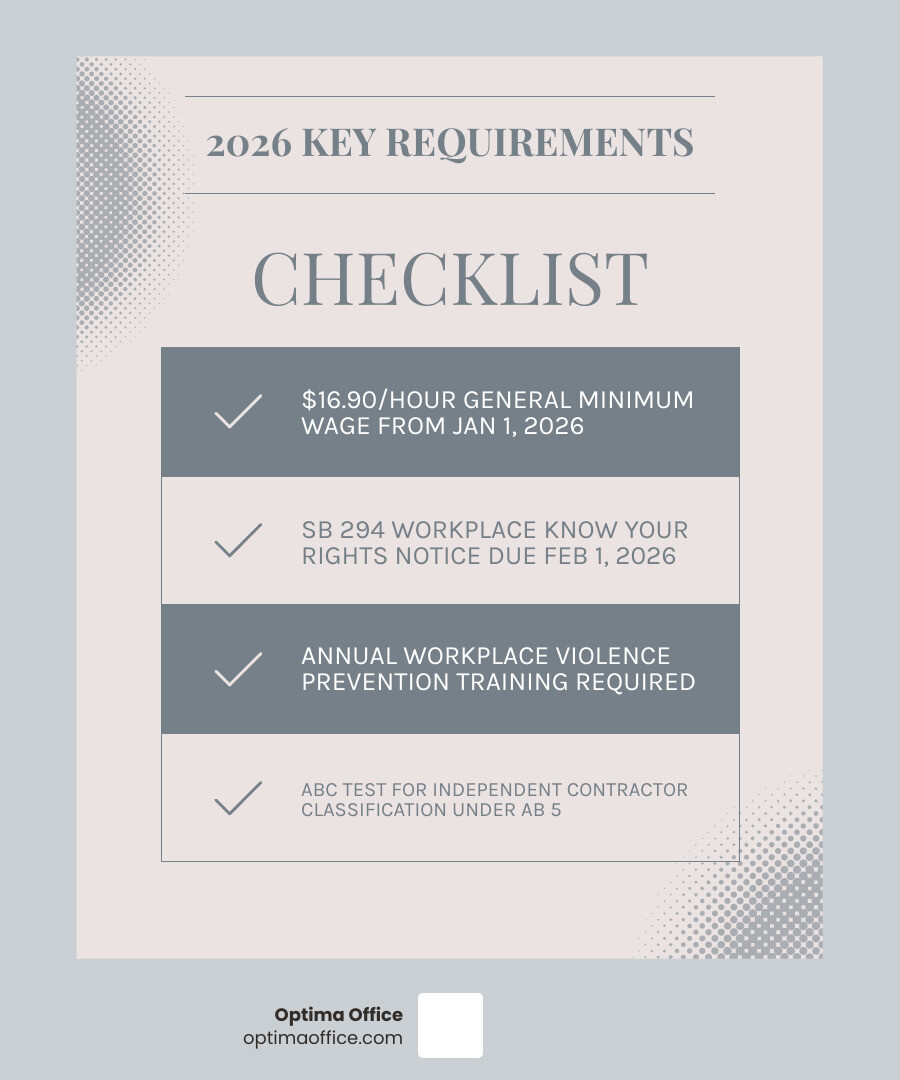
- Minimum wage: $16.90/hour (general); $20.00/hour (fast food); higher rates apply in healthcare and many cities
- Exempt employee salary threshold: $70,304 annually as of January 1, 2026
- SB 294 notice: Standalone written Workplace Know Your Rights notice due to all employees by February 1, 2026
- Emergency contact protocol: Employees must be given the opportunity to designate emergency contacts by March 30, 2026
- Mandatory training: Sexual harassment prevention every two years; workplace violence prevention annually
- Worker classification: Must apply the ABC test under AB 5 to independent contractors
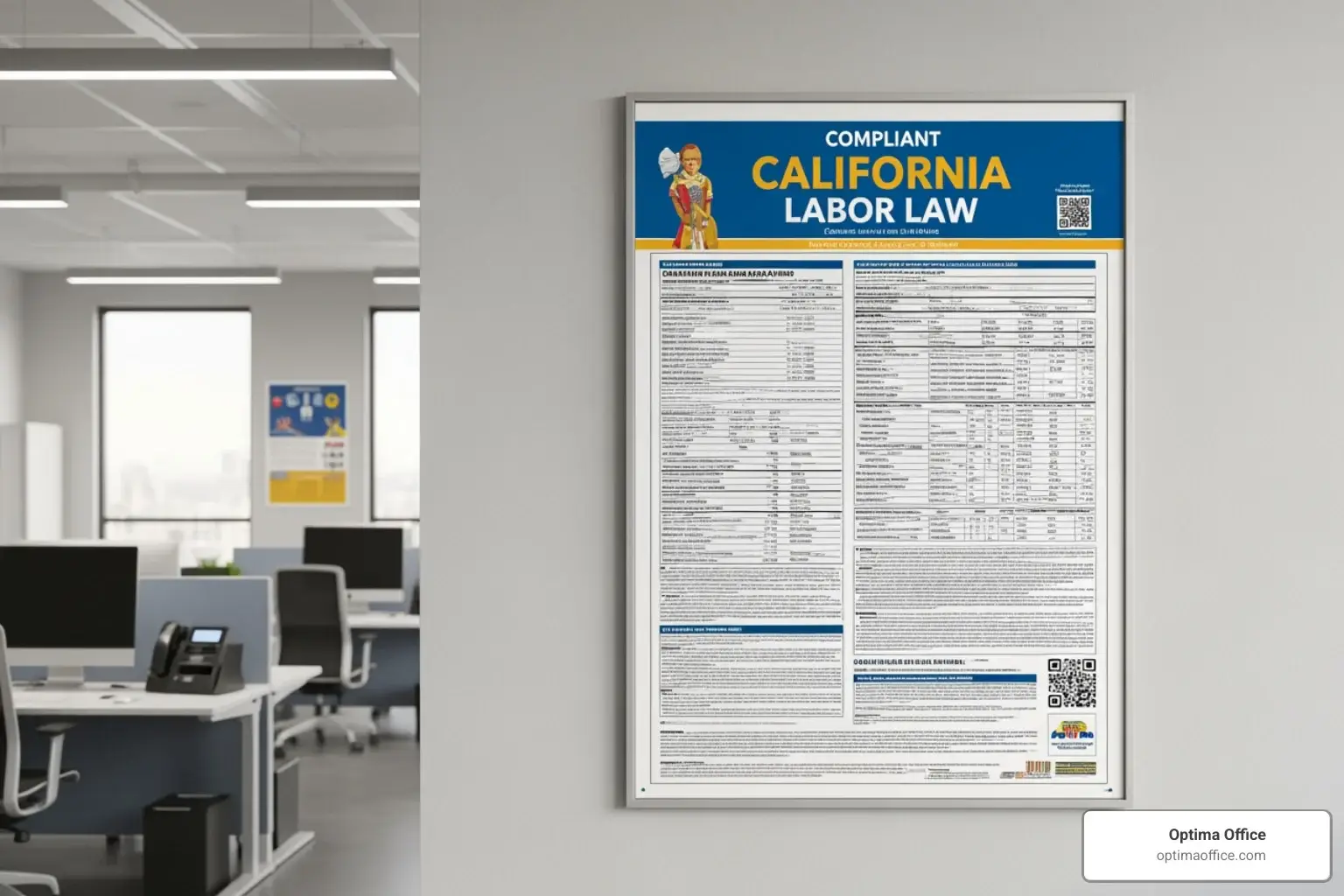
- Required postings: Updated state and federal labor law posters, including local ordinance supplements for cities like Los Angeles, San Diego, and San Francisco
California has long been recognized as having some of the most complex and frequently updated labor laws in the country. In 2026, employers face another wave of requirements that affect nearly every part of how they manage people, payroll, training, and documentation.
For business owners, CEOs, and HR leaders, especially those running growing companies without dedicated legal or HR teams, staying current is essential. The question for most organizations is not whether these laws apply to them. The question is whether they have the systems and expertise to follow them consistently.
Mandatory Postings and the Workplace Know Your Rights Act
As employers navigate the complexities of 2026, the first line of defense in California labor law compliance remains the physical and digital workplace. Every employer in California is required to display a variety of state and federal notices that inform employees of their rights. These are not suggestions. Failure to display updated posters can lead to citations during a labor audit.
In addition to federal requirements like the Fair Labor Standards Act and the Family and Medical Leave Act, California-specific posters must include updates for the Healthy Families Act and the current minimum wage.
To simplify this, many employers use combination posters that satisfy both state and federal requirements in a single display. Modern compliance tools have also introduced QR code technology, allowing HR managers to scan a code on the poster to verify whether the version on the wall is current.
For businesses with remote or hybrid teams in Southern California, digital poster portals are now an important part of the compliance toolkit. These systems help ensure workers who never step into a physical office still have access to mandatory legal notices.
Local ordinances in cities like San Diego, Los Angeles, and San Francisco add another layer of complexity. These jurisdictions often have higher minimum wages or more generous paid sick leave requirements than the state. Employers must display supplemental posters specific to these cities.
New Employee Notice Requirements Under SB 294
The Workplace Know Your Rights Act, also known as SB 294, has introduced a significant administrative requirement for 2026. Employers are required to provide a standalone, annual written notice to all employees outlining their workplace rights.
This notice must be distributed by February 1, 2026, and every year thereafter. It is not enough to include the information in a handbook. It must be a distinct document provided in the language the employer normally uses to communicate with staff.
The SB 294 notice must cover several categories, including information regarding I-9 inspections, protection against unfair immigration-related practices, and rights during law enforcement actions. It also serves as a reminder of workers’ compensation rights and labor organizing protections.
SB 294 also introduces an emergency contact protocol. By March 30, 2026, employers must give employees the opportunity to designate emergency contacts and indicate whether those individuals should be notified if the employee is arrested or detained at the worksite or during work hours.
Maintaining accurate, updated records of these designations is a critical task for HR departments this year.
Wage and Hour Standards: Minimum Wage and the 4-Hour Rule
Effective January 1, 2026, the general minimum wage in California increased to $16.90 per hour for all employers, regardless of size. This statewide floor is only the starting point because specific industries and local jurisdictions may require higher wages.
Fast food workers in covered restaurants continue to have a higher minimum wage requirement. Healthcare workers also have specialized minimum wage paths that employers must monitor closely to avoid wage violations.
These increases have a direct ripple effect on exempt employee salary thresholds. In California, to qualify as an exempt executive, administrative, or professional employee, an individual must earn a monthly salary equivalent to no less than two times the state minimum wage for full-time employment.
With the 2026 increase, the exempt salary threshold has risen to $70,304 annually, or $5,858.67 monthly. If an employee’s salary falls below this threshold, the employee may need to be classified as non-exempt, creating potential liability for overtime, meal breaks, rest breaks, and related wage-and-hour requirements.
To maintain California labor law compliance, employers must also calculate the regular rate of pay correctly. This is not limited to the base hourly rate. It must include other forms of compensation such as nondiscretionary bonuses, commissions, and piece-rate earnings when applicable.
The regular rate is used to calculate overtime and meal or rest break premiums. Miscalculating this figure is one of the common reasons employers face wage-and-hour exposure.
| Wage Category | 2025 Threshold | 2026 Threshold (Effective Jan 1) |
|---|---|---|
| General Minimum Wage | $16.00/hr | $16.90/hr |
| Fast Food Minimum Wage | $20.00/hr | $20.00/hr+ (Industry specific) |
| Exempt Annual Salary | $66,560 | $70,304 |
| Exempt Monthly Salary | $5,546.67 | $5,858.67 |
Applying the 4-Hour Rule for Exempt Employees and Non-Exempt Staff
Understanding reporting time pay requirements is vital for scheduling and payroll accuracy. In California, reporting time pay rules, often referred to as the 4-hour minimum shift rule, require employees to receive certain minimum pay when they are required to report to work but are given less than half of their usual or scheduled day’s work.
For example, if a worker is scheduled for an 8-hour shift but is sent home after only one hour because business is slow, the employer may need to pay for a total of four hours. These rules are designed to compensate workers for the time and expense of reporting to work when the employer does not provide the promised work.
For exempt employees, these rules operate differently. Generally, if an exempt employee works any part of a day, they must be paid their full salary for that day. However, full-day absences for personal reasons may be handled differently depending on the company’s bona fide benefit plans and applicable wage rules.
Navigating reporting time pay and exempt salary rules requires a clear understanding of California wage orders and federal guidelines. Mistakes can create payroll exposure and may also jeopardize an employee’s exempt status.
Compliance with California Bathroom Break Laws and Rest Periods
California bathroom break laws are closely connected to broader rest period requirements. Employees are generally entitled to a net 10-minute paid rest period for every four hours worked, or major fraction thereof. These breaks should be taken in the middle of each work period when practical.
Restroom breaks are part of the broader compliance picture. Employers must provide an adequate number of restrooms and may not impose unreasonable restrictions on their use. Additional accommodations may also be required for employees with specific medical conditions.
Violations of rest period or meal period requirements can result in premium pay. That means one additional hour of pay at the employee’s regular rate for each workday that a required break is missed.
Supervisors should understand these requirements and avoid discouraging employees from taking legally required breaks. Training managers properly is one of the most practical ways to reduce compliance risk.
Strategies for Maintaining California Labor Law Compliance
Maintaining California labor law compliance is not a one-time task. It requires a proactive and integrated strategy.
A strong starting point is a comprehensive internal audit of HR practices. This includes reviewing employee handbooks to ensure they reflect 2026 changes, such as expanded leave requirements and workplace violence prevention protocols. An outdated handbook can become evidence of a broader compliance problem in employment disputes.
Recordkeeping has also become more important. Employers should maintain documentation that includes the employee’s name, training provider, duration, date, and specific competencies covered. Digital documentation systems are highly recommended so these records are easy to access during an audit.
At Optima Office, we often find that a lack of structured documentation is one of the biggest hurdles for businesses trying to respond to Labor Commissioner inquiries.
Integrated financial and HR leadership is valuable for many Southern California businesses. By having financial leadership and HR leadership work together, employers can make sure payroll systems correctly calculate regular rates of pay and that labor cost analysis reflects wage increases. If your compliance needs connect directly to payroll, budgeting, or financial reporting, Optima Office’s outsourced accounting services can help strengthen the finance side of compliance.

Understanding Enforcement Risks and Penalties
The risks of non-compliance in California are significant. Enforcement actions can result in penalties, back wages, attorney fees, class-action exposure, and reputational harm.
Many penalties stem from wage-and-hour violations, sick leave issues, worker recall rules, or claims brought under the Private Attorneys General Act, also known as PAGA. These issues can affect businesses across industries, including restaurants, warehouses, hotels, car washes, and other labor-intensive operations.
To mitigate these risks, employers should conduct regular misclassification audits. With the ABC test firmly in place under AB 5, many workers previously treated as independent contractors may legally qualify as employees.
Misclassifying even one worker can create a chain of unpaid payroll taxes, workers’ compensation premiums, wage claims, and penalties. Proactive self-correction is almost always less expensive than a settlement reached under the pressure of a lawsuit.
Required Training: Harassment Prevention and Workplace Violence
Training is no longer just a best practice. It is a legal mandate for California labor law compliance.
Under AB 1825 and SB 1343, employers with five or more employees must provide sexual harassment prevention training to both supervisory and non-supervisory staff every two years. New hires or employees promoted to supervisory roles must receive the required training within the applicable deadline.
Another major compliance area is workplace violence prevention. SB 553 requires most California employers to establish a comprehensive Workplace Violence Prevention Plan. This includes annual employee training on how to recognize and report workplace violence hazards.
This training should be specific to the actual hazards present in the workplace. Generic training may not be enough if it does not address the company’s real environment and risks.
Workplace safety also involves maintaining an Injury and Illness Prevention Program. Cal/OSHA standards require regular safety audits and risk assessments to identify potential dangers before an accident occurs.
Maintaining these programs is not only about avoiding fines. It is about building a culture of safety that protects employees and reduces operational risk. If your business needs help building or updating the required plan, Optima Office’s Workplace Violence Prevention Plan services can help create a clearer compliance structure.

Employee Classification and Misclassification Risks
The line between an employee and an independent contractor is sharper than ever. California uses the ABC test, codified by AB 5, to determine worker status.
To classify someone as a contractor, the business generally must show that:
- The worker is free from the control and direction of the hiring entity.
- The worker performs work outside the usual course of the hiring entity’s business.
- The worker is customarily engaged in an independently established trade or occupation.
Failing this test can be costly. Beyond the ABC test, 2026 also brings new restrictions on stay-or-pay clauses under AB 692. These clauses, which may have required employees to pay back training costs if they left the company early, are now largely prohibited.
Employers should review employment agreements to ensure they do not contain unenforceable repayment provisions or non-compete-style language.
Professional services exemptions exist for certain roles, including accountants, lawyers, and engineers, but they are narrow and specific. If your business relies heavily on freelancers or 1099 workers in Southern California, now is the time to perform a classification review.
Ensuring contracts and day-to-day operations align with AB 5 is a cornerstone of any California labor law compliance strategy.
Financial Reporting and Labor Audit Readiness
In 2026, the intersection of HR and accounting is where many compliance issues are won or lost. Financial reporting may require more transparency around labor liabilities, especially when wage claims, payroll corrections, or employment-related disputes are involved.
Strong internal controls, such as separating the people who track time from the people who process payroll, can help prevent fraud and support audit readiness.
Labor cost analysis should be a standard part of the monthly financial review. This helps employers understand the impact of minimum wage changes on margins and allows for better budgeting around mandatory benefits like paid sick leave and leave obligations.
For public works employers, prevailing wage monitoring and apprenticeship utilization may also be critical to avoid being barred from future government contracts.
Audit readiness means having documentation organized before the Labor Commissioner or an external auditor requests it. This includes payroll journals, signed meal break waivers where applicable, and proof of workers’ compensation insurance.
When accounting and HR are integrated, these documents are easier to access, reducing the stress and cost of regulatory inquiries.
Accounting for Subsequent Events in Labor Litigation
When a business is facing a labor lawsuit or PAGA claim, having proper procedures for subsequent events may be required under GAAP.
A subsequent event is an occurrence after the balance sheet date but before the financial statements are issued. There are two types: recognized subsequent events, also known as Type 1, and unrecognized subsequent events, also known as Type 2.
For example, if a wage theft lawsuit was filed in December 2025 and settled in February 2026 before the 2025 books were closed, this may be a Type 1 subsequent event. The business may need to adjust its 2025 financial statements because the underlying condition existed at the balance sheet date.
By contrast, a Type 2 subsequent event might involve an event that happens after the balance sheet date and does not change the prior period’s numbers, but may require disclosure.
A clear subsequent events policy helps support accurate reporting and maintain trust with investors, lenders, and other stakeholders.
FAQs about California Labor Law Compliance
What is the California minimum wage for 2026?
Effective January 1, 2026, the general minimum wage is $16.90 per hour for all employers. Specific industries like fast food and healthcare may have higher requirements, and many Southern California cities also have local ordinances that set the rate higher.
When must the new Workplace Know Your Rights notice be distributed?
Employers must provide the standalone written notice to employees by February 1, 2026, and annually thereafter. Plus, employees must also be given the opportunity to designate emergency contacts for arrest or detention scenarios by March 30, 2026.
What are the penalties for misclassifying employees as contractors?
Penalties can include fines from the Labor Commissioner, unpaid back wages, unpaid payroll taxes, and potential class-action litigation under PAGA. Employers may also be liable for unpaid workers’ compensation and unemployment insurance premiums.
Securing Your Business Future in California
Maintaining California labor law compliance in 2026 is a continuous process that requires HR expertise, strong documentation, and sound financial oversight. By staying ahead of minimum wage increases, mandatory training deadlines, classification rules, and new notice requirements like SB 294, business owners can better protect their operations from costly litigation and state citations.
Optima Office provides the fractional HR and financial leadership needed to navigate these complexities. Our team helps businesses create stronger systems around HR, payroll, recruiting, accounting, and workplace safety compliance so leadership can focus on running the business.
Explore Optima Office’s HR services to see how the right support can help your business stay organized, reduce risk, and manage California labor law compliance with more confidence this year. If you have any questions, please contact us today.