
Managing a growing team is one of the most rewarding yet challenging aspects of entrepreneurship. As your company expands, the administrative burden of human resources can quickly become overwhelming, often distracting leadership from core business goals and increasing compliance risks.
Understanding the Models to Outsource HR for Small Business
Outsource HR for small business is the practice of partnering with an external provider to handle some or all of your HR functions — from payroll and compliance to hiring and employee relations — instead of managing them with internal staff.
Here’s what small business owners need to know at a glance:
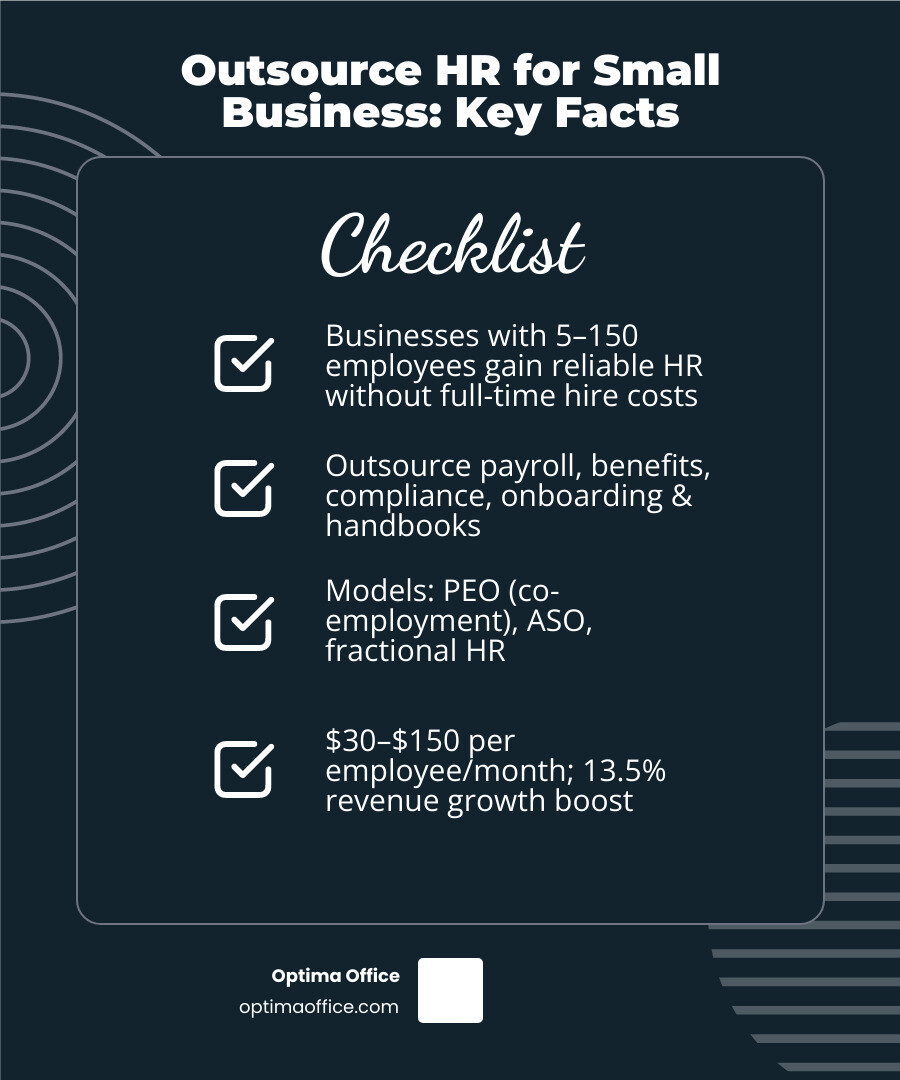
- Who it’s for: Businesses with roughly 5–150 employees that need reliable HR support without the cost of a full-time hire
- What you can outsource: Payroll processing, benefits administration, compliance management, onboarding, employee handbooks, and more
- Main models available: PEO (co-employment), ASO (administrative services only), and fractional HR
- Typical cost: $30–$150 per employee per month, depending on services and business size
- Key benefits: Reduced compliance risk, time savings, access to Fortune 500-level benefits, and measurable growth — PEO clients report 13.5% annual revenue growth vs. 8.5% for businesses managing HR in-house
- When to consider it: Around the 10–15 employee mark, or whenever HR tasks are pulling leadership away from core business operations
If you’re a small business owner in San Diego or elsewhere in Southern California, you’ve probably felt the tension firsthand. You’re running a professional services firm, a medical practice, a nonprofit, or a growing manufacturing operation — and somewhere between managing clients, chasing invoices, and developing your team, HR has become a second job. Or worse, it’s fallen through the cracks entirely.
The compliance landscape doesn’t make it easier. Federal labor law, California wage-and-hour rules, PAGA exposure, workers’ comp claims, family leave requests — the list of things that can go wrong is long, and the cost of getting it wrong is real. One mismanaged termination, one unsigned policy, one missed filing can quickly escalate into a legal situation that consumes your time and your margins.
That’s precisely why so many small businesses are rethinking how HR gets done. According to industry research, one-third of companies spend at least 11 hours per week on HR administration alone — time that compounds into over 570 hours annually and can cost companies with 50–100 employees close to $350,000 per year. For businesses at that size and stage, outsourcing HR isn’t a luxury. It’s often the more strategic and affordable path forward.
This guide walks you through everything you need to make a smart decision: the different outsourcing models, what to keep in-house, how much it costs, and how to choose a provider that actually fits your business.
Outsource hr for small business terms to learn:
When you decide to outsource hr for small business, you aren’t just buying a service; you’re choosing a partnership structure. The “right” model depends on how much control you want to retain and whether you need someone to simply give advice or actually execute the work.
At Optima Office, we often see businesses confused by the alphabet soup of HR acronyms. Broadly, the market is divided into three main paths: Professional Employer Organizations (PEO), Administrative Services Organizations (ASO), and fractional outsourced hr consulting. While a consultant might just tell you what to do, an outsourced HR partner actually rolls up their sleeves to do the work.
| Feature | PEO (Co-employment) | ASO (Administrative Services) | Fractional HR Advisory |
|---|---|---|---|
| Employment Status | Co-employment (shared tax ID) | Direct employer (your tax ID) | Direct employer (your tax ID) |
| Benefits Access | Large group “Fortune 500” rates | Individual market rates | Individual market rates |
| Compliance Risk | Shared liability | You retain liability | You retain liability |
| Customization | Standardized packages | Highly flexible | Fully bespoke |
| Strategic Focus | Transactional/Administrative | Administrative | Strategic & Operational |
Professional Employer Organizations (PEO)
A PEO operates under a co-employment model. This means your employees are technically employed by both your company and the PEO for tax and insurance purposes. This model is popular for very small teams because it allows them to tap into San Diego County HR Outsourcing Services that offer high-end health insurance and 401(k) plans usually reserved for massive corporations. By pooling thousands of employees from different small businesses, PEOs secure lower insurance rates and handle all tax filings under their own FEIN.
Administrative Services Organizations (ASO)
If the idea of “sharing” your employees makes you nervous, an ASO might be a better fit. Under an ASO model, you remain the sole employer of record. The provider handles payroll processing, compliance support, and tax reporting, but they do so under your company’s tax ID. This offers a middle ground for businesses that want professional administrative help without the legal complexities of co-employment.
Strategic Benefits and Timing for External HR Support
Outsourcing isn’t just about offloading paperwork; it’s a proven driver of business health. Companies that outsource their HR functions tend to grow faster and keep their people longer. In fact, businesses working with HR partners report an annual revenue growth of 13.5%, compared to just 8.5% for those who don’t.
Beyond the bottom line, the mental relief of knowing your hr compliance success is being monitored by experts allows you to focus on what you actually enjoy: growing your business.
When is the Right Time to Outsource HR for Small Business?
Most experts agree that the “danger zone” begins around the 10th to 15th employee. At this stage, the informal “family” vibe of a startup begins to clash with the rigid requirements of labor laws. You might notice that you’re spending more time on “people problems” than on product development.
Key indicators that it’s time to look for help include:
- You are struggling to keep up with changing California labor laws.
- Your onboarding process feels chaotic or non-existent (only 12% of employees think their company does this well!).
- You’ve experienced a “near miss” with a legal claim or a payroll error.
- You need to hire quickly but don’t have a structured talent acquisition strategy.
Primary Advantages of Outsourcing
The advantages go far beyond simple cost savings. While a full-time HR manager can cost upwards of $7,000 per month, outsourcing provides a team of experts for a fraction of that price.
- Expert Guidance: You get access to senior-level HR directors who have seen it all, from high-risk terminations to complex workplace safety compliance.
- Turnover Reduction: PEO and fractional HR clients see a 19.6% lower turnover rate. When employees feel supported and their benefits are handled professionally, they stay.
- Risk Mitigation: Especially in California, the risk of a lawsuit is high. Providers like Optima Office act as a shield, ensuring your hr compliance is airtight.

Core Functions: What to Outsource vs. Retain In-House
One of the biggest mistakes small business owners make is thinking they have to outsource everything or nothing. In reality, the most successful partnerships are modular. You can pick and choose the hr services that cause you the most stress while keeping the “soul” of your company in-house. Organizations like the San Diego Employers Association often recommend this hybrid approach to maintain culture while ensuring legal safety.
Functions Typically Outsourced
Administrative and high-risk tasks are the prime candidates for outsourcing. These are the “must-haves” that don’t necessarily require your personal touch but require 100% accuracy.
- Payroll & Tax Filing: Automating this removes the risk of government penalties.
- Compliance Management: Keeping your employee handbook updated with state-specific laws.
- Benefits Administration: Managing health insurance, 401(k) enrollments, and COBRA.
- Recruitment Support: Using professional recruiting services to find the right cultural fit without spending 40 hours a week on LinkedIn.
- Claims Management: Handling workers’ compensation and unemployment claims.
Functions to Keep In-House
While an external partner can provide the tools, you should remain the primary driver of:
- Company Culture: Your values and the “vibe” of your office are yours to define.
- Strategic Planning: Deciding where the company is going in the next 5 years.
- Performance Feedback: While an HR partner can provide performance management support, the actual coaching should come from direct managers.
Navigating Costs and Provider Selection
Understanding the cost of outsourcing hr is crucial for budgeting. Most small businesses find that outsourcing is significantly more affordable than a full-time hire, but pricing models vary wildly. You might pay a flat monthly retainer, a percentage of total payroll, or a per-employee-per-month (PEPM) fee.
Evaluating the Cost of Outsourcing HR for Small Business
In 2026, the typical range to outsource hr for small business is between $30 and $150 per employee per month. If you have 20 employees, you might be looking at $1,000 to $3,000 a month. Compare that to the $80,000+ salary (plus benefits and taxes) of an in-house HR Generalist, and the math becomes clear.
Setup costs are also common, usually ranging from a few hundred to a few thousand dollars to migrate your data and perform an initial hr assessment.
Criteria for Choosing a Provider
Don’t just choose the cheapest option. A bad HR partner can be more expensive than no HR partner if they make compliance mistakes. When reviewing a service agreement, look for:
- Industry Expertise: Do they understand the specific regulations for your field (e.g., healthcare, construction, or California-specific HR)?
- Responsiveness: If an employee has a crisis at 9:00 AM, will your provider answer the phone?
- Scalability: Can they grow with you from 10 employees to 100?
- Technology: Do they use modern tools like BambooHR, Gusto, or proprietary platforms that make life easier for your staff?
Frequently Asked Questions
What is the difference between a PEO and an HR consultant?
A PEO is a co-employer that shares legal liability and handles the “back-office” transactions. An HR consultant typically provides advice but doesn’t always execute the work. Outsourced hr providers like Optima Office offer a “fractional” model, which means we act as your internal team—executing the strategy and the paperwork—without the co-employment requirement.
How long does the transition to an outsourced provider take?
Most transitions take between 30 and 60 days. This period includes auditing your current files, migrating payroll data, setting up new benefits portals, and introducing the new HR team to your employees. A successful transition is key to unlocking your business potential.
Can outsourcing HR help with California-specific compliance?
Absolutely. California is notoriously difficult for employers. Between the California hr compliance checklist and mandatory harassment training, there is a lot to track. Local providers who specialize in navigating California employment are invaluable for avoiding the fines and lawsuits that commonly plague Golden State businesses.
Maximizing Growth with Integrated HR and Financial Leadership
At Optima Office, we believe that HR and Finance are two sides of the same coin. You can’t make smart hiring decisions without a clear budget, and you can’t maintain a healthy budget without managing your largest expense: people.
Our mission is to provide exceptional accounting and HR services while building positive relationships within our team and local communities. Based in San Diego, we offer a unique “concierge” approach through our fractional CFO, controller, and HR advisory services. What sets us apart is our rapid team deployment—we can have a team on-site or remote in just 3 to 5 days.
Using our proprietary five-point system, we ensure that every professional we send your way is not just a technical expert, but a cultural fit for your specific environment. Whether you are dealing with top hr challenges or simply need a better way to handle the day-to-day grind, we provide the expertise of a complete department for a fraction of the cost.
Ready to take HR off your plate and get back to growing your business? Explore our services and see how an integrated approach to HR and Finance can drive your enterprise growth.