
Training and development strategies help businesses build stronger employees, close skill gaps, improve retention, and prepare teams for future growth. For small and mid-sized companies, especially those without a dedicated internal HR department, training can easily become reactive instead of strategic.
That’s where structure matters. With the right plan, training becomes more than a one-time workshop. It becomes a system for building performance, confidence, and leadership capacity across the business.
If your company needs help building a stronger people strategy, Optima Office’s HR services can help you create the structure, compliance support, and workforce planning needed to make training more effective.
The Core Pillars of Employee Training and Development
If you’re looking for the essentials fast, here’s what you need to know:
- What it is: Structured programs and activities that build employee knowledge, skills, and capabilities.
- Training vs. development: Training focuses on current job performance, while development prepares employees for future responsibilities.
- Why it matters: Strong training can improve retention, productivity, engagement, compliance, and leadership readiness.
- Common methods: Instructor-led training, e-learning, microlearning, on-the-job coaching, mentoring, and blended learning.
- How to start: Conduct a needs assessment, design targeted content, choose the right delivery format, and measure outcomes.
For small and mid-sized businesses, this is where things get complicated fast. Leaders know their people need to grow, but between managing compliance, handling turnover, and keeping operations moving, building a real training strategy often falls to the bottom of the list.
That is a costly gap. Training and development should not be treated as a nice-to-have benefit. Done well, it helps employees perform better today while preparing the business for tomorrow.
This guide breaks down what actually works, including the types of programs available, the methods that drive real skill-building, and the steps to build a training strategy your team will actually use.
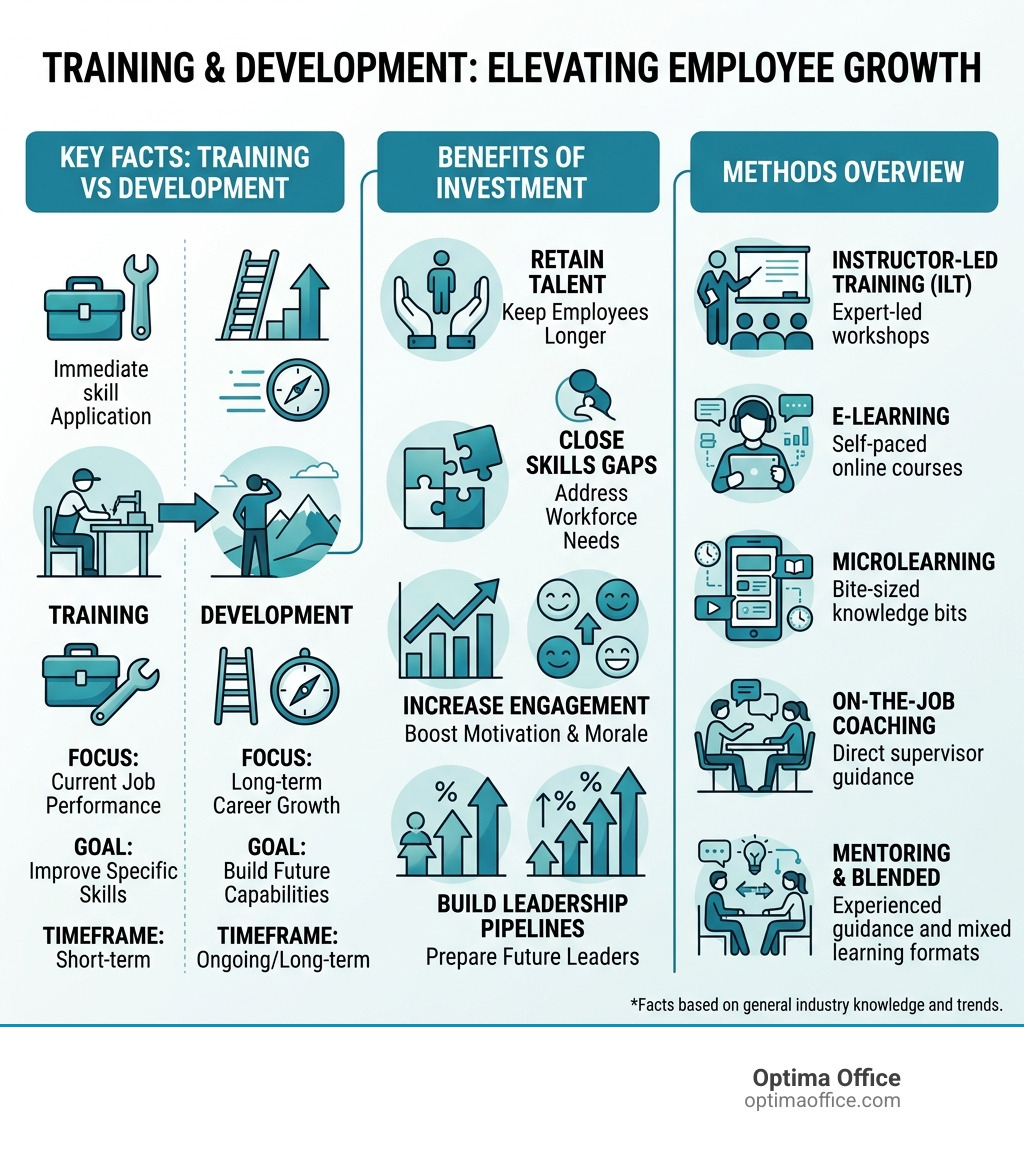
At its core, training and development is about improving both individual and organizational performance. Training helps employees build the skills they need to do their current jobs well. Development prepares them for future responsibilities, leadership roles, and long-term career growth.
Strong training programs usually include three core pillars:
- Knowledge acquisition: Helping employees understand the “what” and “why” behind their work, including policies, systems, industry knowledge, and company expectations.
- Skill enhancement: Giving employees the practical tools and repetition needed to apply what they learn.
- Performance improvement: Turning knowledge into better execution, stronger results, and fewer mistakes.
A strong training strategy should connect directly to business goals. If the goal is better customer service, training should improve communication, response time, and issue resolution. If the goal is stronger compliance, training should help employees understand exactly what is required and how to follow the process.
Distinguishing Between Training and Development
Training and development are related, but they are not the same thing.
Training is usually short-term and role-specific. It helps employees improve performance in their current position. For example, teaching an accounting team how to use a new software system or training managers on proper documentation practices would fall under training.
Development is longer-term and growth-focused. It prepares employees for future responsibilities through coaching, mentoring, leadership development, career planning, and broader skill-building.
The best workforce strategies include both. Training solves immediate performance gaps. Development builds the next layer of leaders.
| Feature | Training | Development |
|---|---|---|
| Focus | Current Job | Future Career |
| Scope | Individual Task | Entire Professional Path |
| Timeframe | Immediate/Short-term | Ongoing/Long-term |
| Goal | Fix a skill gap | Prepare for leadership/growth |
| Outcome | Improved performance today | Higher retention and succession |
Measuring the ROI of Training and Development
Training only works if it creates measurable improvement. Counting how many employees attended a session is not enough. Leaders need to know whether the training changed behavior, improved performance, reduced risk, or strengthened the business.
Useful training metrics may include:
- Employee engagement scores
- Retention rates
- Productivity improvements
- Error reduction
- Compliance completion rates
- Manager feedback
- Customer satisfaction
- Promotion or internal mobility rates
The point is simple: training should produce outcomes. If employees attend a course but nothing changes afterward, the program needs to be adjusted.
Training return on investment should be measured by what employees can do better after the training, not just whether they completed it.
Strategic Benefits for Organizations and Employees
Investing in training and development is not just an employee perk. It is a business strategy.
Employees want to know they have a future inside the organization. When companies invest in skill-building, coaching, and career development, employees are more likely to feel valued and more motivated to stay.
Training also supports stronger operations. Employees who understand their roles, systems, and expectations make fewer mistakes. Managers who receive leadership training communicate more clearly, handle conflict better, and support their teams with more consistency.
Development is also critical for succession planning. If a senior leader leaves and there is no trained internal bench, the business is forced into reactive hiring. That creates risk, delays, and pressure. A strong development strategy helps prepare internal talent before the need becomes urgent.
This connects directly to hiring and workforce planning. When internal development is paired with smart external hiring, businesses can build stronger teams from both directions. If your company needs support finding the right people for key roles, Optima Office’s recruiting services can help strengthen the talent pipeline.
Effective Delivery Methods and Program Types
The way training is delivered matters. A strong topic can still fail if the format does not fit the team, the schedule, or the type of skill being taught.
Some employees learn best through live instruction. Others need short, practical lessons they can reference while working. Most businesses benefit from a blended approach.
Common training delivery methods include:
- Blended learning: Combines online learning with live workshops, coaching, or practice sessions.
- Microlearning: Uses short lessons focused on one specific concept, process, or skill.
- Instructor-led training: Gives employees access to a live expert who can answer questions and provide real-time feedback.
- Virtual instructor-led training: Delivers live training remotely for hybrid or distributed teams.
- On-the-job coaching: Helps employees apply skills in real work situations with immediate feedback.
- Mentoring: Connects less experienced employees with experienced team members for long-term development.
A complete program may include several types of training:
- Technical skills: Software, systems, tools, job-specific processes, and technical responsibilities.
- Soft skills: Communication, emotional intelligence, leadership, teamwork, and conflict resolution.
- Compliance training: Required training related to harassment prevention, workplace safety, cybersecurity, privacy, and other risk areas.
- Leadership development: Coaching, delegation, performance management, and decision-making skills.
- Role-specific onboarding: Training that helps new hires ramp up faster and understand expectations clearly.
Compliance training deserves special attention because it protects both the employee and the business. For California employers, required training is not something to leave informal or undocumented. If your company needs support with workplace safety planning, Optima Office’s Workplace Violence Prevention Plan service can help create a more structured approach.
7 Steps to Implement a Successful Program
Building a training program from scratch can feel overwhelming, but the process becomes more manageable when it is broken into clear steps.
- Conduct a needs assessment: Identify where skill gaps, compliance gaps, performance issues, or leadership challenges actually exist.
- Set clear goals: Define what the training should improve, such as productivity, retention, safety, compliance, or customer service.
- Design the learning experience: Build content that’s practical, relevant, and easy to apply.
- Choose the delivery format: Decide whether the training should be live, virtual, on-demand, hands-on, or blended.
- Get leadership buy-in: Managers need to support the training, reinforce it, and model the behavior expected from employees.
- Pilot the program: Test the training with a smaller group before rolling it out across the full team.
- Measure and refine: Review results, gather feedback, and improve the program over time.
The biggest mistake companies make is treating training as a one-time event. Real behavior change requires reinforcement. Employees need time to practice, ask questions, receive feedback, and connect the training to their actual work.

Navigating Challenges and Future Trends
Training and development are evolving quickly. Skills that were valuable a few years ago may need to be updated as technology, automation, remote work, and customer expectations change.
Artificial intelligence is one of the biggest drivers of this shift. Employees across departments are learning how to use new tools, evaluate AI-generated work, protect sensitive information, and adapt workflows without losing quality or accountability.
Remote and hybrid work have also changed the way companies train employees. Training now needs to be accessible, flexible, and easy to apply across different locations and schedules.
Key trends shaping training and development include:
- Remote-first training: Programs designed for teams that are not always in the same office.
- Personalized learning: Training paths based on role, goals, skills, and performance needs.
- Skills gap analysis: A more intentional way to identify which capabilities the business needs next.
- Agile learning: Shorter training cycles that launch quickly, gather feedback, and improve over time.
- Manager enablement: More focus on helping managers coach, communicate, and lead through change.
- AI readiness: Training employees to use AI tools responsibly and effectively.
The businesses that win will not be the ones that offer the most training. They will be the ones that offer the right training at the right time, tied to the right business outcomes.
Frequently Asked Questions About Training and Development
What Is the Difference Between Training and Development?
Training focuses on the present. It helps employees build the skills and knowledge needed for their current role.
Development focuses on the future. It prepares employees for long-term growth, leadership opportunities, and expanded responsibilities.
Both matter. Training improves performance now. Development builds the future strength of the organization.
How Do You Conduct a Training Needs Assessment?
A training needs assessment identifies where the business has skill, knowledge, performance, or compliance gaps.
A strong assessment usually looks at three levels:
- Organizational needs: What goals is the business trying to reach?
- Role or task needs: What skills are required to perform the work well?
- Individual needs: Which employees or teams need support in those areas?
Surveys, performance reviews, manager interviews, compliance audits, and employee feedback can all help identify where training is needed most.
What Are the Most Effective Training Methods for Remote Teams?
Remote teams usually need a mix of live and self-paced training. Virtual instructor-led training works well for discussion, role-play, and real-time feedback. E-learning and microlearning work well for process training, compliance refreshers, and short skill-building lessons.
Remote training should also include collaboration. Tools like Slack, Microsoft Teams, shared documents, and follow-up coaching can help employees stay connected and apply what they learn.
Driving Enterprise Growth Through Expert HR Advisory
Training and development strategies work best when they are connected to the company’s larger people strategy. Training should not live in a vacuum. It should support hiring, onboarding, compliance, retention, manager development, and long-term growth.
At Optima Office, we help small and mid-sized companies build stronger HR infrastructure without needing a massive internal department. Our team supports businesses across San Diego and Southern California with human resources, recruiting, compliance, and workforce planning support.
Whether your company needs required training support, leadership development, onboarding structure, or a stronger employee growth plan, the right HR partner can help turn training from a scattered task into a repeatable system.
Explore Optima Office’s HR services to see how expert HR advisory can help your business build a stronger, more capable workforce.