
HR department outsourcing gives growing businesses access to professional human resources support without building a full internal HR team. For small and mid-sized companies, this can help reduce administrative strain, improve compliance, strengthen recruiting, and give leadership more time to focus on the business. If your team is stretched thin or your HR responsibilities have become too complex to manage casually, Optima Office’s HR services can help you build a more reliable people function. The goal is not to replace leadership, it’s to give leadership better systems, stronger support, and fewer HR fire drills.
When HR Becomes Too Much to Handle Alone
HR department outsourcing is the practice of delegating some or all human resources functions to an external provider. This can include payroll, compliance, benefits administration, recruiting, employee relations, policy updates, and HR leadership support.
Here’s a quick breakdown of what that looks like in practice:
- What it is: Contracting a third-party HR specialist to handle specific HR tasks or broader HR operations.
- Who it’s for: Small and mid-sized businesses without dedicated HR leadership, or teams stretched beyond capacity.
- How it works: You choose which functions to delegate, and the provider supports those services as an extension of your team.
- What it costs: Pricing is often structured as a flat per-employee-per-month fee or a percentage of payroll.
- The result: Less administrative burden, stronger compliance, and access to HR expertise without the overhead of a full internal department.
For small businesses, especially those without a dedicated HR director, HR strain shows up quickly. It can look like missed compliance deadlines, inconsistent employee policies, unclear onboarding, payroll confusion, delayed hiring, or leadership time lost to issues that should never reach the executive level.
The challenge is not a lack of effort. It is a structural issue. HR is a specialized function that requires current regulatory knowledge, clear documentation, reliable systems, and consistent follow-through.
That is where outsourcing changes the equation. Whether you are navigating an HR leadership gap, preparing your business for a sale, or are tired of handling employment questions without a clear answer, the right outsourcing arrangement can turn HR from a daily fire drill into a stable business function.
This guide walks through how to make that shift, from understanding your options to choosing the right model and putting it into practice.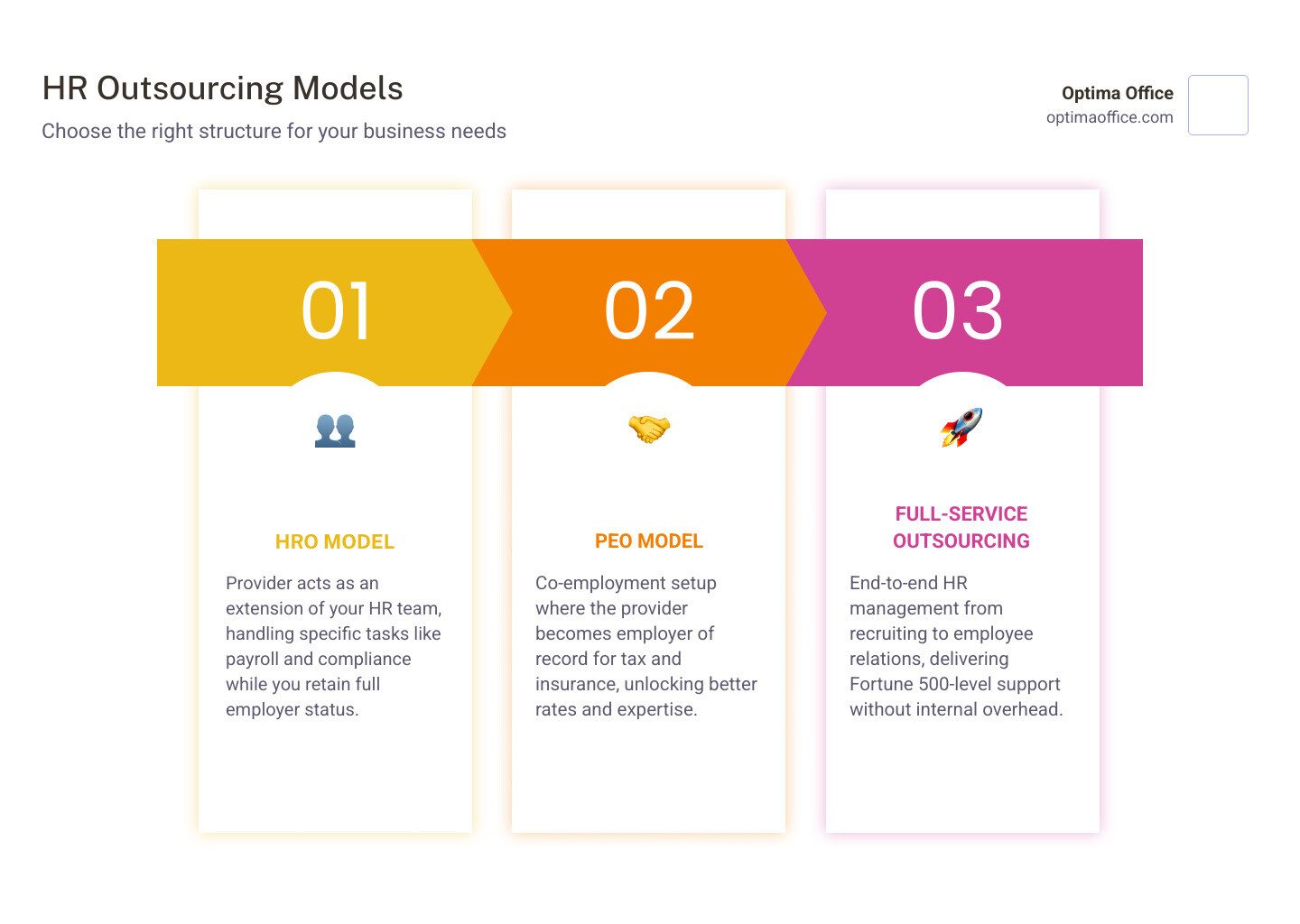
Understanding the Mechanics of HR Department Outsourcing
At its core, HR department outsourcing is a strategic partnership. Instead of hiring a full-time internal team for payroll, benefits, compliance, recruiting, employee relations, and HR leadership, your business gains access to an existing team of specialists.
There are several ways to structure this relationship. Some businesses choose a Professional Employer Organization model, also called a PEO, which can involve co-employment. In this setup, the provider may become the employer of record for certain tax and insurance purposes.
Other businesses prefer a Human Resources Outsourcing model, often called HRO. In this arrangement, the provider manages specific HR responsibilities while the business retains full employer status.
The primary goal is administrative relief and stronger HR execution. By offloading the most time-consuming and high-risk parts of employment management, leadership teams can focus more on culture, strategy, operations, and growth.
Whether you need broad HR support or fractional HR leadership, the flexibility of modern outsourcing helps you pay for the support you actually need.
Evaluating the Cost of HR Department Outsourcing
One of the most common questions business owners ask is whether outsourcing HR is less expensive than hiring internally. In many cases, it can be more cost-effective, especially when you factor in salary, payroll taxes, benefits, software, training, and the cost of recruiting the right HR professional.
HR department outsourcing is often priced in one of two ways: a flat per-employee-per-month fee or a percentage of total payroll. The right model depends on the provider, the scope of services, and the size of your team.
The financial benefit is not only about reducing cost. It is also about converting fixed labor costs into more flexible support. As your headcount changes, your HR support can scale up or down without forcing the business to overbuild internally.
That flexibility matters for growing businesses. You get access to expertise when you need it without carrying unnecessary capacity when you do not.
Critical Functions to Delegate for Maximum Impact
You do not have to outsource everything at once. Many businesses start by delegating the HR tasks that are most time-consuming, most compliance-sensitive, or most likely to distract leadership from higher-value work.
Payroll processing is a common starting point because it requires accuracy, deadlines, and ongoing tax updates. Compliance is another critical area because employment rules change often, especially for California businesses.
Other high-impact areas include:
- Benefits administration: Managing open enrollment, health benefits, retirement plans, and employee benefit questions.
- Strategic HR leadership: Using outsourced HR managers or directors to support policy creation, culture building, and leadership guidance.
- Talent acquisition: Managing the recruiting lifecycle, from job postings and screening to candidate communication and interview coordination.
- Employee relations: Providing support for sensitive workplace issues, performance concerns, and employee communication.
- Workplace safety and prevention planning: Supporting policies and documentation tied to workplace safety requirements.
If hiring is one of the biggest strain points inside your business, Optima Office’s recruiting services can help you create a more structured and effective hiring process.
Strategic Benefits: Why Businesses Move to an External Model
The shift toward HR department outsourcing is not just about reducing administrative work. It is about removing friction that slows growth and increases risk.
When an external team handles complex HR responsibilities, the company’s risk profile can change. Instead of relying on one overwhelmed internal person or informal processes, the business gains clearer documentation, stronger systems, and more consistent execution.
Scalability is another major benefit. If your business grows from 20 to 50 employees in one year, one internal HR person may quickly become overwhelmed. An outsourced partner can adjust support as your headcount grows.
HR outsourcing can also improve the employee experience. Employees benefit from clearer policies, faster answers, organized onboarding, better benefit support, and more consistent communication.
For growing companies, HR structure is not just an internal operations issue. It affects retention, recruiting, compliance, culture, and leadership capacity.
Signs Your HR Setup Is Overdue for an Upgrade
Your current HR setup may be failing before the problem becomes obvious. The signs are often subtle at first, then expensive later.
If managers still track vacation time manually, if employee records are scattered across systems, or if your handbook has not been reviewed in years, your HR function may not be keeping up with the business.
Other red flags include:
- Frequent compliance scares: You discover policies, forms, or employee classifications may be outdated.
- Slow recruiting: Hiring takes too long because no one has time to screen candidates properly.
- High turnover: Employees do not feel supported or do not see a clear path for growth.
- Leadership burnout: Owners or executives spend hours each week fixing payroll, employee, or compliance issues.
- Inconsistent onboarding: New employees receive different information depending on who trains them.
- No clear HR ownership: Everyone touches HR, but no one truly owns it.

If these problems sound familiar, it may be time to move toward a more modern HR model that automates the repetitive work and creates structure around the strategic work.
How Outsourcing Ensures Regulatory Compliance
Employment law is complex, especially for businesses operating in California. Paid leave requirements, overtime rules, employee classifications, wage-and-hour standards, workplace safety obligations, and documentation requirements all need to be handled carefully.
Outsourced HR providers help businesses stay organized by conducting policy reviews, maintaining documentation, supporting employee classification decisions, and helping leaders follow consistent processes.
This proactive approach does more than reduce legal exposure. It creates a more stable environment for employees and managers.
Compliance should not be treated as a one-time project. It should be part of the company’s operating rhythm.
If your business needs support with California workplace safety requirements, Optima Office’s Workplace Violence Prevention Plan services can help you build the required structure with less confusion.
Navigating the Implementation: A Step-by-Step Guide
Transitioning to HR department outsourcing requires a clear plan. The goal is to improve support without disrupting day-to-day operations or confusing employees.
The first step is a needs assessment. This helps identify the biggest gaps in your current HR function, whether those gaps are in compliance, benefits, payroll, recruiting, employee relations, technology, or documentation.
Once you understand your needs, the process usually follows a structured path:
- Vendor selection: Choose a partner that fits your business, culture, industry, and service needs.
- Technology integration: Connect your human resources information system with payroll, accounting, time tracking, and other tools where appropriate.
- Communication planning: Explain the change clearly to employees so they know who to contact, how to access support, and what is changing.
- Documentation review: Update handbooks, policies, forms, employee records, and compliance documentation.
- Ongoing management: Establish a regular rhythm for reporting, check-ins, issue resolution, and improvement.

| Feature | Full-Service HRO/PEO | Partial/Fractional Outsourcing |
|---|---|---|
| Control | Shared (Co-employment) | High (Client Retains Control) |
| Benefits | Master Plan Access | Client-Specific Plans |
| Best For | Total Admin Removal | Strategic Growth & Flexibility |
| Cost | Percentage of Payroll | Flat Fee or Hourly |
The right model depends on how much control you want to retain and which HR responsibilities need the most support.
Frequently Asked Questions about HR Outsourcing
Can I outsource HR if I already have an internal team?
Yes. Many businesses already have a small internal HR function, sometimes a “department of one,” but that person may be buried in administrative work.
In that case, HR department outsourcing can act as an extension of the internal team. An outside partner can handle high-volume tasks like payroll, benefits administration, compliance documentation, or recruiting coordination so the internal HR person can focus on culture, employee engagement, and leadership support.
The goal is partnership, not replacement.
How does technology play a role in modern HR services?
Technology is the backbone of efficient HR. Modern HR providers often use cloud-based platforms that allow employees to access paystubs, request time off, update benefits information, and find key documents without relying on manual back-and-forth.
For leadership, these systems can provide visibility into turnover trends, labor costs, recruiting metrics, and employee data. That makes HR easier to manage and easier to measure.
Technology is not the full solution on its own. It needs the right process, the right data, and the right people managing it.
Future-Proofing Your Growth with Integrated HR Leadership
The ultimate goal of any HR shift should be stronger business growth. HR should not operate in a vacuum. It connects directly to finance, payroll, staffing, compliance, culture, and long-term planning.
When HR and financial leadership work together, the business gains a clearer view of labor costs, hiring needs, profitability, and workforce planning. That matters because people are often one of the company’s largest expenses and biggest growth drivers.
At Optima Office, we support businesses with HR, recruiting, accounting, controller, and fractional CFO services. That integrated model helps companies connect people strategy with financial discipline.
If your business needs stronger financial visibility alongside HR support, Optima Office’s fractional CFO services can help leadership plan around hiring, cash flow, and long-term growth.
By choosing a partner that understands the San Diego and Southern California business landscape, you gain practical support that fits your market, workforce, and operating reality.
Summarizing the Outsourcing Advantage
Moving to an outsourced HR model is more than a cost-cutting measure. It is a commitment to professionalizing the way your organization supports employees, manages risk, and prepares for growth.
By delegating complex HR functions like payroll, compliance, benefits administration, recruiting, and employee relations to experienced professionals, you can reduce administrative bottlenecks and give leadership more room to lead.
Whether you are a startup looking for foundational support or a mid-sized company ready to scale, the right outsourcing playbook gives your business the structure and flexibility to operate with more confidence.
Ready to strengthen your HR function without building a full internal department? Explore Optima Office’s HR services to see how outsourced HR support can help your business reduce risk, save time, and scale with stronger systems.