Workplace culture consulting helps organizations diagnose, reshape, and sustain the behaviors, values, and leadership practices that determine how work actually gets done. For CEOs and business leaders, culture is not just an employee experience issue. It directly affects retention, recruiting, productivity, leadership alignment, and financial performance.
If your organization is struggling with high turnover, team friction, or inconsistent leadership practices, Optima Office’s HR services can help strengthen the people systems behind your culture.
If you’re a CEO or business leader trying to improve your organization’s culture, here’s what you need to know upfront:
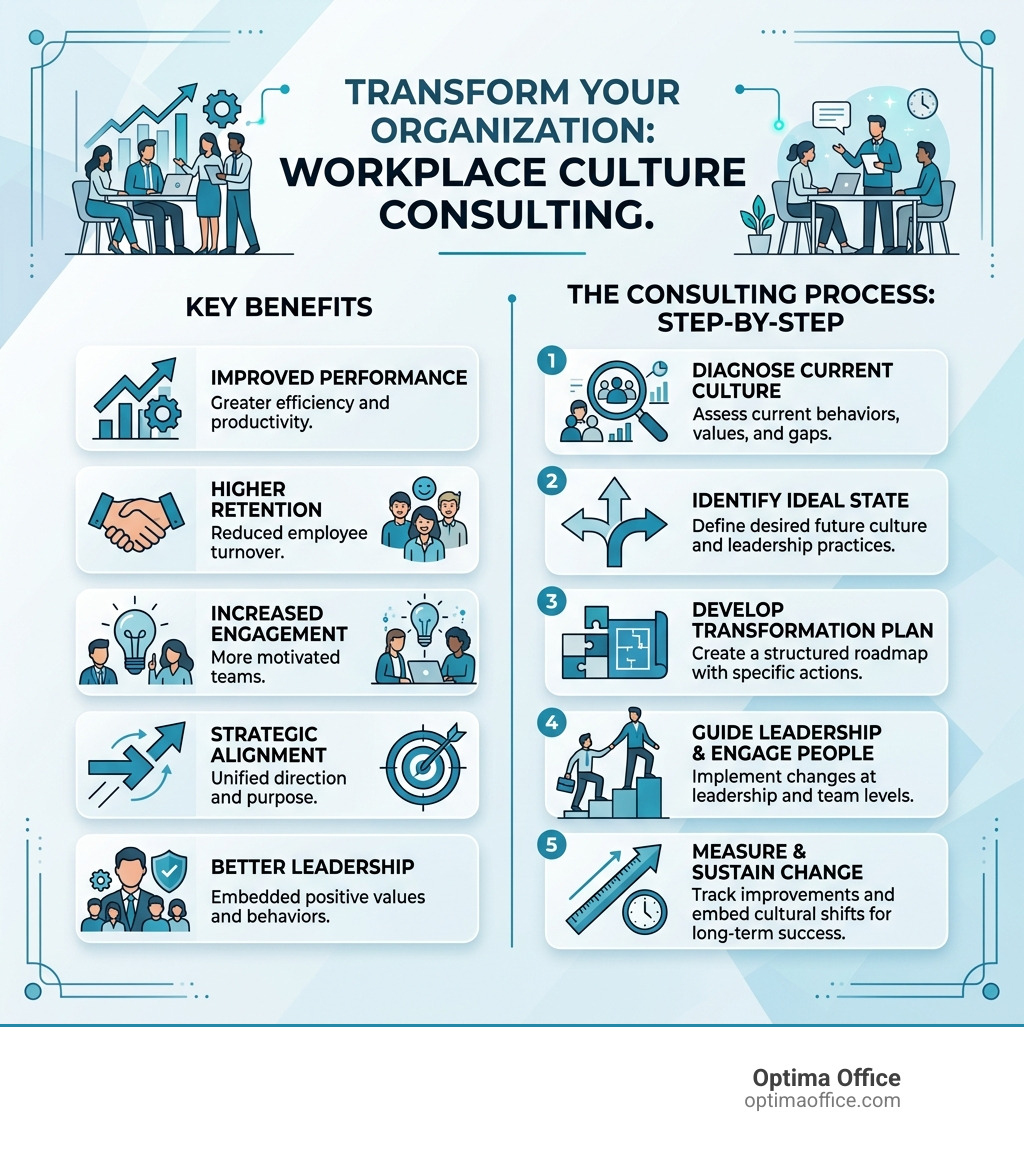
- What it is: A structured process where outside experts assess your current culture, identify gaps, and guide leadership through a transformation that aligns people with business strategy.
- Why it matters: Strong culture can improve performance, reduce turnover, strengthen engagement, and help organizations retain top talent.
- Who needs it: Organizations experiencing high attrition, strategy misalignment, leadership friction, rapid growth, mergers, digital shifts, or hybrid work challenges.
- What success looks like: Embedded behaviors, aligned leadership, measurable engagement improvements, and a culture that strengthens over time instead of eroding under pressure.
- The risk of inaction: Toxic or misaligned culture can drive turnover, reduce productivity, weaken trust, and make it harder to execute the company’s strategy.
The stakes are real. Many organizational transformations fail not because the strategy is weak, but because the culture does not support the change. When leaders engage their people at the level of mindset, motivation, and daily behavior, they create a stronger foundation for lasting results.
For small and mid-sized businesses, especially those in high-cost markets like San Diego and Southern California, culture is not a luxury. It is a retention strategy, a recruiting advantage, and a financial performance driver.
The Business Case for Workplace Culture Consulting
In the past, culture was often dismissed as a “soft” metric. Today, the data tells a different story. For CEOs, culture is a serious business lever because it affects retention, engagement, productivity, and the company’s ability to execute.
A strong culture in the workplace helps employees understand what matters, how decisions get made, and what behaviors are expected. That clarity improves collaboration and reduces the friction that slows teams down. When employees feel connected to the company’s purpose and supported by leadership, they are more likely to stay, contribute, and perform at a higher level.
Culture also creates a competitive advantage that is difficult to copy. Competitors may be able to match your pricing, services, or technology, but they cannot easily replicate how your people communicate, solve problems, and serve clients. That internal operating system becomes part of your market advantage.

Recognizing the Red Flags of a Toxic Environment
Many leaders realize they need workplace culture consulting only after the damage becomes visible. A toxic or misaligned culture rarely stays hidden for long. It often shows up through turnover, disengagement, poor communication, leadership conflict, or a noticeable gap between company values and daily behavior.
One major red flag is losing strong employees to competitors that offer a better environment. Another is strategy misalignment. If leadership sets a new direction but teams keep operating the old way, the culture is not supporting the business plan.
Siloed communication is another warning sign. Departments may begin protecting their own interests instead of working toward shared goals. Over time, that creates internal friction, weakens trust, and slows execution.
When trust erodes, productivity declines. Employees spend more time navigating politics, covering themselves, or avoiding conflict than solving problems. If your team feels disengaged or disconnected from leadership, it may be time to address the culture directly.
A Proven Framework for Cultural Transformation
Transforming culture is not about putting new values on the wall. It is about changing the behaviors, systems, and leadership habits that shape how work happens every day.
Successful transformation requires leadership commitment, clear expectations, behavior reinforcement, and consistent accountability. Leaders must model the behaviors they want the team to adopt. If leadership does not live the culture, the rest of the organization will not either.
To begin becoming a stronger workplace, leaders need to connect culture to the systems that drive the business. That includes hiring, onboarding, manager training, performance reviews, communication rhythms, and promotion decisions.
| Current Cultural Trait | Desired High-Performance Behavior | Impact |
|---|---|---|
| Siloed Information | Radical Transparency | Faster Decision Making |
| Fear of Failure | Calculated Risk-Taking | Increased Innovation |
| Top-Down Direction | Empowered Ownership | Higher Engagement |
| Reactive Problem Solving | Proactive Continuous Improvement | Operational Excellence |
Phase 1: Workplace Culture Consulting Diagnostics
The first step in any workplace culture consulting engagement is understanding the current state of the organization. This means looking beyond what leadership believes the culture is and uncovering how employees actually experience it.
Diagnostics may include employee listening sessions, focus groups, leadership interviews, engagement surveys, policy reviews, and a comprehensive HR assessment. The goal is to identify the patterns, gaps, and unspoken rules that shape daily behavior.
A strong assessment should include input from executives, managers, front-line employees, and informal team influencers. Culture is not only driven from the top. It is reinforced every day by the people employees trust, follow, and listen to.
Phase 2: Sustaining Workplace Culture Consulting Outcomes
The reason many culture initiatives fail is simple: the follow-through disappears. The kickoff creates momentum, but without structure, people return to old habits.
Sustaining culture change requires leaders to reinforce the desired behaviors consistently. That can include manager training, communication frameworks, performance management updates, leadership coaching, and regular progress measurement.
Sustainability also requires structural support. If the company wants more accountability, accountability has to show up in performance reviews. If the company wants more collaboration, teams need systems that make collaboration easier. Culture must be built into how the organization operates, not treated as a side project.
Selecting the Right Workplace Culture Consulting Partner
Choosing a partner for workplace culture consulting is a high-stakes decision. You need a team that understands the realities of small and mid-sized businesses, especially in Southern California, where labor costs, California compliance, and talent competition can create added pressure.
Many large consulting firms offer broad culture frameworks, but those frameworks do not always translate well to a 50-person or 200-person company. Smaller and mid-sized organizations often need practical support, not just a report.
At Optima Office, we provide a blend of fractional leadership and outsourced HR support. Our team helps businesses connect people strategy with financial discipline, operational structure, and practical execution. That matters because culture does not exist in isolation. It affects hiring, retention, payroll, compliance, management, and long-term growth.
When selecting a workplace culture consultant, look for the following criteria:
- Integrated expertise: Do they understand both the people side and the financial side of the business?
- Local knowledge: Are they familiar with the San Diego labor market and California compliance?
- Fractional flexibility: Can they scale services based on your budget and needs?
- Execution support: Do they help implement change or only provide recommendations?
- Leadership alignment: Can they help managers and executives model the behaviors they expect from the team?
- Measurable outcomes: Can they define what success looks like and track progress over time?
The right partner should bring clarity, structure, and accountability, not generic advice.
FAQs About Workplace Culture Strategies
How Does Culture Consulting Support M&A or Hybrid Work?
Mergers and acquisitions often struggle because of culture clash. Even when the financial deal makes sense, integration can break down if teams have different expectations, communication styles, leadership norms, or decision-making habits.
Workplace culture consulting helps identify those gaps early and create a shared path forward. In hybrid work environments, culture consulting can also help leaders maintain connection, communication, and inclusion when employees are not always in the same room.
What Is the Typical ROI of a Culture Engagement?
The return on culture work often shows up through lower turnover, stronger productivity, better engagement, improved manager effectiveness, and reduced hiring costs. When employees stay longer and perform better, the financial impact becomes easier to measure.
Culture work can also reduce hidden costs. These include leadership time spent resolving conflict, productivity lost to confusion, and recruiting costs caused by preventable turnover.
Why Do Most Culture Transformations Fail?
Most culture transformations fail because leadership does not consistently model the change. If executives and managers say one thing but reward another, employees follow what is rewarded.
Other common pitfalls include short-term thinking, inconsistent communication, vague values, lack of manager training, and failure to embed new behaviors into performance systems. Culture change requires structure, repetition, and leadership discipline.
Driving Sustainable Growth Through Cultural Excellence
Culture is the foundation of how your business operates. When your workplace culture is aligned with your goals, it creates stronger leadership, better employee performance, and a more resilient organization.
Sustainable growth is not just about hitting next quarter’s numbers. It is about building a company that can retain talent, adapt to change, and execute consistently as it scales. Whether you are navigating rapid growth, hybrid work, leadership turnover, or operational change, your culture will shape the outcome.
At Optima Office, we help businesses strengthen the connection between people, finance, and operations. Our fractional HR and accounting services give companies access to experienced leadership without the overhead of a full internal executive team.
Ready to strengthen your workplace culture and build a healthier organization? Explore Optima Office’s HR services to see how the right people strategy can support stronger retention, better leadership, and sustainable growth.