Why Bookkeeping for Consultants Is More Complex Than Most Businesses Realize
Bookkeeping for consultants is fundamentally different from bookkeeping for a typical retail or service business, and getting it wrong costs real money. If you are a consultant managing multiple clients, project-based fees, retainers, and reimbursable expenses, here is what you need to know upfront.
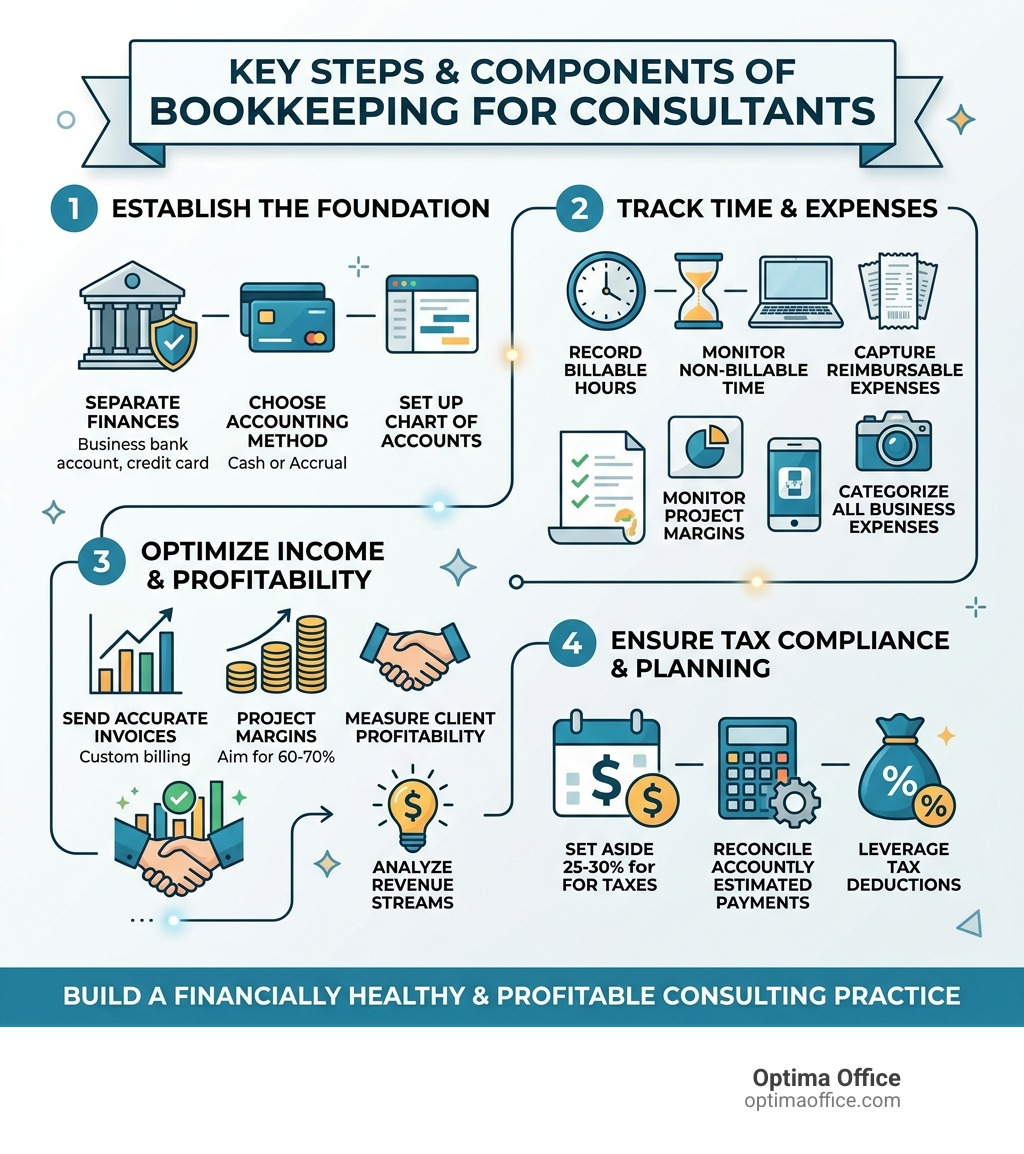
The core elements of effective consultant bookkeeping:
- Separate your finances – Maintain a dedicated business bank account and credit card from day one.
- Choose the right accounting method – Cash accounting suits most solo consultants; accrual becomes essential as you grow.
- Track billable vs. non-billable hours – Untracked time directly reduces your profitability.
- Monitor project delivery margins – A healthy margin often sits between 60% and 70% of project revenue.
- Set aside 25-30% of income for taxes – Self-employment tax obligations catch many consultants off guard.
- Reconcile accounts regularly – Weekly reconciliation prevents costly errors and missed revenue.
- Use cloud-based accounting software – Tools like QuickBooks can reduce manual administrative work substantially compared to spreadsheet-based processes.
Most business owners expect bookkeeping to be straightforward. For consultants, it rarely is. Your revenue does not arrive on a predictable schedule. One month might bring three project completions and a retainer renewal; the next might bring almost nothing. You may be billing different clients at different rates, tracking hours across multiple engagements, and managing expenses that are sometimes reimbursable and sometimes not. Meanwhile, tax obligations do not pause during slow periods. The IRS still expects quarterly estimated payments regardless of whether a major client delays a project.
According to the IRS Small Business and Self-Employed Tax Center, accurate records are essential for tracking income, claiming deductions, and supporting tax filings. For consultants, the risk of error is often higher because irregular income makes it easy to lose track of what has been earned, what is still outstanding, and what will be owed in taxes.
The good news is that with the right systems in place, bookkeeping does not have to be a source of stress. This guide walks through what matters most, from setting up your chart of accounts to tracking project profitability to knowing when it makes sense to bring in professional support.
Simple Bookkeeping for consultants glossary:
Why Bookkeeping for Consultants is Uniquely Challenging
In our experience working with hundreds of professional service firms, we’ve seen that the primary struggle with Bookkeeping for consultants stems from the “intangible” nature of the work. Unlike a shop that sells a physical widget, your “inventory” is your time and expertise. This creates several unique accounting hurdles.
First, there is the issue of project-based revenue. Most consultants don’t have a steady paycheck; they have “milestone payments.” You might work for three months on a strategy project and only see a payment at the very end. Without a robust system, your books will show a massive loss for two months and a massive profit in the third, making it incredibly difficult to understand your true financial health.
Second, the distinction between billable and non-billable hours is often blurred. If you spend three hours researching a client’s industry, is that billable? If you don’t track it, you can’t bill it, and you certainly can’t measure your Professional Services Accounting efficiency.
Finally, reimbursable expenses can become a nightmare. If you fly to a client site in San Diego, stay at a hotel, and grab dinner, those costs must be tagged to that specific project and billed back accurately. If you miss even a few of these, your delivery margin shrinks.

Managing the Feast or Famine Cycle
The “feast or famine” cycle is the consultant’s greatest enemy. One month you are overwhelmed with work (the feast), and the next, you are hunting for leads (the famine). Effective Bookkeeping for consultants acts as a buffer against this volatility.
We recommend creating cash flow projections for at least 3-6 months. This allows you to see the “dips” before they happen. To survive the lean times, we advise our clients to build an emergency fund covering 3 to 6 months of operating expenses.
Another strategy is the use of retainers. By billing a fixed monthly amount, you create a predictable revenue floor. However, from a bookkeeping perspective, retainers must be handled as “deferred revenue.” You shouldn’t count that money as fully earned until the work is actually performed. This prevents you from spending money today that you haven’t technically earned yet.
Essential Habits for Streamlined Bookkeeping for Consultants
Good bookkeeping isn’t a once-a-year event; it’s a series of small, disciplined habits. If you wait until April to look at your receipts, you’ve already lost the battle.
The absolute “Golden Rule” of Business Bookkeeping is the separation of church and state: never mix personal and business finances. Open a dedicated business bank account and credit card. This makes reconciliation faster and protects you in the event of an audit.
Weekly reconciliation is another non-negotiable habit. We suggest blocking 30 minutes every Friday to match your bank transactions with your invoices and receipts. This keeps your data fresh and ensures you don’t forget what a $42.00 charge at a local coffee shop was for three weeks later.
Automating Bookkeeping for Consultants with AI Tools
We live in an era where manual data entry should be a thing of the past. Modern software can save QuickBooks users an average of 29 hours per month compared to old-school methods.
AI-powered tools now handle the heavy lifting. Cloud-based accounting software can connect directly to your bank feeds, using “rules” to automatically categorize recurring expenses like your Zoom subscription or your San Diego office rent. Automation can even help you reclaim up to 20% of previously missed billables by integrating your time-tracking tool directly with your invoicing system. When your timer stops, the invoice is halfway written.
Setting Up a Scalable Bookkeeping for Consultants Framework
As your consulting practice grows, your bookkeeping system needs to scale with you. A “scalable” framework starts with a lean Chart of Accounts. We generally recommend keeping this to 20–30 accounts maximum. You want enough detail to see where your money is going, but not so much that you get lost in the weeds.
Every consultant should use a double-entry bookkeeping system. While it sounds complicated, it simply means that every transaction has a corresponding and opposite entry in a different account. This ensures your balance sheet actually balances and provides a natural check against errors and fraud. For a truly professional setup, look into scalable bookkeeping solutions that can grow from a solo operation to a full-fledged firm.
Choosing the Right Accounting Method and Software
One of the first big decisions you’ll face is choosing between cash and accrual accounting. This choice impacts how you see your profit and how much you pay in taxes.
| Feature | Cash Accounting | Accrual Accounting |
|---|---|---|
| When is Income Recorded? | When the cash hits your bank account. | When the invoice is sent (earned). |
| When are Expenses Recorded? | When you actually pay the bill. | When you receive the bill (incurred). |
| Best For… | Solo consultants and very small firms. | Growing firms with complex projects. |
| Pros | Simple; reflects actual cash on hand. | Better for long-term strategic planning. |
| Cons | Can hide upcoming tax/bill obligations. | More complex to manage day-to-day. |
For most solo consultants in Southern California, cash accounting is the preferred starting point because it’s IRS-friendly for businesses under $25 million in revenue and very easy to understand. However, as you hire subcontractors or take on larger projects, the Bookkeeper Controller Difference becomes important, and moving to accrual accounting may provide a more accurate picture of your long-term profitability.
As for software, QuickBooks Online is the industry standard for a reason. It integrates with over 500 apps and is used by over 7 million customers worldwide. Xero is another fantastic option, especially if you deal with international clients and need robust multi-currency support.
The Benefits of Double-Entry Bookkeeping
We cannot overstate the importance of double-entry bookkeeping. By recording every transaction twice (as a debit and a credit), the system ensures that your “Accounting Equation” (Assets = Liabilities + Equity) remains in balance. This is the foundation of audit preparedness. If a San Diego-based CPA or the IRS ever asks for your records, having a double-entry system in place shows that your books are professional and reliable.
Tracking Project Profitability and Billable Hours
Do you know which of your clients is actually the most profitable? Many consultants are surprised to find that their biggest client is actually their least profitable once they account for “scope creep” and non-billable hours.
A healthy delivery margin for consulting projects is typically between 60% and 70%. This is calculated by taking your project revenue and subtracting the direct costs (like subcontractor fees, travel, and software specifically for that project). If your margin is consistently below 60%, you are likely underpricing your expertise or spending too much time on non-essential tasks.
Maximizing Billable Efficiency
To stay profitable, you must track time to the minute. We recommend using tools like Harvest or Toggl that integrate directly with your accounting software. This allows for “job costing,” where every hour of your time is tagged to a specific project.
By monitoring your utilization rate — the percentage of your working hours that are actually billable — you can make better decisions about when to raise your rates or when to stop taking on “pro bono” work that is draining your energy. Our professional services accounting expertise shows that consultants who review these metrics monthly are twice as likely to see year-over-year growth.
Tax Planning and Deductions for Modern Consultants
Tax season shouldn’t be a surprise. If you’ve been practicing good Bookkeeping for consultants all year, tax time is simply a matter of running a few reports.
One of the biggest deductions for consultants is mileage. For 2024, the IRS standard mileage rate is 65.5 cents per mile. If you are driving across Southern California to meet clients, those miles add up quickly. Use an app to track your business trips automatically so you don’t leave money on the table.
You should also take advantage of the home office deduction if you have a dedicated space for work. Other common deductions include professional insurance, software subscriptions, and even a portion of your internet and phone bills. To avoid a massive bill in April, we recommend our clients set aside 25-30% of every payment into a separate “Tax Reserve” savings account. This ensures the money is there when your quarterly estimated payments are due. For more on how to structure this, see Why Your Business Needs Fractional Bookkeeping Services.
Common Deductions and Compliance
Consultants often operate as sole proprietors or S-Corps, which means you are responsible for self-employment tax (the employer and employee portions of Social Security and Medicare).
If you hire other consultants to help with a project, you must manage 1099 compliance. This means collecting a W-9 form before you ever send them a payment. If you wait until January to ask for their tax info, you’ll find it’s much harder to get a response. Proper professional service models often involve rigorous 1099 tracking to avoid IRS penalties.
Frequently Asked Questions about Consultant Bookkeeping
Should consultants use cash or accrual accounting?
For solo consultants, cash accounting is usually best because it is simple and aligns with your actual bank balance. As your firm grows, adds employees, or manages large multi-month contracts with milestones, accrual accounting becomes necessary to see your true financial performance.
How can I effectively manage irregular cash flow?
The best way is to combine three strategies: build a 3-6 month cash cushion, use retainers to create a “floor” of monthly income, and strictly track your accounts receivable (AR) to ensure clients are paying on time. Research shows consultants get paid 2x faster when using online payment options like PayPal through QuickBooks.
When should a consultant outsource their bookkeeping?
You should consider outsourcing when the time you spend on bookkeeping is worth more than the cost of a bookkeeper. For example, if you can bill $200/hour for consulting but spend 5 hours a month on messy bookkeeping, you’ve effectively “spent” $1,000. Hiring a pro is often much cheaper and significantly more accurate. Learn more about How Outsourcing Bookkeeping Saves Time And Cost.
Achieving Long-Term Financial Clarity
Bookkeeping for consultants isn’t just about staying out of trouble with the IRS. It’s about gaining the clarity you need to lead your business with confidence. When your books are clean, you know exactly how much you can afford to invest in marketing, when you can afford to hire an assistant, and exactly how much you need to bill to hit your personal income goals.
At Optima Office, we specialize in helping Southern California consultants move from financial chaos to total clarity. Our mission is to provide exceptional accounting and HR services while building positive relationships within our team and local communities. Whether you need a part-time bookkeeper to clean up your QuickBooks or a fractional CFO to help you scale your firm to the next level, our proprietary five-point system ensures you get the right fit for your unique needs.
We understand that you didn’t start a consulting business because you love spreadsheets — you started it because you are an expert in your field. Let us handle the numbers so you can focus on the work that drives your passion and your profits. Our rapid team deployment means we can have a professional expert integrated into your business in just 3-5 days.
Ready to stop dreading tax season and start growing your practice? More info about bookkeeping services is just a click away. For a fully integrated fractional team, we are here to help you navigate the complexities of professional services accounting and financial management.
Don’t let poor bookkeeping be an Expensive Mistake. Take control of your finances today and build the consulting firm you’ve always envisioned.