
Performance management support is something most small business owners know they need — but few have time to build properly.
If you’re looking for a quick answer on what it involves, here it is:
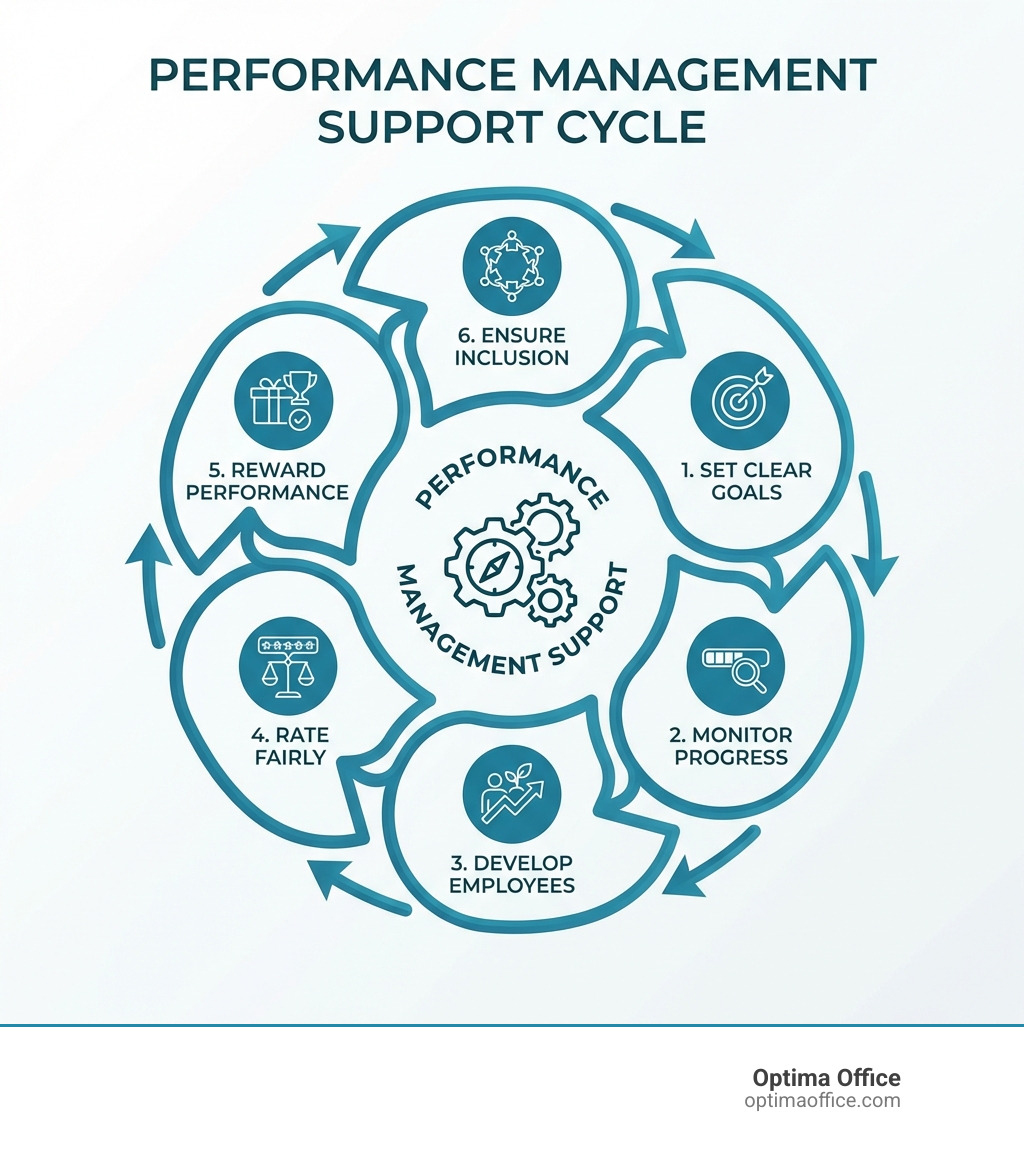
Performance management support includes:
- Setting clear goals aligned to business objectives
- Monitoring progress through regular check-ins and KPIs
- Developing employees through coaching, training, and feedback
- Rating and rewarding performance fairly and consistently
- Addressing underperformance with empathy and documentation
- Adapting for diverse teams, including remote workers and employees with disabilities
Most organizations know performance management matters. But knowing and doing are very different things.
Consider this: 93% of organizations say driving performance is a key goal of their performance management program. Yet fewer than half — just 44% — say their program actually meets that goal.
That gap is expensive.
Companies that get performance management right are 1.5x more likely to outperform competitors financially and 1.25x more likely to see a productivity increase. On the flip side, poor performance management quietly drains your team’s focus, motivation, and loyalty — often without anyone noticing until someone walks out the door.
For small and mid-sized businesses in particular, the stakes are even higher. You don’t have the HR bench strength of a large enterprise. Every manager interaction counts. Every unclear goal costs you time and money.
This guide breaks down exactly how to build a performance management system that works — not just on paper, but in practice.
Performance management support further reading:
- business bookkeeping
- professional bookkeeping services
When we talk about performance management support, we aren’t just talking about a set of HR forms or a mandatory meeting once a year. We are talking about the primary engine that drives financial outperformance and long-term business stability.
Research from a Willis Tower Watson study found that companies using performance management programs effectively are 1.5x as likely to outperform their competitors financially. This isn’t a coincidence. When every person in your organization knows exactly what they are supposed to do, how it helps the company make money, and that they will be supported in doing it, productivity naturally rises.
Beyond the balance sheet, a robust support system is your best defense against turnover. High-performing employees don’t just stay for the paycheck; they stay because they see a path for talent development and feel that their contributions are recognized. By future-proofing your workforce’s skills through continuous learning, you create a competitive advantage that is incredibly hard for rivals to replicate.
The Cost of Disengagement
The alternative to active performance management is a slow slide into disengagement. Many businesses suffer from significant feedback gaps. A Betterworks study reported that 21% of employees say their goals are set annually and never looked at again. Even worse, 16% of employees say they don’t set any goals at all.
When goals lack visibility, employees lose their “why.” They begin to work in silos, often focusing on tasks that don’t actually move the needle for the business. This productivity loss is a silent killer for small businesses in Southern California, where every hire represents a significant portion of the total operating budget. If one in ten employees claims they rarely or never receive feedback, you aren’t just losing work hours; you’re losing the opportunity to course-correct before a small mistake becomes a major liability.
The 4-Stage Performance Management Cycle
Effective performance management support isn’t a single event; it’s a continuous loop. Think of it as a roadmap for the employee’s journey within your company.

- Planning: This is the foundation. You and the employee collaborate to set expectations, define roles, and establish what “success” looks like.
- Monitoring: You don’t wait until December to see how things are going. You track progress through regular check-ins, keeping an eye on both results (the “what”) and behaviors (the “how”).
- Developing: This stage focuses on increasing the employee’s capacity to perform. It might involve training, new assignments that introduce fresh skills, or mentorship.
- Rating and Rewarding: At the end of the cycle, you evaluate performance against the predefined goals. High performers are recognized with financial or non-financial rewards, while underperformers receive targeted support plans.
| Feature | Traditional Appraisals | Continuous Performance Management |
|---|---|---|
| Frequency | Once a year | Ongoing/Regular check-ins |
| Focus | Past performance (Backward-looking) | Future growth (Forward-looking) |
| Tone | Evaluative and judgmental | Coaching and collaborative |
| Goal Setting | Rigid/Fixed | Agile/Flexible |
Setting SMART Goals and KPIs
To make the planning stage work, goals must be more than just “work harder.” They need to be SMART: Specific, Measurable, Achievable, Relevant, and Time-bound.
Instead of telling a sales rep to “increase revenue,” a SMART goal would be: “Increase new client revenue by 15% in the San Diego region by the end of Q3 through targeted LinkedIn outreach and local networking events.” This aligns individual effort with the business’s strategic objectives. When employees are involved in this process, they feel a sense of ownership. For more ideas on keeping this process fresh, check out these 10 creative ways to give performance feedback.
Continuous performance management support and Feedback
The “set it and forget it” model of goal setting is dead. Modern performance management support relies on an ongoing dialogue. As Not the HR Lady notes, performance management should be an ongoing dialogue that happens throughout the year, not just during a stressful annual review.
Regular check-ins—whether weekly or bi-weekly—allow for real-time coaching. If an employee is veering off track, you can nudge them back in the right direction immediately. It also provides a platform for frequent recognition. A simple “I saw how you handled that difficult client call, great job staying calm” can do more for morale than a bonus check delivered six months after the fact.
Inclusive and Hybrid Performance Management Strategies
A one-size-fits-all approach to performance management often leads to bias and exclusion. To build a truly high-performance culture, we must ensure equity and psychological safety for all team members. The Directive on Performance Management sets out the responsibilities for a consistent, equitable approach, emphasizing that every employee deserves a fair shot at success.
Supporting Employees with Disabilities
Inclusivity is particularly vital when supporting employees with disabilities. Inclusive performance management means differentiating between a performance issue and a disability-related need. For example, an employee might meet all their KPIs but require a modified schedule or specific software to do so.
We should focus on:
- Accommodation Plans: Keeping these plans current and integrating them into performance discussions.
- Inclusive Behaviors: Training managers to spot their own biases and focus on contributions rather than “how things have always been done.”
- Open Communication: Encouraging employees to suggest the most effective ways to perform their jobs. According to CASE research on inclusive performance management, employees with disabilities often have strong attendance and safety records when provided with the right environment.
Adapting performance management support for Hybrid Teams
The shift to remote and hybrid work in Southern California has fundamentally changed the manager-employee relationship. Yet, a Willis Tower Watson study reported that only about one in six employers had altered their process to align with remote work.
To support hybrid teams effectively, we must move away from “presenteeism” (judging performance by hours spent at a desk) and toward outcome-focused evaluations. This requires:
- Trust Building: Focusing on results rather than micro-managing digital activity.
- Digital Communication: Using tools to document progress and keep feedback loops tight.
- Well-being Tracking: Remote work can lead to burnout; managers must check in on the “human” side of work just as much as the “task” side.
Addressing Underperformance and Building a Feedback Culture
No manager enjoys dealing with underperformance, but avoiding the conflict only makes it worse. When an employee isn’t meeting expectations, the first step is a root cause analysis. Is it a lack of skills? A lack of resources? Or perhaps a personal issue?
If the issue is skill-based, a Performance Improvement Plan (PIP) can provide a structured way back to success. However, a PIP should never be a surprise. It should be the result of a series of documented conversations where the employee was given a chance to improve. For more guidance on this, read our tips on dealing with difficult employees.
The SBI Feedback Model
To keep feedback constructive and objective, we recommend the SBI model:
- Situation: Describe the specific time and place. (“During yesterday’s team meeting…”)
- Behavior: Describe the observable behavior without using “judgment” words. (“…you interrupted Sarah three times while she was presenting the budget.”)
- Impact: Explain the result of the behavior. (“It made the meeting run long and prevented us from hearing her full proposal.”)
This model removes the “sting” of personal criticism and focuses on actionable steps. By using data-driven feedback, you can focus on boosting morale and retention rather than just pointing out flaws.
360-Degree Feedback and Peer Reviews
A manager’s view is only one piece of the puzzle. 360-degree feedback incorporates perspectives from peers, direct reports, and even clients. This multi-rater approach is excellent for bias mitigation because it provides a more holistic view of an employee’s impact. Only about two in five companies currently use both upward and downward evaluations, but those that do often find it leads to higher levels of transparency and trust.
Modern Methods: From OKRs to Generative AI
The world of performance management support is evolving rapidly, moving away from rigid hierarchies and toward agile, data-driven systems.
- OKRs (Objectives and Key Results): Popularized by Google, this method involves setting ambitious “moonshot” goals and tracking measurable results. It’s highly effective for fast-growing companies that need to stay aligned.
- MBO (Management by Objectives): This focuses on aligning employee goals with the larger mission of the company.
- Agile Performance: This mirrors software development, with short “sprints” of work followed by immediate feedback and adjustment.
A famous Deloitte case study on frequent check-ins and strengths-based coaching showed that by shifting the focus to what employees do best, the firm saw significant gains in engagement and productivity.
The Role of Generative AI in Performance Support
Generative AI is the newest tool in the manager’s kit. According to McKinsey research on Gen AI in performance management, AI can assist with:
- Goal Drafting: Helping managers write SMART goals based on job descriptions.
- Data Aggregation: Summarizing a year’s worth of feedback and KPIs into a concise draft.
- Bias Detection: Flagging language in reviews that might indicate unconscious bias.
- Automation: Handling the “paperwork” so managers can spend more time on actual coaching.
Real-World Success Stories
We see these principles in action at major global brands. For instance, a global bank implemented a mobile feedback app that allowed employees to capture achievements and share feedback in real-time, which was crucial for supporting their remote workforce.
In another instance, an IKEA case study on performance management coaching highlighted how training 750 managers in coaching techniques led to a 5% increase in KPIs. These aren’t just “feel-good” metrics; they are direct contributors to the bottom line.
Frequently Asked Questions about Performance Management Support
What is the difference between performance management and a performance appraisal?
Performance management is an ongoing, year-round process focused on development and future growth. A performance appraisal is a periodic (usually annual), formal evaluation of past performance. Think of the appraisal as a single snapshot, while performance management is the entire movie.
How can managers reduce bias in performance reviews?
The best way to reduce bias is through standardized, evidence-based criteria. Use specific KPIs and the SBI feedback model to keep the focus on behaviors rather than personalities. 360-degree feedback and bias training for managers are also essential tools for creating a fairer system.
What are the best non-financial incentives for employees?
While pay matters, many employees are equally motivated by:
- Career Progression: A clear path to promotion.
- Autonomy: The freedom to choose how they complete their work.
- Public Recognition: Being celebrated in front of their peers.
- Skill Development: Access to training and mentorship.
- Flexible Work: Options for hybrid or remote work.
Conclusion
Building a culture of high performance doesn’t happen by accident. It requires a deliberate strategy, the right technology, and a commitment to ongoing dialogue. When you invest in performance management support, you aren’t just checking an HR box—you are building a more resilient, profitable, and engaged company.
At Optima Office, we understand that small and mid-sized businesses in San Diego and across Southern California often lack the resources to hire a full-time HR director or CFO to build these systems. That’s where we come in. Our team provides outsourced accounting and HR services that give you the expertise of a complete department for a fraction of the cost.
Whether you need help setting up a 360-degree feedback system, training your managers in the SBI model, or integrating your financial KPIs with employee goals, our fractional HR advisory services are designed to deploy rapidly—usually within 3 to 5 days. We bring the right expertise and personality fit to solve your problems quickly, so you can focus on driving enterprise growth.
Ready to transform your performance culture? Let’s build something that actually works.
Next steps for your business:
- fractional HR services
- accounting for small business