
Outsourcing HR for small business gives owners access to professional human resources support without hiring a full-time internal HR team. For growing companies, especially those managing compliance, payroll, hiring, benefits, and employee relations, outsourcing can reduce risk and free leadership to focus on operations. If your team is growing and HR is starting to pull you away from core business priorities, Optima Office’s HR services can help you build structure without adding unnecessary overhead. This guide breaks down what small businesses should outsource, what to keep in-house, how much HR outsourcing typically costs, and how to choose the right provider.
Outsourced HR for Small Businesses at a Glance
Outsourced human resources for small businesses is the practice of partnering with an external provider to manage some or all HR functions. This can include payroll, compliance, hiring, onboarding, benefits administration, employee relations, and handbook updates.
Here’s what small business owners need to know:
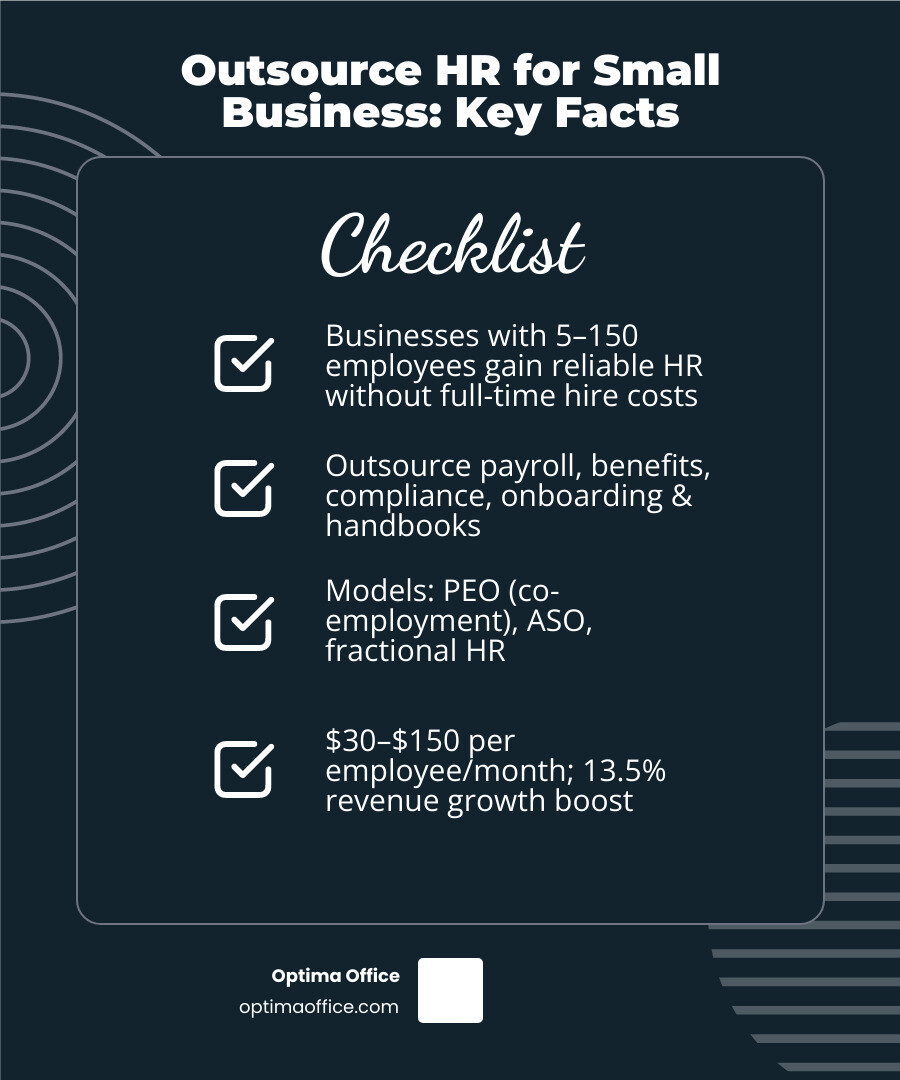
- Who it’s for: Businesses with roughly 5 to 150 employees that need reliable HR support without the cost of a full-time hire.
- What you can outsource: Payroll processing, benefits administration, compliance management, onboarding, employee handbooks, recruiting, and employee relations.
- Main models available: Professional Employer Organization, Administrative Services Organization, and fractional HR support.
- Typical cost: $30 to $150 per employee per month, depending on services, business size, and provider model.
- Key benefits: Reduced compliance risk, time savings, stronger benefits access, better employee support, and more scalable HR operations.
- When to consider it: Around the 10 to 15 employee mark, or whenever HR tasks start pulling leadership away from core business operations.
Why HR Becomes a Problem as You Gro
If you’re a small business owner in San Diego or elsewhere in Southern California, you’ve probably felt the tension firsthand. You may be running a professional services firm, medical practice, nonprofit, manufacturing company, or real estate business while also trying to manage people issues, payroll questions, compliance updates, and hiring needs.
That is where HR starts to become a second job. Or worse, it falls through the cracks entirely.
The compliance landscape does not make it easier. Federal labor law, California wage-and-hour rules, Private Attorneys General Act exposure, workers’ compensation claims, family leave requests, and other HR obligations all create risk. One mismanaged termination, one unsigned policy, or one missed filing can quickly become a legal situation that drains time, money, and leadership focus.
That is why many small businesses are rethinking how HR gets done. According to industry research, one-third of companies spend at least 11 hours per week on HR administration alone. That time adds up to more than 570 hours annually and can cost companies with 50 to 100 employees close to $350,000 per year.
For businesses at that size and stage, outsourcing HR is not a luxury. It is often the more strategic and affordable path forward.
“Take Optima Office’s free HR Compliance Self-Audit to identify potential gaps in your current HR setup before outsourcing HR support.”
HR Outsourcing Models for Small Businesses
When you outsource HR for your small business, you are not just buying a service. You are choosing a partnership structure.
The right model depends on how much control you want to retain, how much administrative support you need, and whether you want someone to advise you, execute the work, or both.
At Optima Office, we often see businesses confused by the alphabet soup of HR acronyms. Broadly, the market is divided into three main paths: Professional Employer Organizations, Administrative Services Organizations, and fractional outsourced HR consulting.
While a consultant may simply tell you what to do, an outsourced HR partner helps execute the work.
| Feature | PEO (Co-employment) | ASO (Administrative Services) | Fractional HR Advisory |
|---|---|---|---|
| Employment Status | Co-employment (shared tax ID) | Direct employer (your tax ID) | Direct employer (your tax ID) |
| Benefits Access | Large group “Fortune 500” rates | Individual market rates | Individual market rates |
| Compliance Risk | Shared liability | You retain liability | You retain liability |
| Customization | Standardized packages | Highly flexible | Fully bespoke |
| Strategic Focus | Transactional/Administrative | Administrative | Strategic & Operational |
Professional Employer Organizations
A Professional Employer Organization operates under a co-employment model. This means your employees are technically employed by both your company and the Professional Employer Organization for tax and insurance purposes.
This model is popular for very small teams because it may allow them to access stronger health insurance, retirement plans, and administrative support than they could secure alone. By pooling employees from different small businesses, Professional Employer Organizations can often negotiate benefit options and handle certain tax filings under their own Federal Employer Identification Number.
The tradeoff is control. Professional Employer Organizations often use standardized packages, processes, and systems. That can work well for some companies, but it may feel limiting for businesses that need a more customized HR approach.
Administrative Services Organizations
An Administrative Services Organization may be a better fit if you want HR support without entering a co-employment relationship. Under this model, you remain the sole employer of record.
The provider can support payroll processing, compliance administration, benefits support, tax reporting, and other HR tasks under your company’s tax ID. This gives businesses professional administrative support while allowing them to retain more direct control over employment structure and decision-making.
Administrative Services Organizations can be useful for companies that need operational HR help but are not looking for a shared employment model.
Fractional HR Advisory
Fractional HR advisory gives small businesses access to experienced HR leadership without hiring a full-time HR executive or manager. This model is often the best fit for companies that need both strategy and execution.
A fractional HR team can help with compliance, recruiting, onboarding, employee relations, performance management, policy updates, and leadership support. The major advantage is flexibility. You can scale support up or down based on your business needs.
For many growing businesses, fractional HR fills the gap between “we cannot afford a full-time HR leader yet” and “we cannot keep managing HR casually anymore.”
When Is the Right Time to Outsource HR for a Small Business?
Most small businesses begin feeling the pressure around the 10 to 15 employee mark. At this stage, the informal “family” feel of a startup can begin to clash with formal labor laws, documentation requirements, payroll complexity, and employee expectations.
You may notice that you are spending more time on people problems than on growth, operations, or client service. That is usually the signal that your HR structure needs to mature.
Common signs it is time to outsource HR include:
- You are struggling to keep up with changing California labor laws.
- Your onboarding process feels inconsistent or nonexistent.
- You have experienced a near miss with a legal claim, payroll issue, or employee complaint.
- You need to hire quickly but do not have a structured recruiting process.
- Your employee handbook is outdated or incomplete.
- Managers are unsure how to handle performance issues.
- HR questions are pulling owners or executives away from higher-value work.
The goal is not to wait until there is a crisis. The goal is to build the structure before the risk becomes expensive.
Primary Benefits of Outsourcing HR
Outsourcing HR is not just about offloading paperwork. Done correctly, it can improve compliance, reduce turnover, support better hiring, and help the business scale with fewer operational gaps.
While a full-time HR manager can cost thousands of dollars per month, outsourcing gives small businesses access to a team of experts at a more flexible cost.
Expert HR Guidance
With outsourced HR support, you gain access to experienced HR professionals who have handled complex employee issues before. That includes terminations, workplace investigations, wage-and-hour questions, handbook updates, leave requests, and workplace safety requirements.
This is especially valuable in California, where employment rules are more complex and employer exposure can be higher.
Reduced Compliance Risk
Compliance is one of the strongest reasons to outsource HR. A good HR partner helps keep policies, documentation, employee classifications, training requirements, and employment practices aligned with current rules.
That does not eliminate risk completely, but it does help reduce avoidable mistakes.
Better Employee Support
Employees expect clear policies, organized onboarding, accurate payroll, benefits support, and responsive communication. When HR is handled casually, employees feel it.
Outsourced HR helps create consistency. That consistency improves trust, reduces confusion, and gives employees a better experience.
Stronger Hiring and Onboarding
Hiring can consume a huge amount of leadership time. Outsourced HR support can help structure job descriptions, candidate screening, interview processes, offer letters, onboarding, and compliance documentation.
If recruiting is a major need, Optima Office’s recruiting services can help businesses find qualified candidates without overwhelming internal teams.
More Time for Leadership
Every hour spent fixing payroll errors, chasing paperwork, or researching employment rules is time not spent leading the business. Outsourcing gives owners and executives time back.
That is the real value. Not just less paperwork. More focus.

What HR Functions Should Small Businesses Outsource?
One of the biggest mistakes small business owners make is thinking they have to outsource everything or nothing. The strongest HR partnerships are often modular.
You can outsource the HR functions that create the most risk or administrative burden while keeping culture, leadership, and strategic decisions inside the company.
HR Functions Commonly Outsourced
Administrative and high-risk tasks are usually the best candidates for outsourcing. These functions require accuracy, consistency, and compliance, but they do not always require the owner’s personal involvement.
Common outsourced HR functions include:
- Payroll and tax filing: Reduces the risk of missed deadlines, inaccurate payments, and government penalties.
- Compliance management: Keeps policies, handbooks, and procedures aligned with current employment rules.
- Benefits administration: Supports health insurance, retirement plans, open enrollment, COBRA, and employee benefit questions.
- Recruiting support: Helps source, screen, and organize candidates.
- Onboarding: Creates a consistent process for new hires.
- Employee handbooks: Keeps policies current, clear, and legally aligned.
- Claims management: Supports workers’ compensation, unemployment claims, and related documentation.
- Employee relations: Gives leaders guidance on difficult conversations, complaints, and performance concerns.
HR Functions to Keep In-House
Even with a strong outsourced HR partner, certain responsibilities should stay close to leadership.
You should usually keep ownership of:
- Company culture: Your values, expectations, and team environment should be defined internally.
- Strategic planning: Leadership should decide where the company is going and what kind of team is needed to get there.
- Performance feedback: HR can provide structure and support, but direct managers should own coaching and day-to-day performance conversations.
- Final hiring decisions: Outsourced HR can support recruiting, but leadership should decide who joins the team.
- Employee trust-building: HR can help create systems, but trust still comes from leadership behavior.
Outsourcing HR should strengthen your leadership, not replace it.

How Much Does Outsourced HR Cost for Small Businesses?
Understanding the cost of outsourcing HR is essential for budgeting. Most small businesses find that outsourcing is more affordable than hiring a full-time HR employee, but pricing can vary depending on the provider and scope of services.
Common pricing models include:
- Flat monthly retainer
- Per-employee-per-month pricing
- Percentage of payroll
- Project-based pricing
- Hybrid pricing based on service level
In 2026, the typical range to outsource HR for a small business is often between $30 and $150 per employee per month. For a business with 20 employees, that may land somewhere around $1,000 to $3,000 per month, depending on the service model.
Setup costs may also apply. These can range from a few hundred dollars to several thousand dollars depending on data migration, payroll setup, compliance review, handbook updates, and the initial HR assessment.
Compared to the salary, benefits, taxes, and overhead of a full-time HR generalist, outsourced HR can be a more flexible way to access senior-level support before your business is ready for a full internal department.
How to Choose the Right HR Outsourcing Provider
Do not choose the cheapest HR provider just because the price looks appealing. A bad HR partner can be more expensive than no HR partner if they mishandle compliance, give generic advice, or fail to respond when issues get serious.
When reviewing providers, look for fit, responsiveness, and accountability.
Key criteria include:
- Industry expertise: Do they understand your field, such as healthcare, construction, professional services, nonprofit, or manufacturing?
- California compliance knowledge: Do they understand California employment requirements?
- Responsiveness: Can they support urgent employee issues quickly?
- Scalability: Can they grow with you from 10 employees to 50, 100, or more?
- Technology: Do they use systems that make payroll, onboarding, benefits, and employee records easier to manage?
- Customization: Can they adapt to your company, or do they force you into a rigid package?
- Execution support: Do they only advise, or do they help complete the work?
- Cultural fit: Do they understand how your team operates?
The right HR provider should bring structure, clarity, and confidence. Not more confusion.
Frequently Asked Questions About Outsourced HR for Small Businesses
What is the difference between a Professional Employer Organization and an HR consultant?
A Professional Employer Organization is a co-employer that shares certain employment responsibilities and often handles back-office HR administration. An HR consultant typically provides advice, but may not always execute the daily HR work.
Fractional HR providers like Optima Office offer a different model. We act as an extension of your internal team, helping with both strategy and execution without requiring a co-employment relationship.
How long does it take to transition to an outsourced HR provider?
Most transitions take 30 to 60 days. This period may include reviewing employee files, auditing current HR practices, migrating payroll data, updating handbooks, setting up systems, and introducing the outsourced HR team to employees.
A strong transition process matters. It helps prevent confusion and gives employees confidence in the new support structure.
Can outsourcing HR help with California-specific compliance?
Yes. California is one of the most complex states for employers, and small businesses need to stay ahead of wage-and-hour rules, leave requirements, harassment training, employee classifications, workplace safety obligations, and documentation standards.
A provider with California HR experience can help identify gaps before they become expensive problems.
Do small businesses lose control when they outsource HR?
Not if the partnership is structured correctly. Outsourcing HR should give leadership more control by creating better systems, cleaner documentation, and clearer processes.
The key is choosing the right model. If you want to remain the employer of record and keep more flexibility, a fractional HR or Administrative Services Organization model may be a better fit than a Professional Employer Organization.
Is outsourced HR only for businesses with employees in one location?
No. Outsourced HR can support businesses with employees in one office, multiple locations, hybrid teams, or remote teams. This can be especially helpful when employees work across different cities or states with different employment requirements.
Build HR Structure Before the Problems Get Expensive
Outsourced human resources for small businesses is not just about getting HR tasks off your plate. It is about building the structure your business needs before people issues, compliance gaps, and administrative overload start costing you real money.
At Optima Office, we believe HR and finance are connected. You cannot make smart hiring decisions without a clear budget, and you cannot maintain a healthy budget without managing your largest expense: your people.
Our team provides accounting, finance, and HR support for growing businesses that need experienced leadership without the cost of a full internal department. Through our fractional CFO, controller, accounting, and HR advisory services, we help companies build better systems, stronger teams, and more confident operations.
Ready to take HR off your plate and get back to growing your business? Explore Optima Office’s HR services to see how outsourced HR support can help your business reduce risk, save time, and scale with confidence.