


Navigating evolving statutory pay floors and municipal compensation regulations is essential for modern business leadership. As states and cities update baseline pay standards, employers must adapt their payroll processing and human resources strategies to remain fully compliant. Understanding these structural changes helps organizations effectively forecast operating budgets while mitigating legal risks. This comprehensive guide breaks down recent minimum wage adjustments, demographic impacts, operational compliance strategies, and future regulatory trajectories.
July 2026 Minimum Wage Increase Updates Across States and Localities

July 2026 marks another significant shift in wage regulations across several states and municipal jurisdictions. In Alaska, Oregon, and Washington, D.C., state-level pay adjustments directly raise earnings for over 361,000 workers, providing more than $221 million in total annual wage lifts. Meanwhile, California employers face a complex web of local municipal increases taking effect on July 1 across various cities and unincorporated county regions. Navigating these overlapping state and municipal laws requires business leaders to track exact physical work locations to ensure full compensation compliance.
Across the West Coast and other regions, state wage laws take different approaches to geographic cost differences. Oregon utilizes a three-tier geographic system where the Portland Metro area commands $16.80 per hour, standard counties stand at $15.55 per hour, and nonurban counties sit at $14.55 per hour. In California, while the statewide floor reached $16.90 per hour in January 2026, local city ordinances raise the bar even higher. Cities such as Emeryville climb to $20.34 per hour, Berkeley and San Francisco reach $19.61 per hour, and Los Angeles City shifts to $18.42 per hour.
For employers managing multi-location or hybrid teams in Southern California and beyond, complying with local wage thresholds is mandatory. When state, local, and industry rates differ, businesses must legally apply whichever pay floor is highest for the specific hours worked in that jurisdiction. Failing to adjust base hourly compensation creates severe legal exposure under state labor standards and local city ordinances. We recommend auditing all job sites and municipal boundaries before each midyear shift to avoid payroll processing errors.
Demographic Impact of Mid-Year Minimum Wage Increase Adjustments
The economic benefits of a minimum wage increase reach far beyond entry-level teenage workers. Demographic data shows that 89.3% of workers affected by mid-year wage adjustments are age 20 or older, with 62.1% aged 25 or older. Furthermore, 52.9% of these individuals work full-time hours, and 23.6% are parents supporting children. Additionally, half of affected workers belong to households earning less than 200% of the federal poverty line, making wage floors a critical lifeline against rising living costs.
Women and minority populations represent the largest share of low-wage workers gaining from midyear pay adjustments. Women account for 56.3% of the workers benefiting from July increases across key states and districts. Black workers represent 15.3% of affected workers despite comprising 10.4% of the combined workforce, while Hispanic workers make up 26.0% of affected staff while representing 12.4% of the total workforce. Boosting base hourly earnings directly supports these communities by narrowing long-standing pay disparities and improving overall economic security.
Oklahoma Ballot Measure SQ 832 and Political Obstacles
While statutory rate increases took effect across many jurisdictions, political challenges elsewhere prevented low-wage workers from seeing similar gains. In Oklahoma, State Question 832 sought to gradually increase the state minimum wage from $7.25 to $15.00 per hour over several years. However, the ballot initiative ultimately failed following strong opposition from business trade groups and election timing during a low-turnout primary. This outcome left over 20% of Oklahoma workers earning under $15 per hour without a legislative pay increase.
The defeat of SQ 832 highlights the steep hurdles low-wage advocates face when relying on direct voter initiatives. Had voters approved the measure, affected full-time Oklahoman workers would have gained an average of $2,322 in annual gross earnings. In total, the initiative would have unlocked $783 million in cumulative wage boosts across the state’s low-wage labor force. The failure of the initiative demonstrates how corporate lobbying, political friction, and voter turnout dynamics can stall minimum wage momentum even in high-poverty regions.
Wage Indexing Mechanics and Federal Floor Disparity
A major structural issue in modern labor markets is the widening gap between the federal pay floor and state regulations. The federal minimum wage has remained frozen at $7.25 per hour since July 2009, marking the longest period without an increase in federal history. Due to cumulative inflation, that $7.25 floor has lost over 30% of its real purchasing power over the last decade and a half. Consequently, 30 states and 68 local municipalities have enacted their own higher pay floors to protect basic living standards.
To keep pay rates aligned with economic growth, many jurisdictions use statutory indexing formulas tied to inflation or employment costs. States like California and Oregon adjust rates based on the Consumer Price Index for All Urban Consumers (CPI-U), while Connecticut pegs adjustments to the federal Employment Cost Index (ECI). Other states, such as New York, plan to tie future increases to regional moving averages of the CPI-W. These structural formulas eliminate the need for perpetual legislative debates while giving employers predictable annual adjustments.
Despite state progress, federal legislation like the Raise the Wage Act continues to be debated in Congress to raise the national baseline to $17 per hour. Passing a higher federal baseline would significantly impact low-income demographics across remaining federal-floor states. Federal studies indicate that raising the national floor to $17 would raise wages for 20.9% of Black workers, 16.7% of Hispanic workers, and 17.6% of working women nationwide. Establishing a modern federal floor prevents a national race to the bottom while restoring baseline purchasing power.
Economic Effects of Minimum Wage Increase Mechanics on Inflation and Costs
A common question among corporate executives is whether a minimum wage increase triggers broader price inflation across the economy. Empirical economic research shows that wage floor increases have a modest impact on overall consumer price metrics. Specifically, a 10% increase in the minimum wage is associated with only a 0.14 percentage point increase in the Consumer Price Index. Conversely, that same 10% wage hike boosts earnings at the 10th percentile of workers by roughly 3.6%, delivering a clear net gain in purchasing power.
Labor-intensive industries such as food service and healthcare experience the most direct operational cost shifts when baseline pay increases. For example, when California enacted its $20.00 per hour minimum wage for fast-food workers, fast-food menu prices adjusted upward by an average of 2.1%. In manufacturing, where labor accounts for roughly 12% of total operational revenues, wage compression often requires adjustments across middle-tier technical roles. Businesses must balance strategic pricing updates with operational productivity enhancements to maintain profit margins.
Employer Compliance Challenges for Remote and Mobile Workforces

Managing remote and hybrid employees presents distinct compliance risks under localized minimum wage ordinances. Under California labor standards, the governing minimum wage is determined by the physical location where the employee performs work, not the company headquarters address. Consequently, an employee working remotely from a home office in Berkeley or Los Angeles must be compensated according to that city’s higher municipal rate. Failing to identify employee remote work addresses exposes companies to back-pay audits, steep interest penalties, and civil fines.
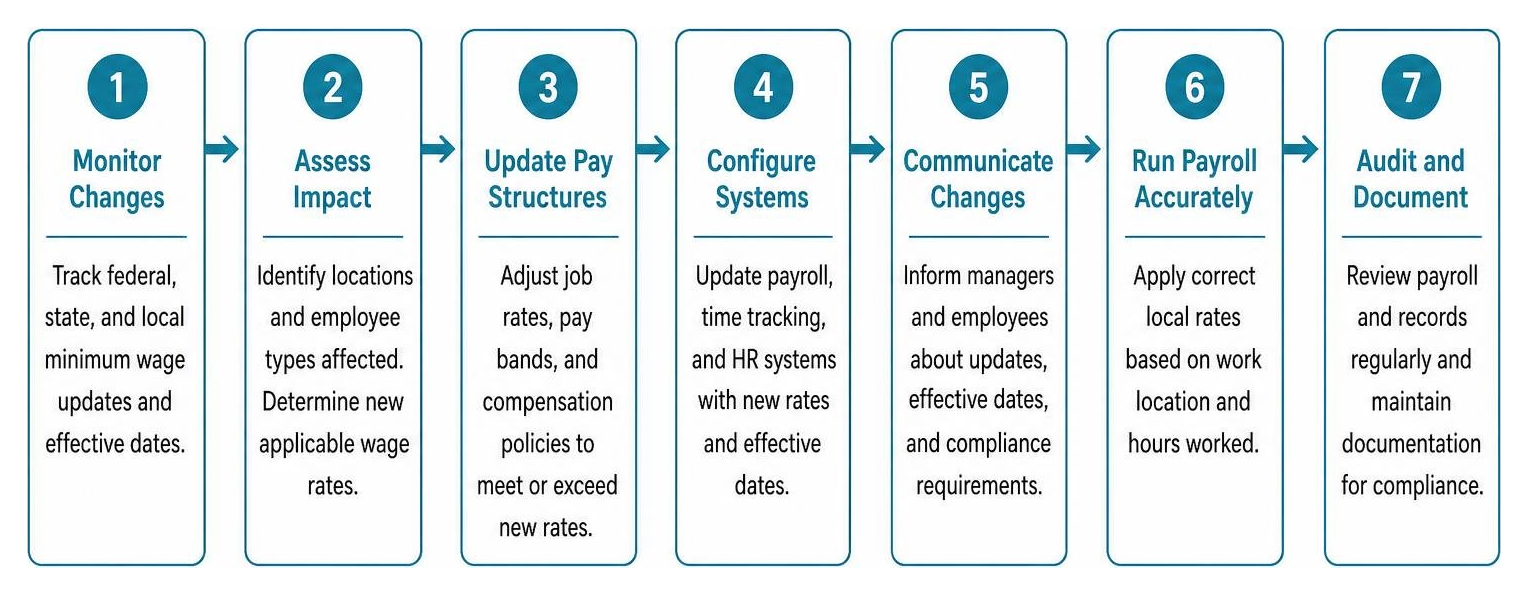
Mobile workforces, including field service technicians, sales representatives, and delivery drivers, present additional payroll tracking complexities. If an employee performs work across multiple city jurisdictions during a single pay period, payroll systems must track and apply local municipal rates for hours worked within those specific boundaries. To mitigate liability, employers should establish clear geographic tracking policies and perform regular wage audits. We routinely help growing enterprises implement localized pay rate schedules to maintain seamless compliance across diverse workforce footprints.
Operational and Payroll Adjustments for Business Compliance
When a minimum wage increase takes effect, businesses must adjust several secondary payroll metrics beyond base hourly pay. In California, non-exempt hourly wage rates directly dictate overtime pay, meal and rest period penalty premiums, paid sick leave calculation rates, and reporting time pay obligations. Furthermore, wage stub accuracy is critical, as minor underpayments can trigger derivative wage statement penalties under California Labor Code rules. Employers must audit their timekeeping software well ahead of rate implementation dates to prevent payroll errors.
Another vital operational area is maintaining the legal salary threshold for exempt administrative, executive, and professional employees. Under California law, exempt employees must earn a monthly salary equivalent to at least two times the statewide minimum wage for full-time employment. As the statewide minimum wage rises, any exempt employee earning near the statutory floor must receive a corresponding salary adjustment to retain exempt status. Reclassifying misclassified workers or adjusting executive salaries requires synchronized guidance from experienced finance and human resources professionals.
Future Minimum Wage Adjustments Scheduled for 2027 and Beyond
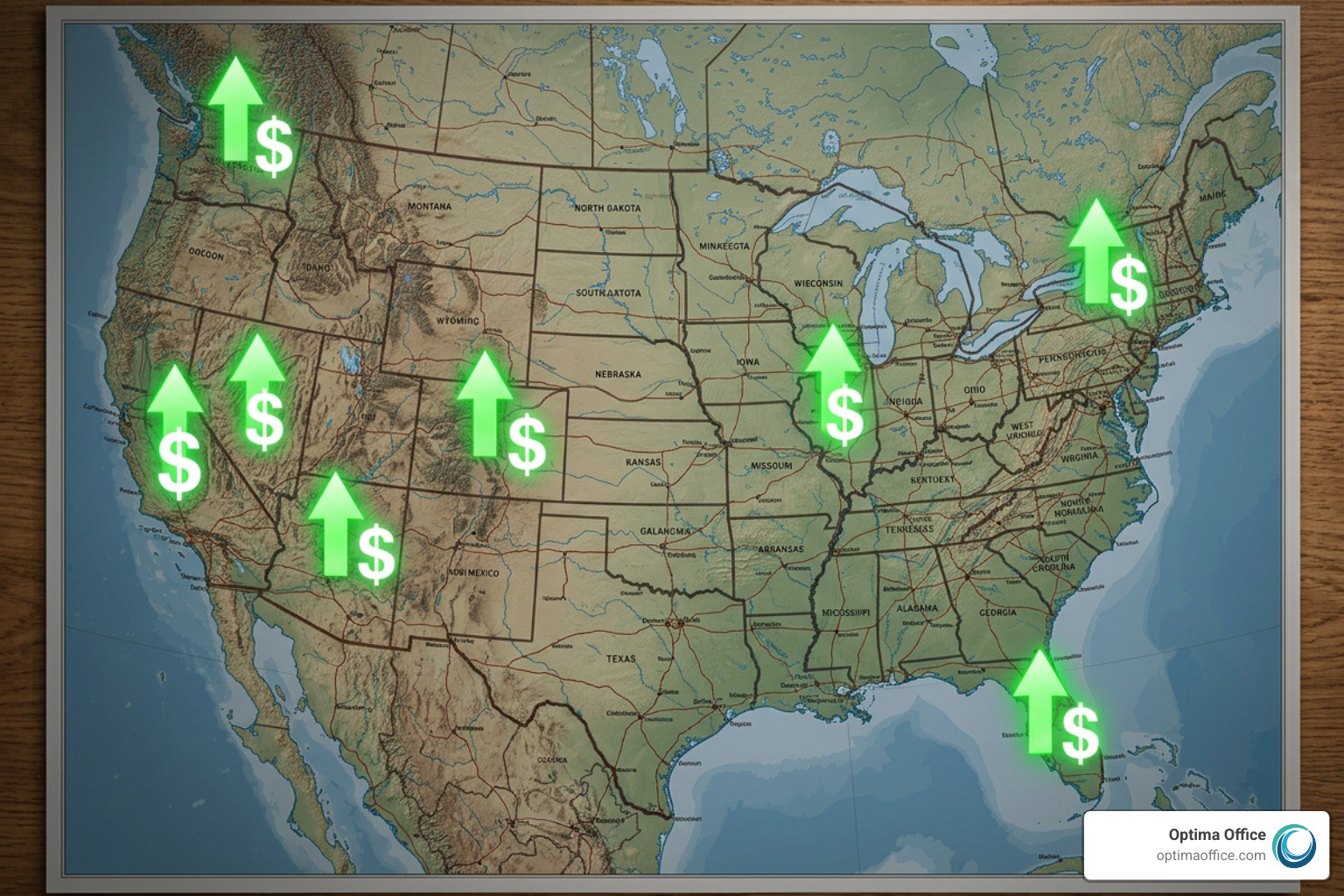
Looking ahead to 2027, state wage floors will continue to rise across multiple regions due to scheduled legislation and mandatory inflation indexing. In California, Governor Gavin Newsom announced that the statewide minimum wage will increase to $17.40 per hour starting January 1, 2027, cementing its status as the highest statewide floor in the nation. Similarly, Connecticut state officials confirmed that their minimum wage will rise to $17.48 per hour on January 1, 2027, representing a 54-cent increase driven by the federal Employment Cost Index.
Other major states are preparing for substantial multi-year statutory wage shifts that will impact regional corporate operational budgets. Michigan will see its statutory minimum wage rise to $13.73 in 2026 and reach $15.00 per hour on January 1, 2027, while gradually phasing down its tipped worker wage credit. In New York, baseline rates across New York City and surrounding downstate counties will transition to annual CPI-W inflation indexing starting in 2027. Proactively projecting these long-term statutory changes allows leadership teams to build resilient multi-year hiring and operating budgets.
Frequently Asked Questions About Minimum Wage Adjustments
How does the federal minimum wage compare to state and local rates?
The federal minimum wage is set at $7.25 per hour and has remained unchanged since 2009. In contrast, 30 states and 68 local jurisdictions enforce higher minimum wage rates based on regional economic conditions and local legislation. When federal, state, and local rates overlap, employers are legally required to pay the highest rate applicable to the employee’s work location. For example, while the federal baseline remains $7.25, California enforces a statewide floor of $16.90, with local cities reaching up to $20.34 per hour.
How do local minimum wage ordinances apply to remote employees?
Local minimum wage ordinances apply based on the physical location where the worker actually performs their job duties. If a remote or hybrid employee works from home in a city with a specific municipal wage ordinance, the employer must pay that local city rate for all hours worked there. The primary headquarters or office location of the company does not dictate the applicable minimum wage floor. Employers should regularly verify remote work addresses and update payroll software to ensure localized rate compliance.
What penalties do employers face for failing to update minimum wages?
Failing to pay required minimum wage updates exposes employers to severe statutory penalties, legal back-pay claims, and administrative fines. In California, underpayment violations can trigger back wages, interest, liquidated damages, and penalties for non-compliant wage stubs. Additionally, employee wage underpayments frequently form the legal foundation for representative lawsuits under the Private Attorneys General Act (PAGA). Proactively auditing timekeeping records and partnering with HR experts prevents costly legal exposure and workforce disputes.
Navigating Minimum Wage Increases with Optima Office
Managing dynamic minimum wage increases, remote worker compliance, and complex payroll structures requires proactive administrative leadership and expert financial planning. A sudden minimum wage increase impacts company-wide labor costs, salary exemption thresholds, overtime premiums, and long-term operating margins. Trying to navigate these evolving statutory shifts without dedicated expertise increases legal exposure and places unnecessary stress on internal administrative staff.
At Optima Office, we empower small and mid-sized businesses by providing integrated fractional CFO, financial controller, bookkeeping, and HR advisory services. Based in San Diego, our team delivers rapid deployment within 3 to 5 days, bringing specialized financial and human resources expertise tailored to your organizational needs. Whether you need to conduct a payroll compliance audit, model future labor cost adjustments, or refine your remote workforce tracking, we provide the leadership required to minimize risk and drive growth.
To explore how our flexible HR and financial advisory services can streamline your compliance strategies and keep your operations thriving, please contact us today to book a discovery call.