


HR department outsourcing is the practice of delegating some or all of your human resources functions, including payroll, compliance, benefits administration, recruiting, and more, to an external provider so your leadership team can focus on running the business instead of managing HR paperwork.
Here’s a quick breakdown of what that looks like in practice:
- What it is: Contracting a third-party specialist to handle HR tasks, either partially or end-to-end
- Who it’s for: Small and mid-sized businesses without dedicated HR leadership or teams stretched beyond capacity
- How it works: You choose which functions to delegate, from payroll processing to full HR management, and the provider delivers those services as an extension of your team
- What it costs: Typically structured as a flat per-employee-per-month (PEPM) fee or a percentage of payroll, often more cost-effective than maintaining in-house staff
- The result: Reduced administrative burden, stronger compliance, and HR expertise without the overhead of a full internal department
Nearly 75% of HR professionals report that their department is already working beyond capacity. For small businesses in particular, especially those without a dedicated HR director, that strain shows up as missed compliance deadlines, inconsistent employee policies, and leadership time lost to issues that should never reach the executive level.
The challenge isn’t a lack of effort. It’s a structural one: HR is a specialized, ever-evolving function that demands full-time attention, deep regulatory knowledge, and systems built for scale. Most growing businesses simply aren’t set up for that, at least not internally.
That’s where outsourcing changes the equation. Whether you’re navigating a sudden HR leadership gap, preparing your business for a sale, or just tired of fielding employment law questions without a clear answer, a well-structured outsourcing arrangement can transform HR from a daily fire drill into a reliable, strategic function.
This guide walks you through exactly how to make that shift, from understanding your options to choosing the right model and putting it into practice.
Understanding the Mechanics of HR Department Outsourcing
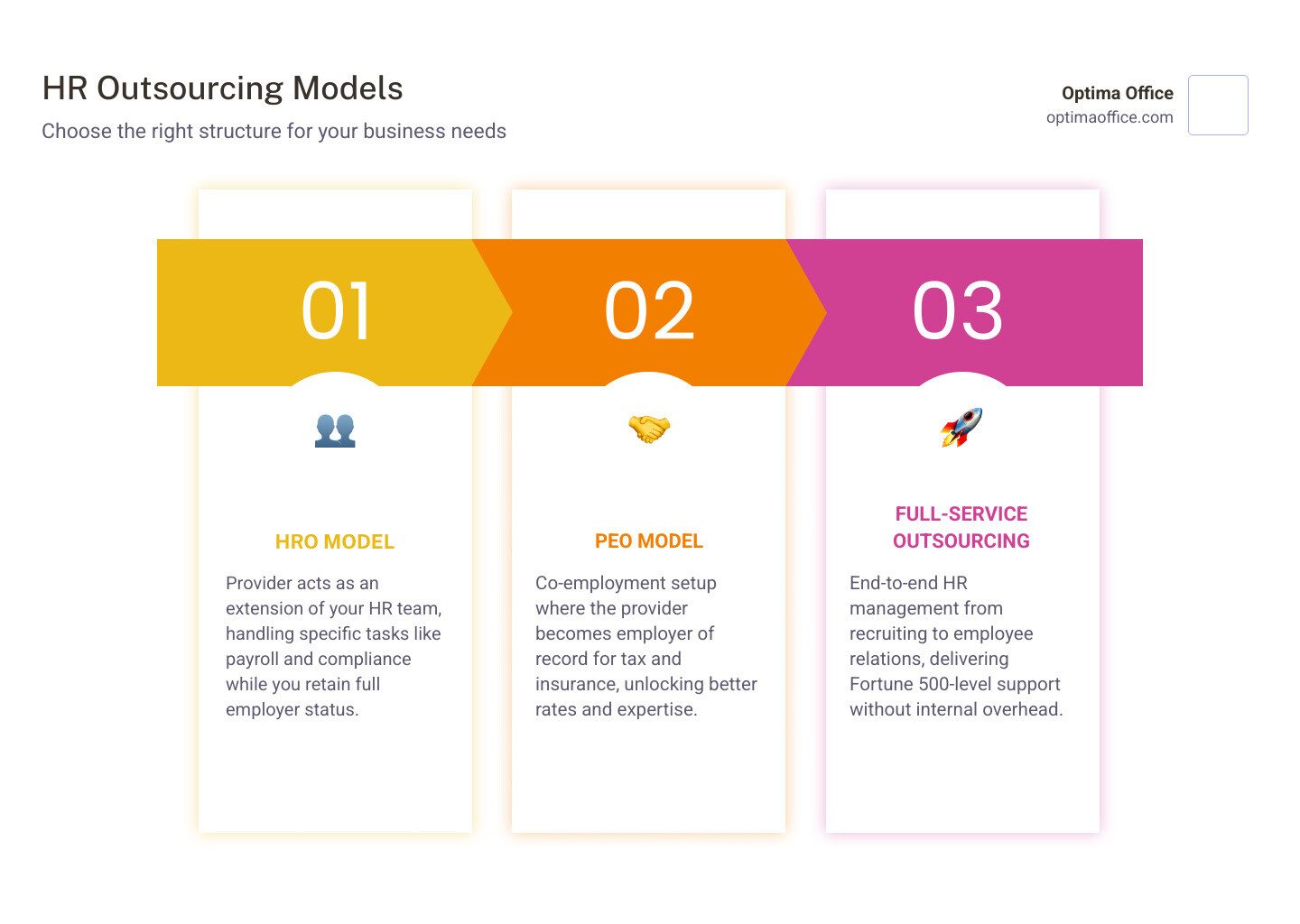
At its core, HR department outsourcing is a strategic partnership. Rather than hiring a full-time, in-house team for every specialized niche, including recruiting, benefits, legal compliance, and payroll, you plug into an existing infrastructure of experts. This model allows small and mid-sized businesses to access the same level of sophisticated HR support as a Fortune 500 company without the massive overhead.
There are several ways to structure this relationship. Some businesses choose a Professional Employer Organization (PEO) model, which involves “co-employment.” In this setup, the provider becomes the employer of record for tax and insurance purposes, often granting the business access to better health insurance rates.
Others prefer a Human Resources Outsourcing (HRO) model, where the provider acts as a highly specialized outsourced HR team that manages specific tasks while the business retains full employer status.
The primary goal is administrative relief. By offloading the “paperwork” side of employment, leadership teams can stop playing amateur lawyer or bookkeeper. Instead, they can focus on culture, strategy, and growth. Whether you need a full-service transition or a fractional expert to handle high-level strategy, the flexibility of modern outsourcing ensures you only pay for what you actually use.
Evaluating the Cost of HR Department Outsourcing
One of the most common questions we hear is, “Is this actually cheaper than hiring someone?” The answer is almost always yes, especially when you factor in the hidden costs of employment, like taxes, benefits, office space, and software licenses.
The cost of outsourcing HR is typically structured in one of two ways: a flat per-employee-per-month (PEPM) fee or a small percentage of your total payroll.
When looking at the ROI, the numbers are compelling. Research from the National Association of Professional Employer Organizations shows that businesses utilizing these services can see an average of a 27% ROI on cost savings alone. Furthermore, outsourcing can lead to a 35% reduction in annual administrative costs.
By converting fixed labor costs into variable expenses, you gain the ability to scale your HR support up or down as your headcount changes, ensuring you never overpay for capacity you don’t need.
Critical Functions to Delegate for Maximum Impact
You don’t have to outsource everything at once. Many businesses start by delegating the most time-consuming or high-risk tasks.
Payroll processing is the most common entry point, as it requires absolute precision and constant updates to tax laws. Beyond payroll, maintaining HR compliance is a critical function to hand off to experts who live and breathe labor law.
Other high-impact areas include:
- Benefits Administration: Managing open enrollment, COBRA, and 401(k) plans
- Strategic Leadership: Utilizing outsourced HR managers and directors to handle high-level policy creation and culture building
- Talent Acquisition: Managing the entire recruitment lifecycle, from job postings to vetting candidates
- Employee Relations: Providing a neutral third party to handle sensitive workplace disputes or performance management issues
Strategic Benefits: Why Businesses Move to an External Model
The shift toward outsourcing isn’t just about saving a few dollars on administrative tasks; it’s about unlocking your business potential by removing the friction that holds back growth.
When an external team handles the complexities of employment, the risk profile of the company changes overnight. You are no longer one missed regulatory update away from a massive fine.
Beyond risk mitigation, there is the benefit of scalability. If your business grows from 20 to 50 employees in a single year, an in-house HR person might become overwhelmed. An outsourced partner simply allocates more resources to your account. This flexibility allows you to remain agile.
Plus, because many outsourcing firms pool their clients together, they can offer Fortune 500-style benefits packages that a small business could never negotiate on its own, making you a much more attractive employer in a competitive talent market.
Signs Your Current HR Department Outsourcing Needs a Refresh
How do you know if your current setup, whether in-house or a legacy provider, is failing you? Often, the signs are subtle until they become expensive.
If your managers are still using manual spreadsheets to track vacation time or if you lack an employee self-service portal, you are losing hours of productivity every week.
Other red flags include:
- Frequent Compliance Scares: Realizing your employee handbook hasn’t been updated in three years
- Stagnant Hiring: Recruitment takes months because no one has time to vet resumes properly
- High Turnover: Employees feel there is no clear path for growth or support
- Leadership Burnout: Your CEO is spending four hours a week dealing with payroll glitches

If these top HR challenges sound familiar, it’s time to move toward a more modern, technology-enabled model that automates the mundane and prioritizes the strategic.
How Outsourcing Ensures Regulatory Compliance
Employment law is a minefield, particularly in regions like Southern California. Between shifting paid leave requirements, changing overtime exemptions, and complex tax regulations, it is nearly impossible for a generalist business owner to stay current.
This is where an HR compliance guide for California becomes your best friend, or better yet, having a partner who implements those rules for you.
Staying updated with the California Department of Industrial Relations is a full-time job in itself.
Outsourced providers conduct regular policy audits to ensure your business remains on the right side of the law. They manage risk by documenting every employee interaction, ensuring fair pay practices, and overseeing workplace safety protocols.
This proactive approach doesn’t just prevent lawsuits; it creates a stable, predictable environment where employees feel secure and the business remains protected.
Navigating the Implementation: A Step-by-Step Guide
Transitioning to an outsourced model requires a clear plan to avoid disrupting your daily operations. The first step is always a thorough needs assessment.
We recommend starting with a professional HR assessment to identify where your current gaps are, whether they are in your technology stack, benefit offerings, or legal documentation.
Once you’ve identified your needs, the process follows a structured path:
- Vendor Selection: Look for a partner that offers a “personality fit” for your culture, not just a software platform.
- Technology Integration: Sync your new HRIS (Human Resources Information System) with your existing accounting and time-tracking tools.
- Communication Plan: Transparently explain the change to your employees so they understand how to access their benefits and whom to contact for help.

| Feature | Full-Service HRO/PEO | Partial/Fractional Outsourcing |
|---|---|---|
| Control | Shared (Co-employment) | High (Client Retains Control) |
| Benefits | Master Plan Access | Client-Specific Plans |
| Best For | Total Admin Removal | Strategic Growth & Flexibility |
| Cost | Percentage of Payroll | Flat Fee or Hourly |
Frequently Asked Questions About HR Outsourcing
Can I Outsource HR if I Already Have an Internal Team?
Absolutely. In fact, many of our clients already have a “department of one,” usually an HR coordinator or manager who is buried in administrative tasks.
In these cases, HR department outsourcing acts as an extension of your team. We can handle high-volume tasks like payroll and benefits administration, freeing up your internal person to focus on culture building and employee engagement.
It’s about partnership, not replacement.
How Does Technology Play a Role in Modern HR Services?
Technology is the backbone of efficient HR. Modern providers use cloud-based platforms that offer self-service for employees, allowing them to download pay stubs, request time off, and update their health benefits from their phones.
For leadership, these systems provide real-time data analytics. You can see turnover trends, labor costs, and recruitment metrics at a glance, allowing for data-driven decisions rather than guesswork.
Future-Proofing Your Growth With Integrated HR Leadership
The ultimate goal of any HR shift should be to drive enterprise growth. At Optima Office, we believe that HR shouldn’t exist in a vacuum.
By integrating your human resources with your financial leadership, you create a powerhouse of data and strategy that moves the needle on profitability.
Our unique approach focuses on rapid team deployment. We can often have a team in place within 3-5 days. Whether you need a fractional CFO to manage your capital or an outsourced HR expert to stabilize your workforce, our proprietary five-point system ensures we match the right expertise and personality to your specific business culture.
By choosing a partner that understands the local landscape of San Diego and Southern California, you gain a competitive edge.
You get the benefits of a full-scale HR and finance department for a fraction of the cost of hiring internally. This allows you to stop worrying about the back office and start focusing on the vision that started your business in the first place.
Summarizing the Outsourcing Advantage
Moving to an outsourced HR model is more than a cost-cutting measure; it is a commitment to professionalizing your organization.
By delegating complex functions like payroll, compliance, and talent acquisition to dedicated experts, you eliminate the administrative bottlenecks that stifle innovation.
The result is a more resilient business, a more satisfied workforce, and a leadership team that is finally free to lead.
Whether you are a startup looking for foundational support or a mid-sized firm ready to scale, the right outsourcing playbook provides the expertise and flexibility needed to thrive in today’s complex regulatory environment.