

GAAP amendments effective 2026 represent one of the most significant waves of financial reporting changes in recent years, requiring immediate attention from business owners, CEOs, and heads of HR. The Financial Accounting Standards Board (FASB) has finalized multiple Accounting Standards Updates (ASUs) that took effect for fiscal years beginning after December 15, 2025, meaning the clock is already running for calendar year-end entities.
For small and mid-sized businesses, non-profits, and professional services firms, getting up to speed quickly is essential to maintain compliance and avoid audit issues. Understanding which amendments apply to your organization is the first step toward a clean financial transition this year.
Here is a quick summary of the most important GAAP amendments effective in 2026:
Key GAAP Amendments Effective for Calendar Year-End Entities in 2026
| ASU | Topic | Effective Date (Fiscal Years Beginning After) |
|---|---|---|
| ASU 2025-12 | Codification Improvements (33 issues) | December 15, 2026 |
| ASU 2025-09 | Hedge Accounting Improvements | December 15, 2026 (public); December 15, 2027 (others) |
| ASU 2025-05 | Credit Losses Practical Expedient | December 15, 2025 (all entities) |
| ASU 2025-06 | Internal-Use Software Capitalization | December 15, 2027 |
| ASU 2026-01 | PIK Dividends on Preferred Stock | December 15, 2026 |
| ASU 2023-09 | Income Tax Disclosures | December 15, 2025 (public entities) |
| ASU 2024-03 | Expense Disaggregation Disclosures | December 15, 2026 (annual, public) |
Several of these changes introduce simplified approaches, like a new practical expedient for estimating credit losses on short-term receivables, while others expand disclosure requirements in areas like income taxes and expense line items. On the technical side, the 2026 FASB GAAP Taxonomies (used for XBRL filings) added 120 new elements, deprecated 564 others, and introduced 90 total Data Quality Committee Rules to improve filing accuracy.
Understanding which amendments apply to your entity type, and when, is the first step toward a clean transition. This guide breaks it all down in plain language so your finance team, whether in-house or outsourced, can act with confidence.
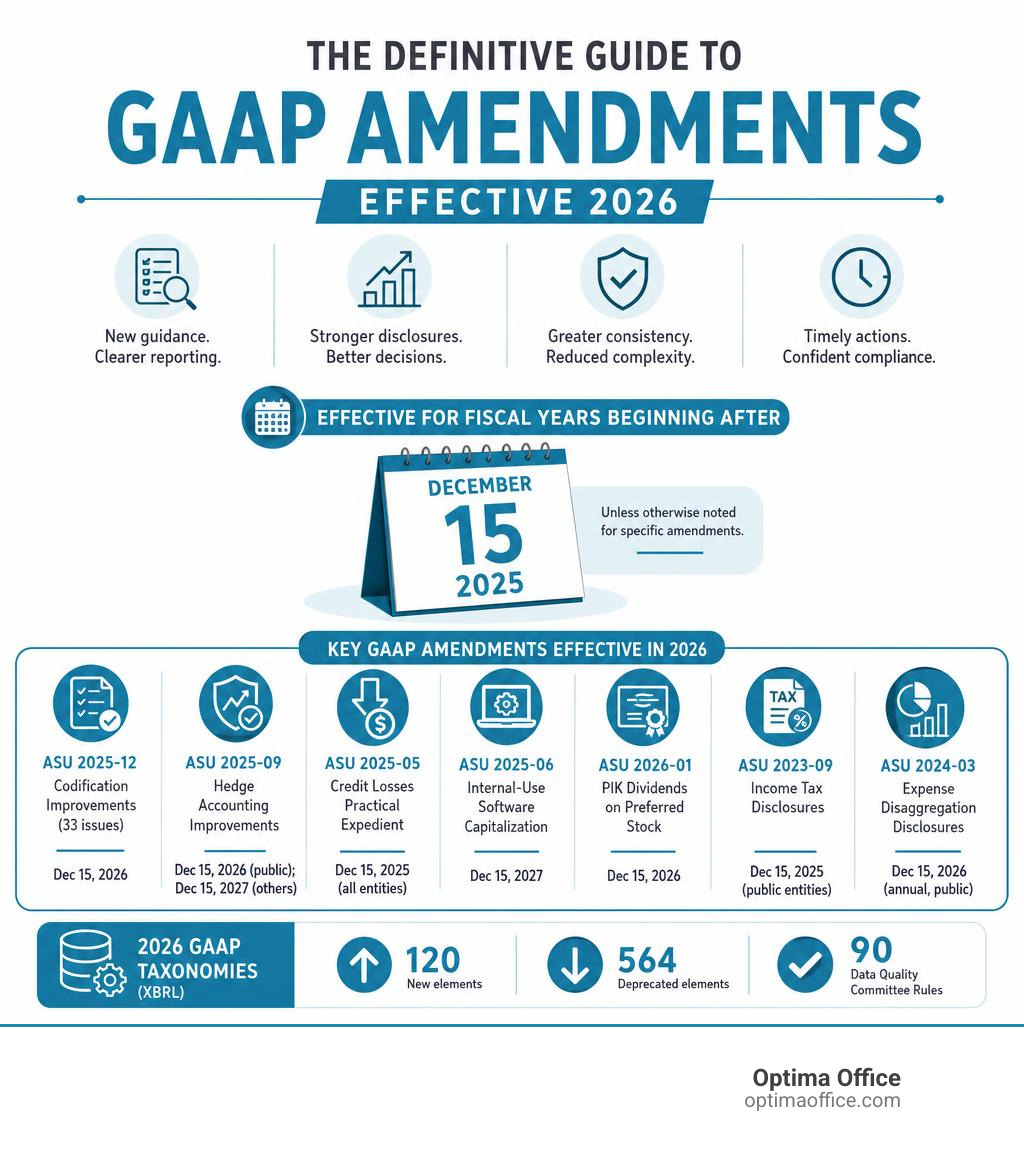
Key GAAP Amendments Effective 2026 for Calendar Year-End Entities
Major ASUs and GAAP Amendments Effective 2026
The FASB has busy years, but the run-up to 2026 has been especially active for standard-setters looking to clean up and clarify existing guidance. A major cornerstone of this effort is ASU 2025-12, which introduces 33 specific codification improvements designed to simplify financial reporting without fundamentally altering underlying accounting models.
This “evergreen” refresh addresses diverse issues, including a crucial clarification on how to calculate diluted earnings per share (EPS) during loss periods by evaluating the combined numerator and denominator effects.
Beyond general clean-up, we are seeing major updates to specialized transactions, such as ASU 2026-01, which clarifies the initial measurement of paid-in-kind (PIK) dividends on equity-classified preferred stock. Previously, U.S. GAAP lacked explicit guidance for these instruments, leading to widespread diversity in practice. Under the new standard, issuers must initially measure PIK dividends using the dividend rate stated directly in the preferred stock agreement.
This change directly impacts both equity balances and EPS calculations, creating a more standardized approach across industries.
Effective Dates and Early Adoption Provisions
Navigating the staggered effective dates of these updates requires careful planning, as requirements often differ based on whether you are a public business entity (PBE) or a private organization. For example, ASU 2025-09 (Hedge Accounting Improvements) is effective for public entities for fiscal years beginning after December 15, 2026, while private entities have until December 15, 2027, to comply.
Most of these standards permit early adoption, allowing proactive management teams to implement simplified frameworks ahead of schedule.
Transition methods also vary, requiring your accounting team to evaluate whether prospective, retrospective, or modified retrospective application is required on an issue-by-issue basis. For instance, the diluted EPS clarification in ASU 2025-12 must be applied retrospectively, which means historical financial statements will need to be adjusted for comparative purposes.
Conversely, standards like ASU 2025-09 must be applied prospectively, only impacting transactions entered into after the date of adoption.
Technical Taxonomy Updates and Structural Changes
New and Deprecated Elements in the 2026 Release
For public companies and entities filing with the SEC, the 2026 FASB GAAP Taxonomies introduce substantial structural modifications. The 2026 release adds 120 new elements to the GAAP Financial Reporting Taxonomy (GRT), 3 to the Shared Reporting Taxonomy (SRT), and 3 to the Employee Benefit Plan Taxonomy (EBPT). These additions are balanced by a massive cleanup effort, deprecating 564 elements in the GRT, 38 in the SRT, and 1 in the EBPT.
Furthermore, 266 elements that were originally deprecated in the 2023 GRT have been completely removed and are no longer available for use. This continuous refinement is part of the FASB’s ongoing Reference Project, which systematically reviews taxonomy elements to ensure they align perfectly with current reporting requirements. Preparers must carefully review their existing XBRL extension lists to ensure they are not using deprecated or removed elements when rolling forward their 2025 templates.
Technical Modifications to Labels, References, and Datatypes
The technical updates for 2026 extend far beyond simply adding and deleting elements; they alter the very metadata that defines how financial data is read by machines. The FASB implemented 3,186 reference modifications, 72 documentation label updates, and 39 standard label modifications in the GRT alone. These changes clarify the exact accounting context for each element, reducing tagging errors and improving data comparability for investors.
A highly technical but critical structural change in the 2026 taxonomy is the introduction of the new limitedToken datatype, which replaces the standard string datatype for seven typed domains. This new datatype restricts the allowed character length to 255 characters, preventing preparers from entering excessively long narrative strings where concise identifiers are expected. This structural constraint enforces validation rules automatically, ensuring cleaner database integration for data users.
Practical Implementation Guidance and Resources
Implementing GAAP Amendments Effective 2026 in Financial Reporting
To assist financial teams with these changes, the FASB and XBRL US have updated their practical compliance resources. The 2026 Data Quality Committee Rules Taxonomy (DQCRT) now includes 30 additional rules, bringing the total to 90 validation rules designed to catch formatting and logic errors before submission. This includes updated checks under Rule 0015, which helps identify inconsistent values within financial statements.
Additionally, the 2026 taxonomy release introduces two new meta model relationship groups: Concept-numerator and Concept-denominator. These 12 total meta model relationships help automated systems identify the mathematical components of complex calculations, such as ratios or per-share metrics, directly from the tagged data. Utilizing these relationships, along with the SEC’s Inline XBRL viewer, allows preparers to verify that their financial disclosures are both human-readable and structurally perfect.
Employee Benefit Plan Reporting and Form 11-K
Reporting for employee benefit plans on SEC Form 11-K has also received dedicated updates in the 2026 release. Preparers should utilize the separate entry point specifically designed for employee benefit plans, which incorporates the us-gaap-ebp prefix elements. The 2026 EBPT includes 3 new elements, 1 deprecated element, and 10 documentation label modifications to better reflect current regulatory requirements.
When tagging these filings, it is important to remember that the SRT role should be used as the default linkrole for extensible enumeration domain-member relationships. The 2026 updates also refine the 9611 relationship groups, making it easier to present disaggregated plan assets and obligations. These technical adjustments ensure that employee benefit plan filings remain compliant with the latest SEC modeling guidelines.

Key Simplifications and Practical Expedients
Credit Losses and Accounts Receivable (ASU 2025-05)
One of the most welcome simplifications for businesses of all sizes is ASU 2025-05, which introduces a practical expedient for estimating credit losses under the CECL (Current Expected Credit Losses) model. This standard allows entities to assume that historical and current conditions remain unchanged at the balance sheet date when evaluating short-term receivables and contract assets. This eliminates the need for complex macroeconomic forecasting for standard trade receivables.
For non-public entities, the standard goes a step further by permitting the use of post-balance-sheet collection data when estimating credit losses. If a private company collects a receivable shortly after the close of the period, they can use that real-world collection data to support their credit loss valuation. This practical expedient significantly reduces compliance costs and reporting complexity for small and mid-sized businesses.
Internal-Use Software and Capitalization (ASU 2025-06)
Technology and software development accounting are also getting a major modern facelift with ASU 2025-06. The standard completely eliminates the outdated, stage-based capitalization model for internal-use software, which relied on rigid definitions of “preliminary,” “development,” and “post-implementation” phases. Instead, the FASB has introduced a principles-based capitalization model that aligns better with modern, agile software development practices.
Under this new framework, software development costs are capitalized once management authorizes funding and it is probable that the project will be completed as planned. This principles-based approach requires significant judgment but removes the administrative burden of tracking timesheets against arbitrary project stages. Additionally, the standard requires entities to apply standard Property, Plant, and Equipment disclosure rules to capitalized software, increasing overall balance sheet transparency.
Ongoing Monitoring and Transition Considerations
Post-December 2025 Pronouncements and Future Standards
While we focus heavily on the standards taking effect right now, proactive financial leaders must keep an eye on the horizon. The FASB continues to deliberate on several major projects, including ASU 2025-10 (Government Grants) and ASU 2025-11 (Interim Reporting Improvements). Standards finalized after December 1, 2025, are typically placed in the FASB’s Development Taxonomy, giving preparers a preview of future tagging requirements before they are officially integrated into the main release.
Furthermore, the newly published Environmental Credit Standard (issued on May 19) is set to establish the first authoritative GAAP rules for environmental credits and obligations. While not mandatory for PBEs until fiscal years beginning after December 15, 2027, early adoption is permitted. Keeping a close watch on these developments ensures your team can build robust, forward-looking accounting policies that prevent year-end compliance bottlenecks.
Frequently Asked Questions about GAAP Amendments
What are the most significant GAAP amendments effective in 2026?
The most significant updates for 2026 include ASU 2025-12 (Codification Improvements), ASU 2025-05 (Credit Losses Practical Expedient), ASU 2025-06 (Internal-Use Software Capitalization), ASU 2025-09 (Hedge Accounting Improvements), and ASU 2026-01 (PIK Dividends on Preferred Stock). These standards collectively aim to simplify accounting treatments, reduce reporting diversity, and modernize disclosure frameworks.
How do the 2026 taxonomy updates affect XBRL filing?
The 2026 FASB GAAP Taxonomies introduce 120 new elements, deprecate 564 elements, and completely remove 266 elements that were deprecated in 2023. Additionally, the update includes 30 new Data Quality Committee validation rules (bringing the total to 90) and introduces new meta model relationships to help automated systems parse complex calculations.
What is the new limitedToken datatype in the 2026 taxonomy?
The limitedToken datatype is a structural update applied to seven typed domains in the 2026 taxonomy, replacing the standard string datatype. It enforces a strict limit of 255 characters on narrative inputs, preventing preparers from entering overly long or unstructured text where short, standardized identifiers are required.
Navigating 2026 Compliance with Expert Financial Leadership
Staying compliant with the rapid pace of GAAP amendments effective 2026 requires dedicated technical expertise that many small and mid-sized businesses struggle to maintain in-house. Between implementing principles-based software capitalization, applying new CECL practical expedients, and managing complex transition disclosures, the burden on your internal accounting staff can quickly become overwhelming.
At Optima Office, we solve this problem by providing highly customized, fractional financial leadership. Based in San Diego and serving businesses across Southern California, we deliver fractional CFO, controller, bookkeeping, and HR advisory services tailored to your specific operational needs. Our unique value proposition is our rapid team deployment, matching your business with the perfect financial or HR professionals within just 3 to 5 days.
Our proprietary five-point system ensures an exact match for both technical skill and cultural fit, giving your business the benefits of a complete, institutional-grade finance department at a fraction of the cost of full-time internal hires. Whether you need to navigate these complex 2026 GAAP transitions, prepare for an upcoming audit, or restructure your internal controls, we are here to help you maximize profits, minimize risk, and drive sustainable growth.
Ready to secure your financial compliance and streamline your operations? Contact Optima Office today to schedule a consultation with our expert team.
More Resources
- GAAP for Nonprofits
- Accounting Tips You Can Prepare to Implement Year Round
- Top 5 Trends in Accounting for 2024
- 5 Accounting Ideas to Prepare Yourself for Uncertain Times
- The Ultimate Audit Readiness Checklist from Chaos to Compliance
- Optima Office Outsourced Accounting Services