
Maintaining financial integrity is essential for organizations dedicated to public service. In Southern California, bookkeeping services for nonprofits in San Diego provide the specialized expertise needed to navigate fund accounting, grant reporting, and strict regulatory requirements. By establishing reliable financial systems, nonprofits can protect their tax-exempt status and build lasting trust with donors, board members, and the community.
For organizations that need stronger nonprofit-specific support, Optima Office’s nonprofit accounting services can help create the structure needed for clean reporting and better financial oversight.
Why San Diego Nonprofits Need Specialized Bookkeeping Support

Bookkeeping services for nonprofits in San Diego are fundamentally different from standard small business accounting. Choosing the wrong provider can lead to missed grant requirements, compliance failures, and board credibility issues.
Here’s a quick snapshot of what San Diego nonprofits typically need from a bookkeeping provider:
| Service Area | What It Covers |
|---|---|
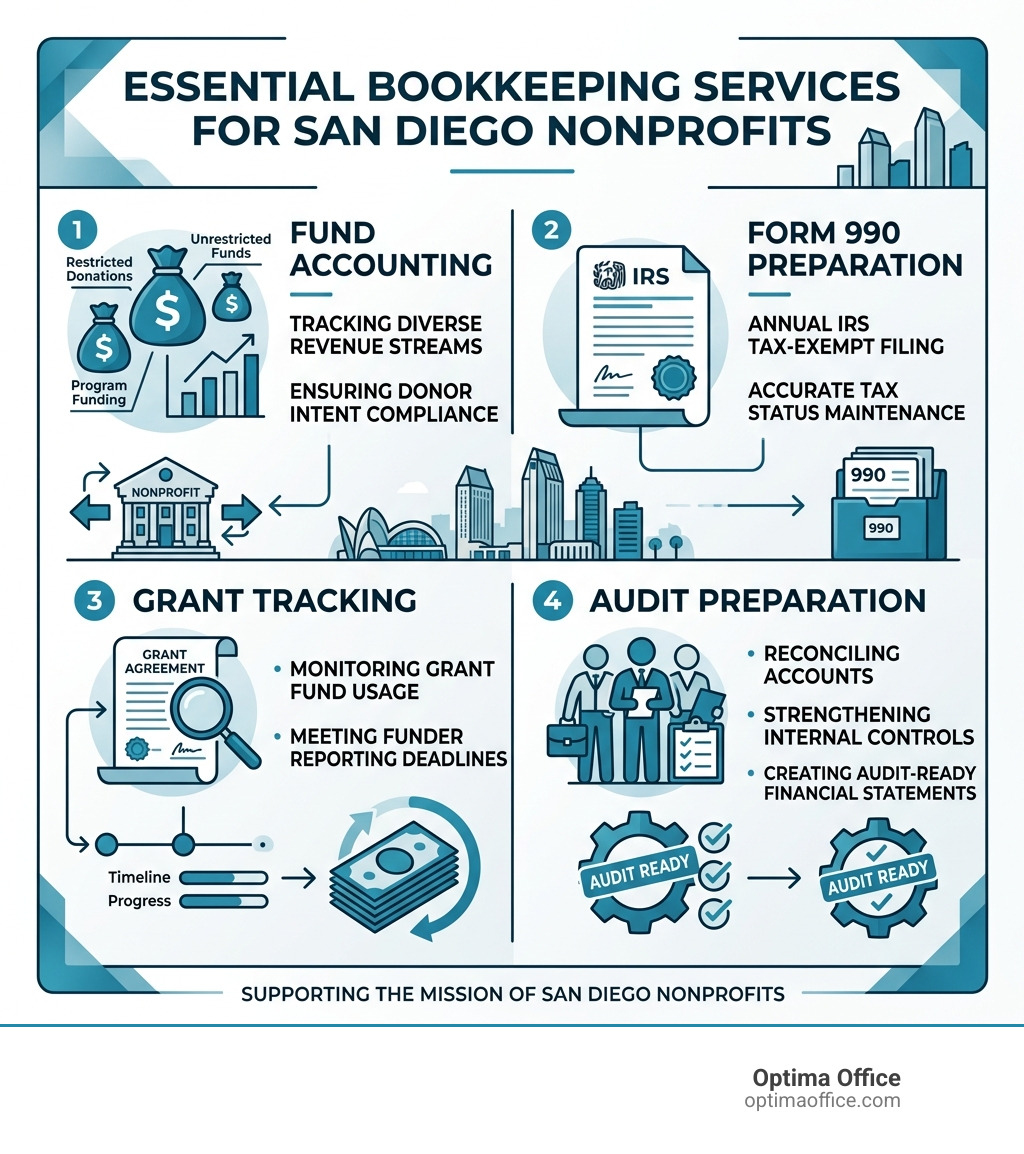
| Fund accounting | Tracking restricted vs. unrestricted donations separately |
| Grant management | Monitoring spend against funder requirements and deadlines |
| Form 990 preparation | Annual IRS filing required to maintain tax-exempt status |
| Treasurer reports | Monthly financial summaries for board oversight |
| Audit readiness | Reconciliations, internal controls, and documentation |
| Payroll coordination | Functional expense allocation across programs and admin |
| GAAP-compliant reporting | Statements of Financial Position and Activities |
San Diego is home to a dense and active nonprofit sector serving millions of residents, from social services and veterans organizations to arts institutions and environmental advocacy groups. These organizations depend on accurate, transparent financials not just for legal compliance, but to attract donors, secure grants, and maintain the trust of their communities.
The challenge is real. Nonprofit bookkeeping requires a specialized skill set that most general accounting firms do not have. Managing donor intent, restricted revenue, unrelated business income, and federal grant compliance at the same time demands expertise that goes well beyond balancing a general ledger.
Many nonprofit leaders spend hours each week trying to reconcile books, chase down expense reports, or prepare board presentations. That time should be spent on the mission.
That is where purpose-built bookkeeping services make the difference.
Why Bookkeeping Services for Nonprofits in San Diego Differ from For-Profit Accounting
Nonprofit bookkeeping is not just about tracking profit and loss. In the for-profit world, the bottom line is often the main focus. In the nonprofit world, the mission line matters just as much.
This shift requires a completely different accounting structure known as fund accounting.

Unlike a standard business where revenue generally belongs to the owners or shareholders, a nonprofit’s revenue often comes with restrictions. These restrictions reflect donor intent. Every dollar must be tracked carefully to ensure it is used exactly as the donor intended.
If a donor gives $10,000 specifically for a youth literacy program in Chula Vista, that money cannot be used to pay the electric bill for the main office in Mission Valley.
Adhering to nonprofit accounting standards helps make these distinctions clear. Transparency is not just a buzzword. It is a requirement for board reporting, donor confidence, and public trust.
Tracking Restricted and Unrestricted Revenue
The core of nonprofit accounting lies in distinguishing between restricted and unrestricted revenue. Unrestricted funds are the lifeblood of an organization because they can be used for general operating expenses.
Restricted funds, however, are governed by donor intent or specific grant requirements. These funds must be tracked separately and released properly as they are spent on designated programs.
Strong revenue recognition policies help organizations know when to record a pledge and how to track the release of restrictions. Without this level of detail, financial statements may not accurately reflect the organization’s true financial health or its remaining obligations to donors.
The Importance of Net Asset Classification
In the nonprofit sector, organizations do not look at equity the same way a for-profit business does. They look at net assets.
Net assets are classified based on the presence or absence of donor-imposed restrictions. The Statement of Activities and the Statement of Financial Position should provide a clear picture of these assets.
Proper asset tracking is essential because it shows how much money is actually available for use. A nonprofit may have cash in the bank, but that does not always mean the cash is available for general operations.
This classification is a cornerstone of professional nonprofit accounting and bookkeeping. It helps board members understand the difference between available cash and restricted funds.
Essential Bookkeeping Services San Diego Nonprofits Require
San Diego nonprofits face a unique set of administrative challenges. From managing unpredictable grant cycles to handling payroll in a high-cost region, the back office needs to be well organized.
This is why many organizations turn to bookkeeping services that understand the nuances of the nonprofit sector.
A comprehensive service package should include more than data entry. It should include expense allocation across cost centers so every dollar spent is categorized correctly for program, management, or fundraising purposes.
| Internal Bookkeeping | Outsourced Nonprofit Bookkeeping |
|---|---|
| Higher overhead (benefits/taxes) | Fixed or scalable fractional cost |
| Key person risk (if they leave, data goes) | Team-based approach with no downtime |
| Generalist knowledge | Specialized nonprofit/fund accounting expertise |
| Limited internal controls | Built-in segregation of duties |
| Manual reporting | Automated, cloud-based transparency |
Managing Grant Compliance and Reporting
For many local organizations, federal funding is a major revenue source. However, that funding comes with detailed reporting requirements and strict compliance expectations.
Grant compliance requires rigorous spending tracking and detailed documentation. Nonprofits need to show that funds were used properly and within the approved scope.
Clear financials can be transformative. When a nonprofit has a solid financial foundation, leadership can focus more confidently on the mission instead of constantly reacting to reporting issues.
Payroll and Functional Expense Tracking
Payroll is often the largest expense for a nonprofit. Beyond issuing paychecks, organizations must manage payroll tax filings, employee benefits, and accurate allocation of staff time.
Functional expense tracking is especially important. Donors and watchdog groups want to see how much funding goes toward program costs compared with administrative or fundraising costs.
Accurate allocation helps the Form 990 reflect the true impact of the organization’s work. It also gives leadership and the board a clearer view of how staff time and resources support specific programs.
Navigating IRS Compliance and Form 990 Preparation
Maintaining tax-exempt status is one of the most important responsibilities for any 501(c)(3) organization. The annual Form 990 is more than a tax filing. It is also a public document that potential donors and grant makers may use to evaluate the organization.
Late filings, missing information, or inaccurate reporting can create risk. Good bookkeeping helps reduce that risk by keeping records current, organized, and ready for review.
Maintaining 501(c)(3) Tax-Exempt Status
To maintain tax-exempt status, nonprofits must follow strict reporting and operational requirements. This includes filing the correct version of Form 990, whether that is Form 990-N, Form 990-EZ, or the full Form 990, based on the organization’s gross receipts and assets.
Nonprofits also need to understand unrelated business income. If a nonprofit operates a side business that is not directly related to its mission, it may owe taxes on that income.
Clean bookkeeping helps organizations track these details throughout the year instead of trying to untangle them at filing time.
Preparing for Annual Financial Reviews
Good bookkeeping is not just about the past. It also prepares the organization for future reviews, audits, and board reporting.
This includes implementing internal controls to prevent fraud and safeguard assets. Approval workflows, document retention policies, and clean digital records all support stronger review readiness.
Using a knowledgeable bookkeeping partner helps ensure digital records are clean, reconciled, and ready for inspection when needed.

The Strategic Role of Bookkeeping in Audit Readiness
An audit should not feel like a crisis. If bookkeeping is handled correctly throughout the year, the audit process becomes a routine verification instead of a frantic search for missing receipts.
Audit preparation involves maintaining a clean trial balance, performing regular monthly reconciliations, and keeping organized documentation. The goal is to maintain a strong audit trail that shows every transaction was authorized and recorded correctly.
For organizations that need broader support before an audit, outsourced accounting services can help strengthen financial reporting, reconciliations, and documentation.
Strengthening Internal Controls to Prevent Fraud
Unfortunately, nonprofits can be vulnerable to internal fraud when they do not have enough staff to maintain proper segregation of duties.
A strong outsourced bookkeeping structure can help create a third-party layer of oversight. By separating the person who approves a bill from the person who pays it, organizations create checks and balances that protect their reputation and assets.
These controls are not about slowing the team down. They are about protecting the organization’s mission.
Streamlining the Audit Process
When auditors arrive, they want to see organized financial statements, board minutes, grant agreements, reconciliations, and supporting documentation.
The goal is to make the organization audit-ready every month. By collaborating closely with the CPA and handling the year-end closing process, nonprofit bookkeeping support can reduce the time and billable hours auditors need to spend on the books.
Cleaner books create a smoother audit. A smoother audit creates more confidence with leadership, donors, and the board.
Maximizing Mission Impact With Outsourced Bookkeeping Services for Nonprofits in San Diego
Outsourcing is not just about saving money. It is about reallocating resources to where they matter most.
In a city like San Diego, every dollar counts. Reducing back-office strain can help fund programs, support staff, and expand community impact.
By using fractional talent, nonprofits can access controller or CFO-level expertise without the cost of a full-time executive. This scalability is vital for organizations that experience seasonal funding fluctuations or rapid growth.
If your nonprofit needs higher-level financial oversight, Optima Office’s financial controller services can help support reporting, controls, and financial review.
Reducing Administrative Overhead
Every dollar spent on unnecessary back-office inefficiency is a dollar not spent on the mission. Budget optimization starts with understanding true operational efficiency.
Nonprofit leaders need to understand their overhead ratio, including the percentage of the budget spent on administration compared with programs. From there, the organization can find ways to streamline the process without sacrificing compliance.
The goal is not to strip the organization down. The goal is to make the back office stronger, cleaner, and more efficient.
Accessing Specialized Nonprofit Expertise
When you partner with a team that understands nonprofit bookkeeping, you are not just getting data entry. You are getting support from professionals who understand the San Diego philanthropic landscape and the financial requirements that come with mission-driven work.
Whether the organization needs CFO-level advisory for a capital campaign or controller oversight for a complex federal grant, specialized support brings the regulatory knowledge needed to stay safe and successful.
For nonprofits that need strategic planning, capital campaign support, or higher-level financial guidance, Optima Office’s fractional CFO services can help leadership connect financial management to long-term sustainability.
Frequently Asked Questions About Nonprofit Bookkeeping
What Qualifications Should I Look for in Bookkeeping Services for Nonprofits in San Diego?
Prioritize providers with deep experience in fund accounting and nonprofit compliance. Look for a team that understands IRS Form 990 preparation, restricted net assets, board reporting, and the local San Diego nonprofit environment.
A general bookkeeper may not understand the nuances of restricted net assets. That can lead to reporting errors and compliance issues.
How Do Bookkeeping Services for Nonprofits in San Diego Help With Grant Management?
Specialized bookkeeping services help by setting up specific classes, projects, or funds in the accounting system to track grant funding. This allows for real-time compliance monitoring and funder-specific reporting.
This level of detail is often required to secure future funding. It also helps leadership understand whether grant spending is staying aligned with funder requirements.
Which Software Is Best for San Diego Nonprofit Bookkeeping Services?
QuickBooks Online is commonly used by small to mid-sized nonprofits because it is flexible and cloud-based. Larger or more complex organizations may need more advanced fund accounting software, such as Sage Intacct.
The key is not just choosing software. The key is making sure the system supports real-time reporting, fund tracking, board visibility, and compliance.
Empowering San Diego’s Mission-Driven Community
Optima Office provides fractional CFO, controller, accounting, and bookkeeping services tailored to the unique needs of San Diego nonprofits. By deploying expert teams quickly, nonprofits can access the financial leadership needed to maintain compliance, satisfy donors, and support long-term sustainability.
A stronger financial function gives nonprofit leaders more room to focus on community impact instead of complex spreadsheets. Clean books, clear reports, and reliable systems help protect the mission behind the numbers.
To learn more about how specialized financial management can support your organization, explore Optima Office’s bookkeeping services.