


Bookkeeping for lawyers is essential for ensuring legal and financial compliance. For solo practitioners and small to mid-sized law firms in competitive markets like San Diego, effective bookkeeping is not just about balancing the books. It is the foundation of ethical practice, financial stability, and sustainable growth.
If your firm needs cleaner records and stronger financial support, Optima Office’s bookkeeping services can help keep your books organized, compliant, and ready for better decision-making.
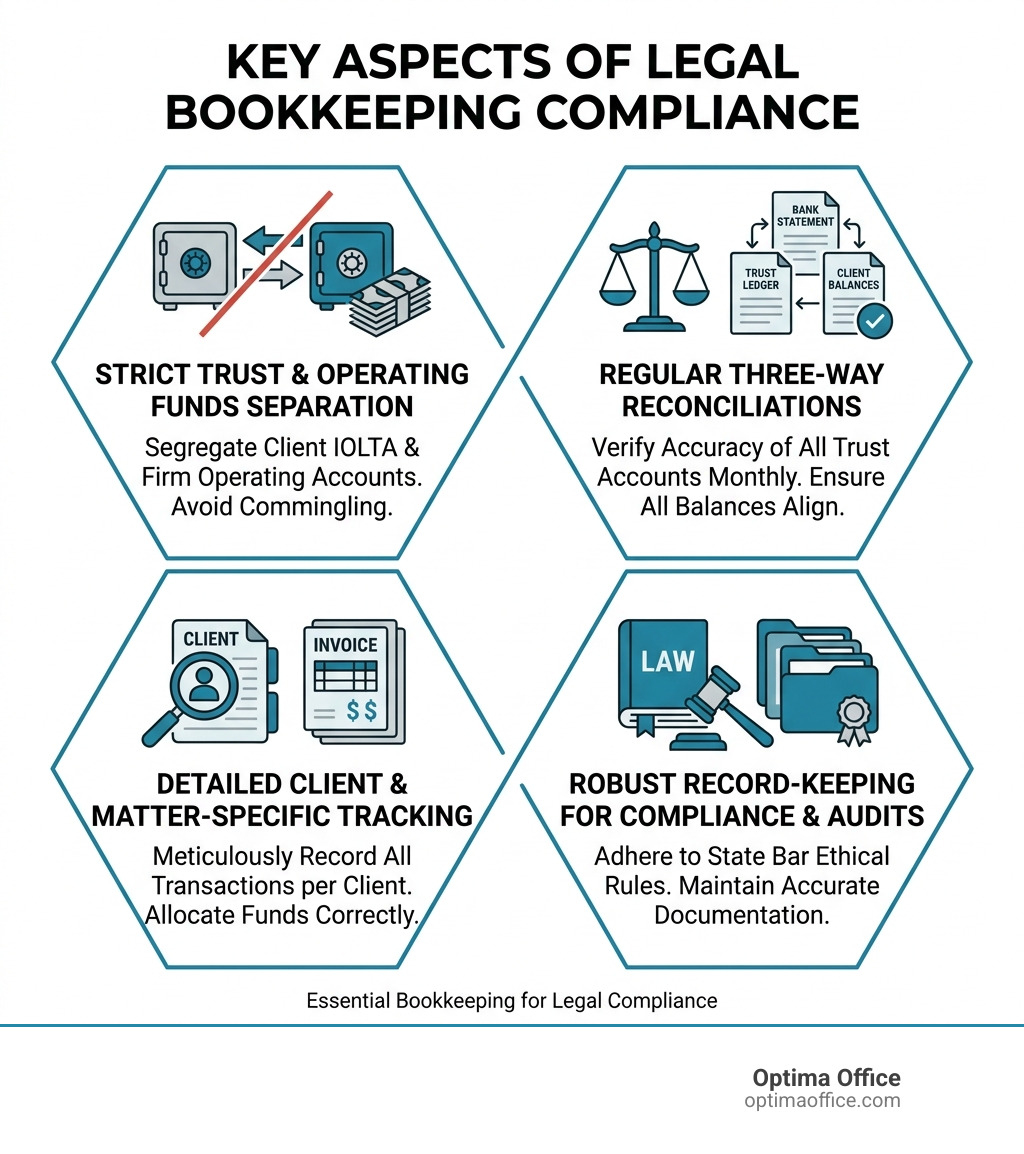
Outsourced bookkeeping for lawyers helps law firms:
- Maintain strict separation between client Interest on Lawyers Trust Account funds and operating funds.
- Perform regular three-way reconciliations of trust accounts to verify accuracy across bank statements, ledgers, and client balances.
- Track client- and matter-specific transactions carefully to prevent commingling and ensure proper allocation of funds.
- Follow state bar ethical rules and recordkeeping requirements.
- Provide accurate documentation for bar audits, tax purposes, and strategic financial reporting.
Attorneys dedicate their careers to navigating complex legal landscapes for their clients, yet many are not equipped to manage the equally complex financial demands of their own practices. This can lead to missed opportunities, compliance risks, and unnecessary stress.
The firms with strong financial management practices are better positioned to collect what they bill, understand profitability, and avoid the kinds of problems that keep law firm owners awake at night. These include slow book closes, unclear profitability, delayed invoicing, and the threat of bar sanctions.
This guide explains the specialized world of legal bookkeeping, including strategies to support compliance, improve profitability, and provide the financial clarity your firm needs to thrive.
Understanding the Foundations of Bookkeeping for Lawyers
At its core, bookkeeping for lawyers is a specialized discipline that goes far beyond simple income and expense tracking. While a retail store or consulting firm may focus primarily on cash flow and profit margins, a law firm must operate under strict fiduciary duties. This means the firm is not just managing its own money. It is often temporarily responsible for client funds.
The most critical component of this foundation is trust accounting. When a client provides a retainer or a settlement check is received, that money does not belong to the firm yet. It must be held in a dedicated account, often an Interest on Lawyers Trust Account.
In California, the rules around these accounts are strict. Interest generated on these accounts is typically remitted to the state bar to fund legal aid for those who cannot afford it, rather than being kept by the lawyer or client.
Effective legal bookkeeping requires a financial system that provides clear visibility into segregated funds. Without that structure, it becomes dangerously easy to lose track of which dollar belongs to which client. That can lead to one of the most serious issues in legal practice: commingling.

Key Differences Between Bookkeeping and Accounting for Lawyers
Many people use the terms “bookkeeping” and “accounting” interchangeably, but in the legal world, they serve two distinct but connected functions.
Bookkeeping is the daily process of recording transactions. It involves data entry, classifying expenses, and ensuring that every dollar moving in or out of the firm is documented. For a law firm, this includes logging billable hours, recording client costs, and updating trust ledgers.
Accounting is the strategic analysis of that data. An accountant takes the records provided by the bookkeeper to interpret financial health, prepare tax returns, and offer higher-level guidance on profitability.
The simplest way to understand the difference is this: bookkeeping tells you what happened. Accounting, controller support, or CFO-level guidance helps explain what it means and how to plan for the future.
For a growing firm in Southern California, having the right bookkeeping and accounting structure helps support daily compliance and long-term planning. If your firm needs broader finance support beyond bookkeeping, outsourced accounting services can help strengthen the full financial function.
Why Specialized Bookkeeping for Lawyers Is Essential for Compliance
Legal professionals are held to a higher standard when managing client funds. Because of that responsibility, a standard off-the-shelf bookkeeping approach is rarely enough.
State Bar audits are not just theoretical. They can become a reality for firms that show signs of financial mismanagement or poor documentation. Proper bookkeeping for lawyers serves as a primary defense by providing a clear audit trail that shows client funds were handled correctly.
Specialized bookkeeping also supports ethical obligations to clients. Clean records help prove that client funds were not used to cover firm operating expenses, that trust accounts were reconciled properly, and that earned fees were transferred correctly.
Beyond compliance, strong bookkeeping helps protect the firm’s reputation. Integrity in financial management is one of the most important foundations of a trustworthy legal practice.
Essential Financial Terms and Compliance Procedures
To manage your firm’s finances effectively, you need to understand the language of legal accounting. These terms are not just jargon. They represent the specific procedures that help keep your firm compliant with California state regulations and ethical requirements.
Mastering Three-Way Reconciliation
The gold standard of trust accounting is the three-way reconciliation. Unlike a standard business bank reconciliation, which compares your bank statement to your checkbook or accounting records, a three-way reconciliation adds a third layer.
You must ensure the following three numbers match every month:
- The bank balance: The actual cash shown on your Interest on Lawyers Trust Account bank statement.
- The trust ledger: The total balance of all trust funds as recorded in your firm’s general ledger.
- The client ledgers: The sum of all individual client balances.
If these three numbers do not align, you have a reconciliation discrepancy. This could be caused by a bank error, a data-entry mistake, or an unauthorized withdrawal.
Regular bookkeeping services can help prioritize this process so errors are caught before they become ethical violations.
Managing IOLTA and Client Trust Accounts
Managing an Interest on Lawyers Trust Account requires a zero-tolerance approach to errors. These accounts are designed to hold small amounts of client funds or funds held for a short period.
Because it is impractical to calculate interest for each individual client in certain scenarios, the interest is pooled and sent to the State Bar.
The primary rule is to prevent commingling. You should never deposit firm revenue into a trust account, and you should never pay firm bills, such as rent or payroll, directly from a trust account.
When a retainer is earned, meaning you have performed the work and sent an invoice, the funds must be transferred from the trust account to your operating account promptly. Leaving earned fees in a trust account for too long can also create a commingling issue because your firm’s money is being mixed with client money.
Best Practices for Law Firm Financial Management
Efficiency in a law firm is often measured by the realization rate, which is the percentage of billable time that actually turns into paid revenue. On average, lawyers only collect a portion of what they bill. Proper bookkeeping can help close that gap by improving invoicing, collections, and matter-level tracking.
Streamlining Invoicing and Collections
The longer you wait to bill a client, the less likely you are to get paid in full. Best practices suggest that invoicing should happen weekly or, at minimum, monthly.
Modern bookkeeping for lawyers uses automated billing systems to send professional invoices and payment reminders. This helps keep billing consistent and reduces the risk of revenue slipping through the cracks.
By integrating time-tracking software with your accounting system, you reduce the money leakage that happens when attorneys forget to log small tasks. Even billing in 0.1-hour increments can significantly affect your bottom line when tracked accurately.
If your firm is struggling with collections, a more structured bookkeeping process can help create a stronger follow-up system.
Accurate Expense Tracking and Matter-Based Accounting
Law firms often incur significant advanced client costs, such as court filing fees, expert witness fees, and travel expenses. These are not always firm expenses. They may be assets or receivables that should be reimbursed by the client.
Matter-based accounting allows you to treat each case as its own cost center. This ensures that when a case settles or concludes, you have a precise record of every dollar spent on that matter.
Failing to track these costs accurately means the firm may absorb expenses that should have been reimbursed. Over time, that can directly hurt profitability.
For law firms and other advisory businesses, professional services accounting can help connect bookkeeping, matter tracking, and financial reporting to the way the business actually operates.
Avoiding Common Bookkeeping Pitfalls and Ethical Violations
Even well-intentioned attorneys can fall into financial traps. Many errors stem from a lack of time, weak processes, or a lack of specialized bookkeeping knowledge.
A single bookkeeping mistake can create a chain reaction of compliance issues, especially when client trust funds are involved.
Preventing Negative Trust Balances
A negative balance in a client’s trust ledger is a major red flag. It implies that one client’s money may have been used to pay another client’s expenses.
This often happens when a firm cuts a check for a settlement before the incoming funds have actually cleared the bank. It can also happen when trust records are not updated in real time.
To prevent this, law firms should use software with built-in guardrails that prevent transactions that would create a negative balance. Real-time tracking is essential. You cannot rely on a gut feeling or a bank balance that may not show pending transactions.
Maintaining Proper Record Retention
In California, the general rule for trust account record retention is five years after the conclusion of the representation.
This includes:
- Bank statements and canceled checks
- Client ledgers and retainer agreements
- Records of all disbursements and receipts
Maintaining these records in a secure digital format with redundant backups is no longer optional. It is part of audit readiness.
If the State Bar requests documentation, your firm needs to be able to produce records quickly and confidently.

Scaling Your Practice With Specialized Financial Support
As your firm grows from a solo practice to a multi-attorney firm, the complexity of your books increases. More attorneys, more matters, more client funds, and more expenses all create a greater need for financial structure.
This is where fractional leadership can become valuable.
The Role of Fractional Leadership in Growth
A fractional CFO or controller provides higher-level financial oversight without the cost of a full-time executive. At Optima Office, this support can help law firms gain stronger visibility into forecasting, cash flow, and profitability.
A fractional CFO can help with:
- Strategic forecasting: Predicting revenue based on your current caseload
- Cash flow management: Ensuring you have the capital to hire new associates or move to a larger office
- Profitability analysis: Identifying which practice areas are most and least profitable
For firms that need stronger reporting, controls, and oversight between bookkeeping and CFO-level strategy, Optima Office’s financial controller services can help build more reliable financial management.
Leveraging Technology for Efficiency
The days of paper ledgers and disconnected spreadsheets are over. Modern law firms use integrated practice management software like Clio, PracticePanther, or CosmoLex, often synced with accounting systems like QuickBooks or Xero.
This integration allows data to flow more smoothly from time entry to invoice to financial report. It also reduces the risk of manual data-entry errors.
Technology does not replace financial discipline, but it can support it. The right systems help law firms maintain cleaner records, improve billing accuracy, and reduce administrative drag.
FAQs About Legal Bookkeeping for Lawyers
How Often Should a Law Firm Perform Three-Way Reconciliations?
Trust accounts should be reconciled at least monthly to comply with State Bar regulations. High-volume firms may benefit from weekly reviews to catch errors early.
This consistency makes the year-end close and tax season much less stressful.
What Is the Most Common Bookkeeping Mistake That Leads to Bar Sanctions?
Commingling client funds with firm operating funds is one of the most frequent ethical violations. This often happens unintentionally, such as when a lawyer pays a business expense directly from the trust account because they believe they have earned that amount in fees but have not yet transferred the funds to the operating account.
Even accidental commingling can create serious compliance problems.
Is It Better for a Small Law Firm to Use Cash or Accrual Accounting?
Most small law firms prefer cash-basis accounting because it allows them to record income when cash is actually received. This is generally simpler for firms that do not carry significant inventory and want a clear picture of immediate liquidity.
However, as firms grow, accrual accounting may provide a better long-term view of financial health.
Future-Proofing Your Firm’s Financial Health
Achieving a profitable and compliant law firm requires more than legal expertise. It requires a commitment to financial discipline.
By implementing the core principles of bookkeeping for lawyers, from rigorous three-way reconciliations to matter-based expense tracking, you can protect your license and build a foundation for long-term success.
At Optima Office, we understand the unique pressures facing Southern California law firms. Based in San Diego, we provide a proprietary five-point system to help match your firm with the right fractional CFO, controller, or bookkeeper.
Whether you need to clean up trust accounts or scale your practice with strategic financial leadership, we can deploy a team within 3 to 5 days so your problems are addressed quickly.
If you’re interested in higher-level financial planning, forecasting, and profitability analysis, explore Optima Office’s fractional CFO services.