

Accounts receivable management services are professional solutions that help businesses track, collect, and optimize the money customers owe them — so cash keeps flowing without constant manual effort.
If you’re looking for a quick overview of what these services cover:
- Invoice management — sending accurate, timely invoices and tracking their status
- Payment follow-up — systematic reminders before and after due dates
- Collections support — escalating overdue accounts through first-party or third-party channels
- Dispute resolution — handling billing disagreements quickly and professionally
- Reporting and analytics — tracking metrics like Days Sales Outstanding (DSO) to measure AR health
Here’s the reality for most small and mid-sized businesses: chasing unpaid invoices eats up time, strains customer relationships, and quietly kills your cash flow.
You send an invoice, then wait. You follow up; you wait again. Meanwhile, your books stay open longer than they should, and your team is stuck doing collections instead of growing the business.
It doesn’t have to work that way.
In fact, 55% of AR professionals say dispute management is their most difficult task — and that’s just one piece of the puzzle. Without a clear, consistent system behind your receivables, even a handful of slow-paying clients can create serious financial strain.
This guide breaks down how managed AR services work, what to look for in a provider, and how businesses like yours can stop the cycle of chasing checks for good.
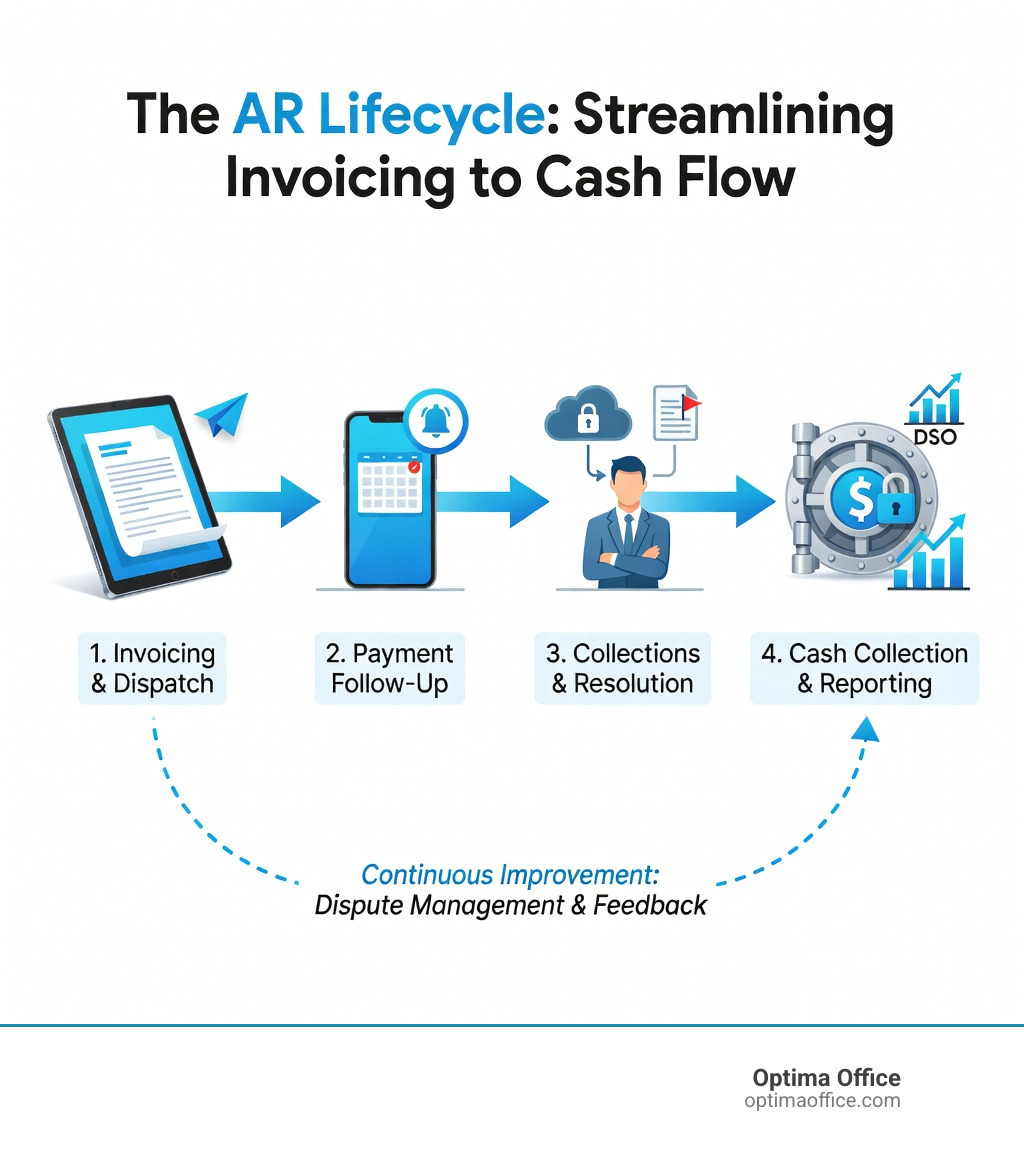
Accounts receivable management services basics:
- business bookkeeping
- professional bookkeeping services
Understanding the Core of Accounts Receivable Management Services
At its heart, accounts receivable (AR) management is the process of monitoring and controlling the money that customers owe your business for credit purchases. It isn’t just about asking for money; it is a comprehensive financial strategy that begins the moment you decide to extend credit to a customer and ends only when the cash is safely in your bank account.
Effective accounts receivable management services involve several critical steps. First, we must assess the creditworthiness of a potential client to ensure they have the capacity to pay. Next comes the generation of accurate, professional invoices sent through a streamlined digital dashboard. This dashboard allows us to maintain real-time visibility into the financial health of the business, showing exactly who owes what and for how long.
Managing the AR lifecycle effectively requires setting clear payment terms and sticking to them. When these processes are manual, things fall through the cracks. However, when managed professionally, the lifecycle becomes a predictable engine for liquidity.

The Difference Between Accounts Payable and Accounts Receivable
It is common for business owners to get these two terms swapped, but they represent opposite sides of your balance sheet.
- Accounts Receivable (AR): This is an asset. It represents money owed to your business by customers. It is a future cash inflow that fuels your operations.
- Accounts Payable (AP): This is a liability. It represents money your business owes to suppliers or vendors. It is a cash outflow that must be managed to maintain your own credit standing.
While AP is about managing your debts, AR is about managing your income. Both are vital, but AR is the primary driver of the “working capital” you need to pay those AP bills in the first place.
How Accounts Receivable Management Services Improve Customer Relationships
A common fear among business owners is that being “too firm” on collections will drive customers away. In reality, the opposite is often true. Professional accounts receivable management services actually improve customer relationships by introducing transparency and consistency.
According to research, AR professionals say dispute management is their most difficult task, with 55% citing it as a major hurdle. When you have a professional team handling these interactions, disputes are resolved through clear communication rather than emotional back-and-forth. By providing clear billing procedures and electronic invoicing, you make it easier for your customers to pay you. This professionalism protects your brand reputation, ensuring that the final “touchpoint” of a sale-the payment-is as smooth as the initial pitch.
The Strategic Impact: Why Efficient Accounts Receivable Management Matters for Your Bottom Line
Efficiency in AR isn’t just about tidying up the books; it’s about survival and growth. Poorly managed receivables lead to “bad debt”—money you’ll never see—which directly eats into your profits. When your cash is tied up in unpaid invoices, your liquidity suffers, making it harder to invest in new opportunities or even cover your daily overhead.
By taking a strategic approach to trade receivables management, businesses can gain deeper insights into sales trends and customer habits. This data allows us to identify market conditions early—for instance, if an entire industry sector starts paying more slowly, we can adjust our credit policies before it impacts your stability.
Reducing Days Sales Outstanding (DSO)
Days Sales Outstanding (DSO) is a critical metric that measures how many days, on average, it takes to collect payment after a sale is made. A high DSO means your cash is sitting in your customers’ pockets instead of yours.
Managed services focus on increasing collection speed and shortening payment cycles. Specialized software and strategies can reduce DSO by up to 25 percent.
| High DSO Impact | Low DSO Impact |
|---|---|
| Restricted cash flow and liquidity | High working capital for growth |
| Increased risk of bad debt write-offs | Predictable financial planning |
| High administrative collection costs | Efficient, automated operations |
| Strained vendor relationships (due to late AP) | Stronger credit standing |
Mitigating Risk and Reducing Bad Debt
Every business that offers credit takes a risk. To mitigate this, we implement a rigorous credit policy that includes credit limits for new customers and ongoing risk analysis for existing ones. For older, more difficult accounts, professional services may use techniques like skip tracing to locate individuals who have moved or are evading communication. If necessary, we initiate legal recovery processes to address even the most stubborn debts according to the law.
Optimizing Your Accounts Receivable Management Workflow
Optimizing your AR workflow requires a blend of the right people and the right tools. It starts with clear billing procedures: every invoice should be easy to read, accurate, and sent the moment the work is completed. We also recommend providing a variety of payment options, such as ACH, credit cards, and online payment portals, to remove any “friction” that might give a customer an excuse to delay.
Leveraging Automation in Accounts Receivable Management Services
Automation is the “secret sauce” of modern financial management. It is truly its time to rethink your accounts receivable if you are still manually entering data into spreadsheets.
Modern AR software provides real-time data and can lead to a 10-50% cash flow improvement almost immediately. Automation handles the repetitive tasks—sending reminders, matching payments to invoices (cash application), and flagging accounts that have exceeded their credit limits. This reduces human error and frees up your team to focus on high-level strategic tasks rather than chasing small checks.
First-Party vs. Third-Party Collections
Understanding the difference between these two approaches is vital for brand protection:
- First-Party Collections: The service provider acts as an extension of your company. They use your brand name, your email signatures, and a dedicated phone line. The goal is a customer-centric “gentle nudge” that resolves payment barriers while maintaining the relationship.
- Third-Party Collections: This is typically used for escalated accounts that are significantly past due. At this stage, a formal collection agency or legal team steps in under their own name. This is a firmer approach used when standard relationship-based efforts have failed.
Measuring Success: Key Metrics for Your AR Department
You cannot manage what you do not measure. A successful AR department relies on Key Performance Indicators (KPIs) to track progress and identify bottlenecks.
Calculating the Collection Effectiveness Index (CEI)
While DSO measures time, the Collection Effectiveness Index (CEI) measures quality. It is a percentage that shows how much of the available AR you actually collected during a specific period.
To calculate it, we look at:
- Beginning AR: What was owed at the start of the month.
- Monthly Credit Sales: New sales made on credit.
- Ending AR: What is still owed at the end.
A CEI close to 100% means your collection processes are highly effective, while a low percentage suggests it’s time to rethink your strategy.
Understanding Accounts Receivable Turnover Ratio (ARTR)
The ARTR measures how many times a company collects its average accounts receivable balance in a year. It is calculated by dividing your net credit sales by your average accounts receivable. This is a powerful liquidity measurement; a higher ratio indicates that your business is efficient at turning credit sales into cash. Efficient asset management here means you have more cash on hand to reinvest in Southern California’s competitive business landscape.
Choosing the Right Accounts Receivable Management Services Provider
Selecting a provider is a major decision for any San Diego business. You aren’t just looking for a “debt collector”; you are looking for a strategic partner who understands your industry and can integrate with your existing team.
Key Considerations for Outsourcing
When vetting a provider, consider the following:
- Customized Approach: Avoid “one-size-fits-all” agencies. Your business needs a plan tailored to your specific customer base.
- Technology Stack: Do they use modern automation tools that provide real-time reporting?
- Compliance and Legal Expertise: Ensure they follow all federal and state regulations (especially in California) to protect you from liability.
- Scalability: Can they handle your volume as you grow from a small shop to a mid-sized enterprise?
Implementation and Training
A smooth transition is key. When we step in to help, we focus on internal alignment. This includes adjusting how revenue is recorded, handling “short pays” (when a customer pays less than the full invoice amount), and refining the overall billing process. Our goal is to train your internal team on these new workflows so that everyone is moving in the same direction toward revenue recovery.
Frequently Asked Questions about AR Management
What is the main difference between accounts payable and accounts receivable?
Accounts receivable represents money owed to your business by customers (an asset), while accounts payable is money your business owes to suppliers or vendors (a liability). Managing AR effectively ensures you have the cash to pay your AP on time.
How does AR management software improve cash flow?
Software automates invoicing and reminders, reduces manual data entry errors, and provides real-time visibility into aging accounts. By removing friction from the payment process and ensuring no invoice is forgotten, businesses often see a 10% to 50% improvement in immediate cash flow.
When should a business consider outsourcing its AR management?
Outsourcing is ideal when a department is overwhelmed by volume, bad debt is increasing, or when the business lacks the time and technology to follow up on payments consistently. It is also a great solution if your team feels uncomfortable making “collection calls” and wants to maintain a positive customer relationship through a professional third party.
Conclusion
Chasing unpaid invoices doesn’t have to be part of running your business. With the right systems, technology, and team behind your receivables, you can turn AR from a constant drain on time into a predictable source of cash flow. Optima Office’s fractional CFOs and controllers bring that structure to businesses across San Diego, without the overhead of a full-time hire. Talk to our team about outsourced accounting services and start collecting faster.