Training and development is the process of helping employees acquire new knowledge and skills — or sharpen existing ones — to improve their performance today and prepare them for greater responsibilities tomorrow. By investing in these programs, organizations can ensure their workforce remains competitive and engaged.
The Core Pillars of Employee Training and Development
If you’re looking for the essentials fast, here’s what you need to know:
- What it is: Structured programs and activities that build employee knowledge, skills, and capabilities
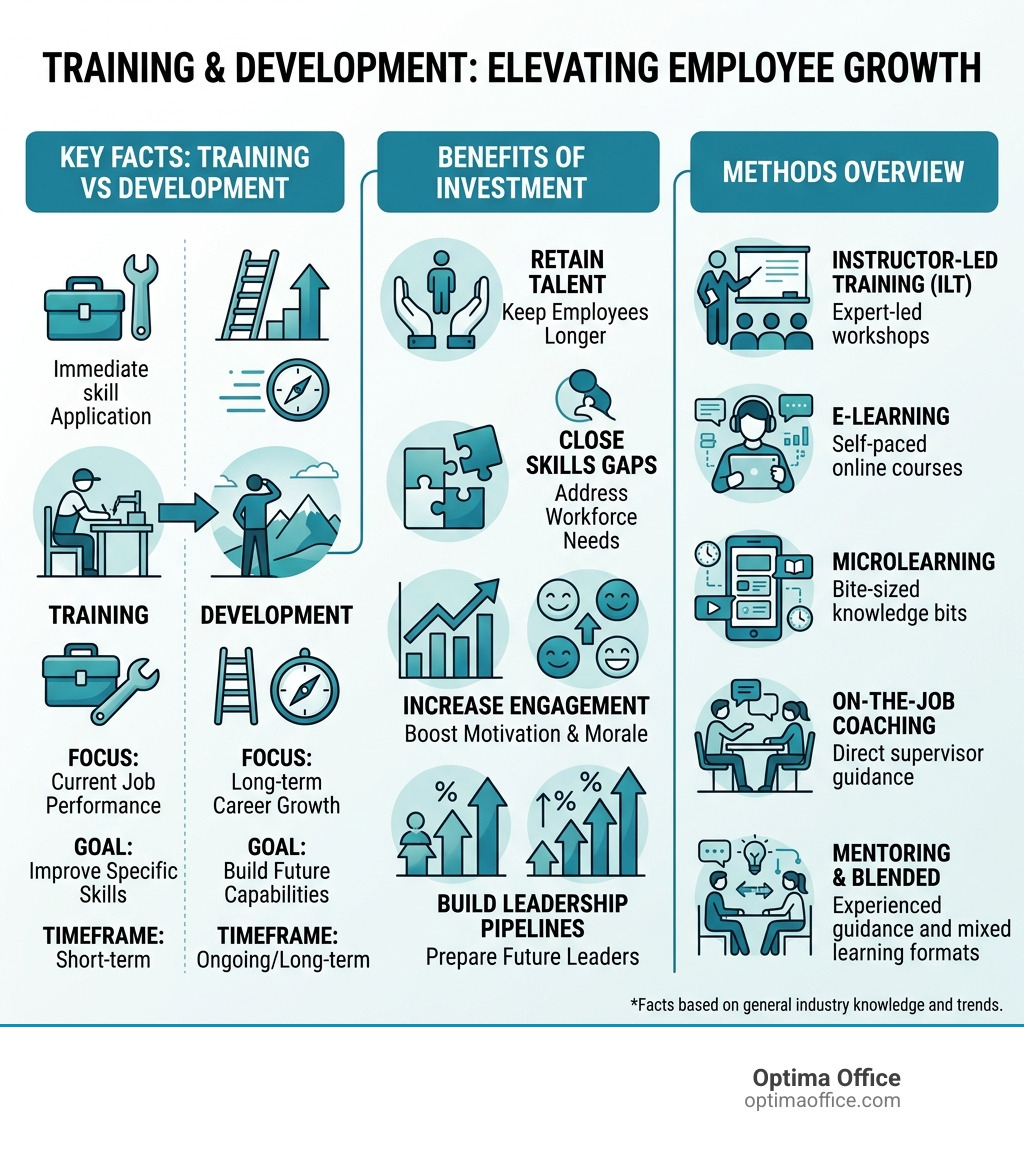
- Training vs. development: Training targets current job performance; development focuses on long-term career growth
- Why it matters: Organizations that invest in learning retain employees longer, close skills gaps faster, and build stronger leadership pipelines
- Common methods: Instructor-led training, e-learning, microlearning, on-the-job coaching, mentoring, and blended learning
- How to start: Conduct a needs assessment, design targeted content, choose delivery formats, and measure outcomes
For small and mid-sized businesses — especially those without a dedicated HR function — this is where things get complicated fast. You know your people need to grow. But between managing compliance, handling turnover, and keeping operations running, building a real training strategy often falls to the bottom of the list.
That’s a costly gap. According to LinkedIn’s 2018 Workplace Learning Report, 93% of employees say they would stay at a company longer if it invested in their careers. And research shows that workers with access to training have engagement scores roughly 15 percentage points higher than those without it. Yet despite these numbers, only 20–30% of training is actually applied on the job within the following month — meaning even well-intentioned programs often miss the mark without the right structure behind them.
This guide breaks down what actually works: the types of programs available, the methods that drive real skill-building, and the steps to build something your team will use.
Discover more about training and development:
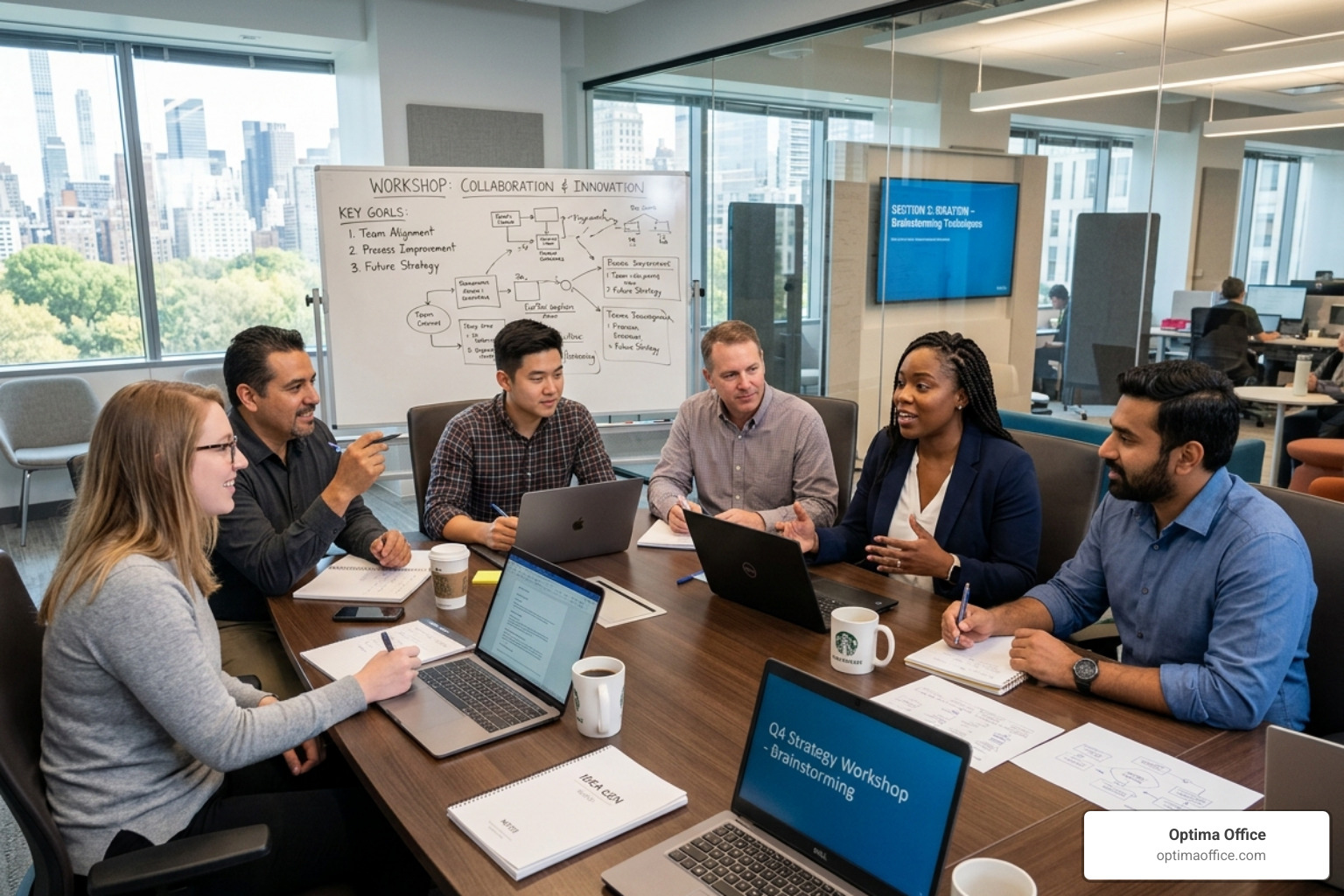
At its heart, training and development is about organizational and individual effectiveness. We often see businesses treat these as “nice-to-have” perks, but in reality, they are the engines of productivity. According to IBM, these programs involve educational activities that advance a worker’s knowledge and instill greater motivation to enhance job performance.
To build a program that actually moves the needle, we focus on three core pillars:
- Knowledge Acquisition: Giving your team the “what” and “why.” This includes industry facts, company policies, and technical information.
- Skill Enhancement: Moving from theory to practice. This is the “how-to” part of the equation, where employees practice using new software, handling difficult customer calls, or managing a budget.
- Performance Improvement: The ultimate goal. We don’t just want people to “know more”; we want them to do their jobs better, faster, and more safely.
To ensure these pillars are sturdy, many professionals use the ADDIE model. This is a classic instructional design framework that stands for Analysis, Design, Development, Implementation, and Evaluation. It ensures that you aren’t just throwing content at a wall to see what sticks, but rather building a structured path toward a specific business goal.
Distinguishing Between Training and Development
While we often use the terms interchangeably, there is a distinct difference between “training” and “development.” Understanding this helps us allocate our resources more effectively.
Training is typically short-term and task-oriented. It’s organized instruction intended to improve an employee’s performance in their current role. Think of it as “fixing a gap.” If a member of our accounting team needs to learn a new version of QuickBooks, that’s training.
Development, on the other hand, is long-term and career-oriented. It prepares employees for future responsibilities and higher-level roles. It’s about “building a bridge.” This often involves coaching, mentoring, and leadership tracks. For instance, Optima Office launched a mentor program specifically to foster this kind of long-term growth, pairing seasoned experts with emerging talent to share social capital and institutional knowledge.
Measuring the ROI of Training and Development
We know that “what gets measured gets managed.” If you want your executive team to buy into a learning budget, you need to show the return on investment (ROI).
Traditional metrics like “number of hours spent in a classroom” are mostly useless. Instead, we look at:
- Engagement Scores: Employees who feel their company cares about their growth are significantly more engaged.
- Productivity Metrics: Are tasks being completed faster? Is the error rate dropping?
- Retention Rates: Since 93% of employees stay longer at companies that invest in them, a drop in turnover is a direct win for your training budget.
| Feature | Training | Development |
|---|---|---|
| Focus | Current Job | Future Career |
| Scope | Individual Task | Entire Professional Path |
| Timeframe | Immediate/Short-term | Ongoing/Long-term |
| Goal | Fix a skill gap | Prepare for leadership/growth |
| Outcome | Improved performance today | Higher retention and succession |
Strategic Benefits for Organizations and Employees
Investing in training and development isn’t just a “feel-good” initiative; it’s a competitive necessity, especially in high-demand markets like Southern California. When we help our clients at Optima Office build these programs, we see several strategic benefits emerge.
First, there is the massive impact on talent retention. Companies with high internal mobility — those that train their people to move up — retain employees for twice as long as those that don’t. In an era where “quiet quitting” and high turnover are constant threats, a robust learning culture acts as “talent glue.”
Second, it solves the succession planning puzzle. By the time a senior leader is ready to retire or move on, you should already have a “bench” of trained internal candidates ready to step up. This reduces the high cost and risk of external executive searches.
From a broader perspective, the job outlook for those who manage these programs is booming. Employment of training and development specialists is projected to grow 11% from 2024 to 2034, which is much faster than the average for all occupations. This growth is driven by the constant need for upskilling in a tech-heavy economy. Whether you are working with our HR directors or building an internal team, having experts who can navigate these waters is vital for driving enterprise growth.
Effective Delivery Methods and Program Types
The “how” of training is just as important as the “what.” In the past, training meant sitting in a windowless conference room for eight hours. Today, we have much better options that cater to how people actually learn.
- Blended Learning: This is often the “sweet spot.” It combines online modules (for theory) with in-person workshops (for practice).
- Microlearning: We love this for busy teams. It involves short, 3-to-5-minute “bursts” of content — like a quick video on how to process a specific invoice — that employees can watch right when they need the information.
- Instructor-Led Training (ILT): Whether in-person or via virtual platforms (VILT), having a live expert like Jennifer Barnes or our other senior leaders can provide real-time feedback that a computer can’t.
- On-the-Job Coaching: This is perhaps the most effective method for skill transfer. It happens in the flow of work, where a supervisor provides immediate guidance as a task is being performed.
In terms of program types, a well-rounded strategy includes:
- Technical Skills: Software, hardware, and job-specific “hard skills.”
- Soft Skills: Often called “power skills,” these include emotional intelligence, communication, and teamwork.
- Compliance Training: Essential for risk mitigation. This covers everything from cybersecurity to harassment prevention, ensuring your business stays on the right side of the law.
For those looking to refine their approach, SHRM outlines 7 key steps for better program design, emphasizing that training must be aligned with organizational goals to be effective.
7 Steps to Implement a Successful Program
Building a program from scratch can feel overwhelming. We recommend following this structured path to ensure your investment pays off.
- Needs Assessment: Don’t guess what your team needs. Use surveys, interviews, and performance data to identify where the real gaps are. Is it a lack of knowledge, or a lack of motivation?
- Instructional Design: Use the ADDIE model mentioned earlier. Design the learning experience so it is engaging and logical.
- Content Curation: You don’t always have to “build” it. Sometimes, purchasing high-quality off-the-shelf content for things like Excel or safety compliance is more cost-effective.
- Access Methods: How will people get the training? Will they use a mobile app? A desktop portal? Ensure the technology doesn’t become a barrier to learning.
- Stakeholder Buy-in: If managers don’t support the training, employees won’t take it seriously. Get leadership involved early.
- Pilot Testing: Run a small version of the program with a “beta group” to catch errors and gather feedback before a full rollout.
- Continuous Feedback: Training isn’t a “one-and-done” event. Use evaluations to see what worked and what didn’t, then iterate.
Navigating Challenges and Future Trends
The landscape of training and development is shifting rapidly. A challenge we face today is the shrinking “half-life” of skills. What was cutting-edge five years ago might be obsolete today.
AI and Automation are the primary drivers of this change. It is estimated that more than 120 million workers in the world’s twelve largest economies may need to be retrained in the next three years because of AI-enabled automation. This isn’t just for tech workers; everyone from HR professionals to accountants will need to learn how to work alongside AI tools.
To stay ahead, organizations are adopting Agile Learning. This approach focuses on “learning by doing” and rapid iterations. Instead of waiting six months to build a perfect course, agile learning encourages launching a “minimum viable” training and improving it based on real-world use.
Other trends we are watching include:
- Remote Delivery: With more teams working from home in Southern California and beyond, training must be “remote-first” to be inclusive.
- Personalized Learning: Using data to suggest specific training to an employee based on their career goals and past performance.
- Skills Gap Analysis: A more data-driven way to look at your workforce and identify exactly which skills you are missing to meet future business goals.
Frequently Asked Questions about Training and Development
What is the difference between training and development?
Training focuses on the “now” — helping an employee master the skills needed for their current job. Development focuses on the “next” — preparing an employee for future roles, leadership positions, and long-term career growth. Training is often a specific event, while development is a continuous process.
How do you conduct a training needs assessment?
A needs assessment involves three levels:
- Organizational: Where does the company want to go?
- Task: What specific skills are required to get there?
- Individual: Who specifically needs help in those skill areas? We use surveys, performance reviews, and consultations with department heads to gather this data.
What are the most effective training methods for remote teams?
For remote teams, we recommend a mix of synchronous and asynchronous learning. VILT (Virtual Instructor-Led Training) allows for real-time interaction, while Microlearning and E-learning modules allow employees to learn at their own pace. Using collaborative tools like Slack or Microsoft Teams for “social learning” also helps keep remote employees connected.
Driving Enterprise Growth Through Expert HR Advisory
At Optima Office, we believe that small and mid-sized companies shouldn’t be at a disadvantage just because they don’t have a massive HR department. Our mission is to provide the same level of expertise — including strategic training and development — that a Fortune 500 company enjoys, but at a fraction of the cost.
Through our fractional HR and advisory services, we help businesses in San Diego and across Southern California navigate complex workforce challenges. Whether you need a proprietary five-point system to find the right cultural fit or a rapid team deployment (within 3-5 days) to solve an immediate crisis, we are here to help.
Our highly-customized mix of outsourced controllers, CFOs, and HR professionals brings the right expertise and personality fit to solve problems quickly. By investing in your people today through structured learning and expert leadership, you can maximize profits, minimize risk, and drive long-term enterprise growth.
Explore our outsourced HR services and see how we can help you build a workforce that is ready for whatever the future holds.