


Audit readiness services are professional consulting engagements that prepare your organization, financials, documentation, internal controls, and people to complete a formal audit with minimal disruption, cost overruns, or surprises. These services help ensure your financial reporting follows applicable accounting standards and gives your team a clear path toward a clean audit opinion.
For small and mid-sized businesses, especially those experiencing leadership turnover, rapid growth, or a first-time audit, readiness often determines whether the process is smooth or stressful. If your company needs stronger financial support before an audit, Optima Office’s outsourced accounting services can help you build cleaner records and better reporting before auditors arrive.
Why Audit Readiness Services Can Make or Break Your Next Audit
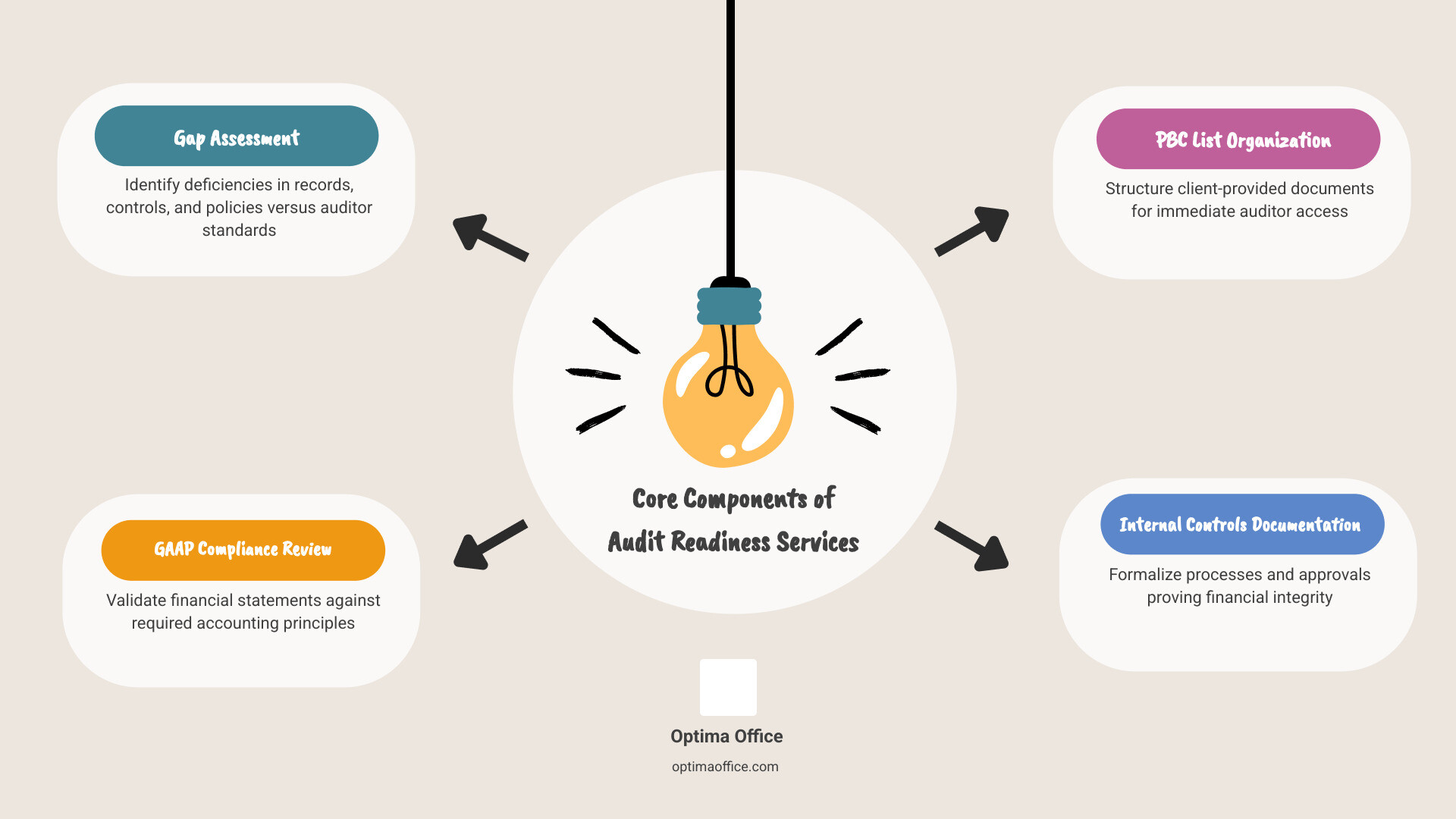
Here’s what audit readiness services typically include at a glance:
- Gap assessment: Identifying where your current records, controls, and policies fall short of auditor expectations
- GAAP compliance review: Ensuring your financial statements meet the accounting standards auditors will test against
- PBC list organization: Structuring the “provided by client” documents auditors will request on day one
- Internal controls documentation: Formalizing the processes and approvals that demonstrate financial integrity
- Technical accounting support: Addressing complex areas like revenue recognition, lease accounting, or recent acquisitions
- Auditor liaison: Managing communication between your team and the external audit firm to reduce back-and-forth
- Post-audit remediation: Implementing corrective actions from management letters to prevent repeat findings
For small and mid-sized businesses, the difference between a smooth audit and a costly, stressful one almost always comes down to how prepared you are before the auditors walk in the door.
Unprepared companies can face extended audit timelines, material weaknesses, elevated audit fees, and damaged credibility with investors, lenders, or board members. The stakes are high because audit delays can erode stakeholder trust and create real barriers to raising capital.
The good news is that with the right preparation and the right partner, the process does not have to become a fire drill.
Understanding the Scope of Professional Audit Readiness Services
When we talk about being audit-ready, we are not just talking about having a clean office or a friendly attitude toward the auditors. We mean that your financial house is in strong enough order for an outside party to verify your numbers without finding major issues. Professional audit readiness services provide a comprehensive safety net.
They help ensure your books are closed, your reconciliations are tied out, and your team is prepared for the technical scrutiny that comes with a high-stakes review.
At the core of these services is GAAP compliance. Generally Accepted Accounting Principles are the rules of the road for financial reporting in the United States. Auditors spend significant time checking whether you have followed these rules. If you have not, you may face audit adjustments, which can delay the process and create extra work for your team.
Audit readiness services also focus heavily on internal controls. These are the checks and balances that help prevent fraud and errors, such as requiring approvals for large payments or separating who pays bills from who records them in the system. Clear documentation helps auditors understand how your business actually operates without having to search for every answer.
Key Frameworks Covered by Audit Readiness Services
While many people think of audits only in terms of dollars and cents, modern businesses may also face compliance audits related to security and data privacy. Professional readiness providers often help prepare for several key frameworks:
- SOC 2: Essential for SaaS and technology companies because it shows how customer data is handled securely
- ISO 27001: A recognized international standard for information security management
- HIPAA: Important for healthcare companies or organizations handling protected health information
- NIST: Often required for government contractors or businesses in high-security sectors
Preparing for these frameworks often involves a dry run or gap analysis. For example, ISO 27001 readiness may act like a mock exam to identify missing documentation or ineffective security controls before the formal certification audit begins.
The Strategic Value of Audit Readiness Services for Startups
If you are a high-growth startup in San Diego or Southern California, you may be preparing for a Series A or Series B funding round. Investors do not just want to see a strong product. They also want to see clean financials.
Unprepared startups can hit a wall when an investor’s due diligence team asks for GAAP-compliant financial statements. Audit readiness services provide the technical accounting support many early-stage companies lack.
This may include complex revenue recognition, stock-based compensation, or other areas that require stronger financial documentation. When those items are handled correctly, your business can present itself as more mature, more organized, and better prepared for institutional capital.
The 5-Stage Roadmap to a Seamless Audit
A successful audit does not happen by accident. It follows a structured timeline. Most experts recommend beginning the readiness process 6 to 12 months before audit fieldwork begins so there is enough time to fix problems without creating a last-minute scramble.
The process generally follows this roadmap:
- Gap Assessment: Review your current state compared with where you need to be.
- Remediation: Fix the gaps by updating policies, cleaning up the ledger, and documenting controls.
- Audit Package Preparation: Create the audit binder, digital or physical, containing the materials the auditor will request.
- Fieldwork Support: Act as the main point of contact for auditors and answer technical questions so your team can keep running the business.
- Post-Audit Wrap-Up: Implement final recommendations from the auditor to make the next audit easier.
For organizations in the social sector, these same stages are especially important because audit readiness directly supports donor confidence, board reporting, and regulatory expectations. If your organization needs nonprofit-specific accounting support, Optima Office’s nonprofit accounting services can help strengthen the financial foundation behind your audit process.
How Audit Readiness Services Accelerate the Timeline
One of the most frustrating parts of an audit is the back-and-forth. The auditor asks for a document, your team takes several days to find it, the auditor finds an issue, and the cycle repeats. This is one reason audits often go over budget.
By organizing the PBC list ahead of time, your team can reduce delays and give auditors cleaner, more complete information. When the auditor asks for a specific item, it should already be in a shared folder, reconciled, and ready for review.
This preparation helps reduce disruption, protects your team’s time, and keeps the audit moving forward.
Post-Audit Support and Continuous Improvement
The audit is not truly over when the report is signed. Auditors often issue a management letter with recommendations about internal processes. Ignoring these recommendations can lead to repeat findings in the next audit.
Professional readiness services include internal control remediation. That means taking the auditor’s findings and turning them into an action plan.
Whether the fix involves updating procedures, adding software approvals, or improving documentation, the goal is to prevent the same issues from happening again. This mindset turns audit readiness from a stressful annual event into a routine part of financial management.
Essential Components of an Audit-Ready Financial Department

To stay audit-ready, your finance department needs more than a talented bookkeeper. It needs a structure that supports U.S. GAAP standards. This means revenue is recorded in the right period, expenses are properly matched, and assets are valued correctly.
The foundation of an audit-ready department is balance sheet reconciliation. Every account on your balance sheet, from cash to prepaid insurance, should have a supporting schedule that proves the balance is correct.
If an account becomes a junk drawer of random transactions, the auditor will spend more time digging through it. That can slow the audit and increase costs.
Documentation and Internal Control Narratives
Auditors do not just look at the numbers. They also look at the process that created the numbers. This is where documentation becomes vital.
Audit-ready businesses should maintain:
- Process flowcharts: Visual representations of how money moves through the company
- Policy memos: Written documents explaining positions on items like capitalization thresholds
- Segregation of duties: A matrix showing that no single person has too much control over a financial transaction
This documentation gives auditors a clearer understanding of your internal controls and reduces unnecessary back-and-forth.
Organizing the PBC List and Supporting Schedules
The PBC list is the auditor’s shopping list. It can include hundreds of items, which is why organization matters.
A professional readiness provider will prepare a comprehensive audit package that may include:
- An adjusted trial balance that ties to the financial statements
- Detailed transaction testing samples that have been reviewed for errors
- Supporting schedules for complex areas like depreciation or accrued liabilities
For charitable organizations, having these items organized is critical for maintaining public trust and meeting reporting expectations. Strong nonprofit accounting support can help keep schedules and documentation aligned with sector-specific needs.

Avoiding Common Pitfalls: Why Preparation Trumps Remediation
The most expensive way to handle an audit is to wait for the auditors to find your mistakes. This can lead to material weaknesses, which are formal statements in your audit report showing that internal controls are not working properly. That can be a major red flag for banks and investors.
Unpreparedness also leads to audit delays. If an audit was expected to take four weeks but stretches into three months, audit fees can rise quickly.
Most audit firms charge by the hour. If auditors are waiting for your team to find a missing invoice or reconcile an account, the meter is running.
Eliminating Surprises Through Mock Audits
A mock audit works like a dress rehearsal. The goal is to perform a gap analysis and dry run of the auditor’s procedures before the formal audit begins.
This process may look for issues such as:
- Unrecorded liabilities
- Revenue recognized too early
- Missing signatures on payroll changes
By identifying these risks early, your team can fix the problem before it becomes a permanent mark on the financial record.
| Feature | DIY Audit Preparation | Professional Audit Readiness |
|---|---|---|
| Timeline | Often delayed/rushed | Up to 75% faster |
| Technical Accuracy | High risk of GAAP errors | CPA-led accuracy |
| Staff Stress | Extremely high (burnout risk) | Managed and supported |
| Audit Fees | Usually higher due to “clean up” | Minimized through efficiency |
| Outcome | Risk of material weakness | Predictable, clean opinion |
Managing Resource Strain on Internal Teams
One of the biggest hidden costs of an audit is staff capacity. Your accounting team already has a full-time job. When you add hundreds of audit requests on top of daily responsibilities, something usually gives.
By bringing in outsourced controllers or a fractional CFO team, you give your internal staff the support they need. External experts can handle the technical requests while your team continues running the business.
If your company needs controller-level support before or during an audit, Optima Office’s financial controller services can help strengthen reporting, reconciliations, and financial controls.
Choosing the Right Partner for Your Compliance Journey
Not all audit readiness services are created equal. When choosing a partner, look for industry expertise. A technology startup has different needs than a manufacturing company, nonprofit, or government contractor.
You want a team that understands your specific requirements, whether those requirements involve GAAP, GASB, SOC 2, or another framework.
At Optima Office, we emphasize pricing transparency and a right-fit approach. We do not believe in over-engineering a solution. Sometimes you need a high-level CFO to support a complex transaction. Other times, you need an experienced controller to get reconciliations done.
The goal is to match the right level of expertise to the specific challenge.
Evaluating Technical Accounting and IT Security Expertise
Financial readiness and IT security are often linked. If you are pursuing SOC 2 or ISO 27001 certification, you need a partner who understands information security management systems and cloud governance.
Audit readiness can help bridge the gap between your IT department and finance department. The goal is to ensure your security controls are as well documented and reliable as your financial controls.
The Advantage of Former Auditor Perspectives
The best way to pass a test is to work with someone who understands how the test is graded. Former auditors bring an examiner’s mindset to audit preparation.
They know the triggers that cause auditors to dig deeper. These may include sudden fluctuations in travel expenses, unusual revenue spikes, missing documentation, or inconsistent reconciliations.
By identifying those triggers early, your team can prepare the explanation and evidence before the auditor asks.
Achieving Perpetual Compliance and Stakeholder Confidence
The ultimate goal of audit readiness services is not just to survive one audit. It is to build a culture of ongoing preparedness.
That means your month-end close is tight, your documentation is clear, and your team can respond to audit requests without panic. This level of clarity can be transformative because it gives leadership, lenders, investors, and board members greater confidence in the business.
Sustaining Audit Readiness Year-Round
The secret to a boring audit, which is usually the best kind of audit, is a strong month-end close. If you wait until December to reconcile your accounts, you are making the audit harder than it needs to be.
Year-round audit readiness should include:
- Timely reconciliations
- Review of new contracts for GAAP implications
- Regular updates to internal control narratives
- For government entities, staying ahead of new GASB implementation requirements
These habits make the audit process more predictable and reduce the risk of last-minute surprises.
Driving Enterprise Growth Through Financial Transparency
Financial transparency is a competitive advantage. It can remove capital barriers and increase confidence with lenders, investors, boards, and leadership teams.
When a bank sees a clean audit report and a well-organized finance department, it has more confidence in the business. When an investor sees that the company has invested in professional readiness, it signals maturity and lower risk.
By using outsourced accounting services, businesses can access CFOs, controllers, and accountants without building a full internal finance department too early. If your organization needs higher-level strategic financial guidance tied to audits, capital planning, or growth, Optima Office’s fractional CFO services can help leadership prepare with stronger financial oversight.
Frequently Asked Questions About Audit Readiness
What Is the Difference Between an Audit and Audit Readiness?
An audit is an independent examination of your financial statements by a CPA firm to provide an opinion on their accuracy. Audit readiness services are the preparatory work done before the auditors arrive.
Think of it this way: the audit is the final exam, and audit readiness is the studying that helps you perform well.
When Should a Company Start Preparing for Its First Audit?
Ideally, a company should start 6 to 12 months before audit fieldwork begins. If you are a startup preparing to raise money or a company approaching a debt covenant requirement, earlier preparation is better.
At a minimum, you want your readiness team in place several months before fiscal year-end so there is time to identify and fix issues before the audit begins.
How Do Audit Readiness Services Reduce Overall Audit Fees?
Auditors charge for their time. If they have to spend hours cleaning up books, reconciling accounts, or waiting for documents, the audit bill can increase.
By providing auditors with a clean package where records are organized and schedules are already tied out, you can reduce unnecessary audit hours, limit out-of-scope charges, and make the process more efficient.