

Virtual CFO services provide businesses with on-demand, senior-level financial leadership—the strategic guidance of a Chief Financial Officer—without the cost or commitment of a full-time executive hire. For many small and mid-sized businesses, the gap between a bookkeeper and a boardroom-ready financial executive is wide and expensive.
What Are Virtual CFO Services — and Do You Need One?
Here’s what that means in practice:
- A seasoned financial executive works with your business remotely, on a fractional or retainer basis
- They handle forward-looking strategy: forecasting, cash flow management, budgeting, scenario modeling, and KPI governance
- They integrate with your existing accounting team and software
- You pay a fraction of a full-time CFO’s salary — typically $3,000 to $10,000 per month, versus $394,200+ per year for an in-house hire
- Engagements are flexible — scale up during a fundraise or acquisition, scale back when things stabilize
If your business is generating $3M or more in revenue, struggling with cash flow visibility, preparing for growth, or has lost a key financial leader — a virtual CFO is likely the most cost-effective path to the strategic oversight you need.
A full-time CFO commands a median salary north of $440,000, not counting benefits or equity. Yet the strategic decisions that determine whether a business grows or stalls — cash runway, profitability by product or client, investor reporting, debt management — demand exactly that caliber of thinking.
That’s the problem virtual CFO services solve. Instead of choosing between flying blind and overextending your payroll, you get experienced financial leadership embedded in your business on terms that actually make sense for your size and stage.
For business owners who’ve outgrown their bookkeeper, lost a controller, or simply can’t get reliable financial data out of their current setup, this model isn’t just convenient — it can be the difference between a business that reacts and one that plans.
Virtual CFO services glossary:
- bookkeeping for small business
- professional bookkeeping services
- what is account management services
Defining the Role: What are Virtual CFO Services?
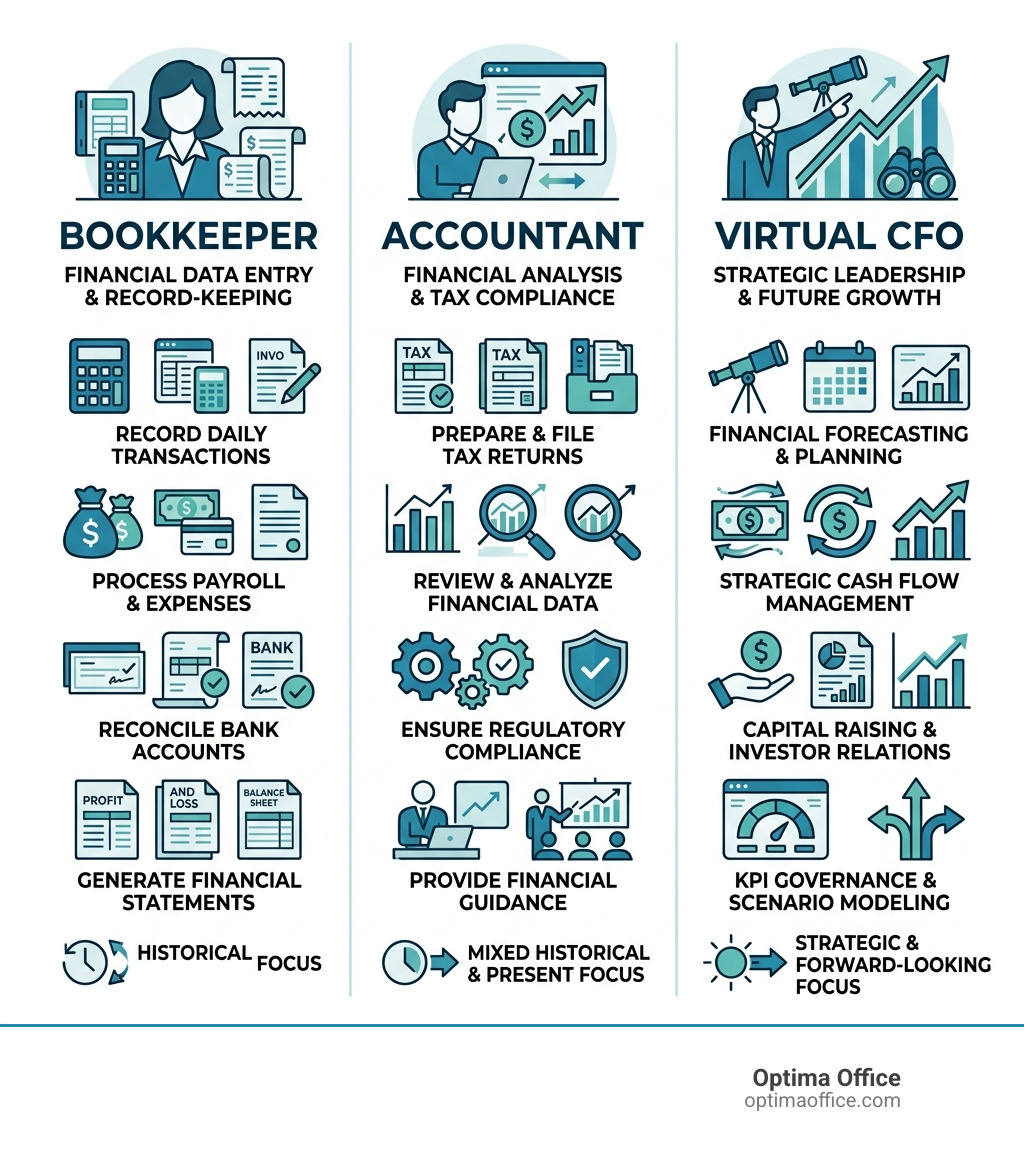
At its core, a virtual CFO is a high-level financial partner who operates outside your physical office but remains deeply embedded in your strategic operations. Unlike a traditional hire who sits in the office down the hall, virtual CFO services leverage cloud technology and remote collaboration tools to provide the same level of executive oversight. We focus on the “why” and the “what’s next” rather than just the “what happened.”
The primary distinction lies in the shift from historical recording to forward-looking strategy. While your tax accountant is focused on the previous year’s filings, your virtual CFO is looking 12 to 24 months into the future. They are the architects of your financial roadmap, ensuring that every dollar spent aligns with your long-term enterprise goals.
When comparing a fractional CFO versus a traditional CFO, the difference is primarily one of accessibility and cost. A traditional CFO is a fixed overhead cost—a massive one at that. A fractional or virtual solution allows you to “right-size” your executive leadership. You get the 25+ years of experience and the strategic brainpower, but you only pay for the time and impact your business actually requires at its current stage.

Distinguishing the CFO from Traditional Accounting
It is a common misconception that a great accountant can simply “do the CFO work.” While both roles deal with numbers, their focus areas are worlds apart. Traditional accounting is compliance-driven. It is about historical data, ensuring the books are balanced, and staying on the right side of the IRS. It is essential, but it is reactive.
The role of the CFO is fundamentally about strategic decision-making and risk mitigation. While the accountant tells you that you spent $50,000 on marketing last month, the CFO tells you whether that spend is sustainable given your current cash burn and what the projected ROI needs to be to hit your next growth milestone. We move beyond the ledger to provide:
- Capital Structure Management: Determining the best mix of debt and equity to fund growth.
- Risk Assessment: Identifying internal and external threats to profitability.
- Stakeholder Communication: Presenting “board-ready” financial packages to investors or lenders.
- Operational Efficiency: Finding the “leaks” in your business model where capital is being wasted.
Strategic Pillars: Forecasting, Budgeting, and Cash Flow
The true value of outsourced CFO services is found in the three pillars of strategic finance: forecasting, budgeting, and cash flow management. Without these, a business is essentially driving at night without headlights.
We don’t just create a static budget at the start of the year and let it collect digital dust. We implement rolling forecasts and scenario modeling. What happens if your biggest client leaves? What if fuel prices spike by 20%? What if you decide to launch a new product line in Q3? A virtual CFO builds the models that answer these questions before they become crises.
Our approach to KPI governance ensures you are measuring what actually matters. Instead of vanity metrics, we focus on the levers that drive value. This includes capital sourcing for expansion, debt restructuring to improve monthly margins, and deep-dive profitability analysis to ensure your most popular products are actually your most profitable ones. For companies refining performance management, it can also help to align reporting with widely recognized guidance on key performance indicators.
Advanced Financial Modeling and Analysis
For businesses in specific sectors like SaaS or manufacturing, general financial advice isn’t enough. You need specialized expertise in unit economics. We help technology startups navigate complex metrics like Customer Acquisition Cost (CAC), Lifetime Value (LTV), and churn rates. For manufacturers, we dive into job costing and inventory turnover to optimize the supply chain.
Variance reporting is another critical tool in our arsenal. By comparing actual performance against our projections every single month, we can identify trends early. This level of analysis allows us to produce professional packages for your board or investors, instilling confidence that the business is being managed with surgical precision.
The Financial Case for Outsourced Leadership
The most immediate benefit of shifting to a virtual model is the dramatic reduction in overhead. When you hire a full-time CFO, you aren’t just paying a salary; you are paying for benefits, bonuses, payroll taxes, office space, and often a significant equity stake.
By unlocking executive expertise through a fractional model, you eliminate these “hidden” costs. This is about fractional CFO advantages—getting the highest level of talent for a predictable, manageable monthly fee. Furthermore, virtual CFOs often come from firms like ours, meaning you don’t just get one person; you get access to an entire specialist network of controllers, HR experts, and tax professionals.
Maximizing ROI through Flexible Engagements
Flexibility is the ultimate currency for a growing business. Our retainer models are designed to scale with you. During a busy season, a merger, or a capital raise, we can increase our involvement to 20 or 30 hours a week. When things normalize, we can scale back to a light-touch advisory role.
This integration extends down the financial stack. By coordinating fractional CFO bookkeeping integration, we ensure that the strategic advice is based on clean, real-time data. This resource optimization means you aren’t paying a CFO to do data entry, and you aren’t paying a bookkeeper to try and figure out your five-year strategic plan. Everyone is playing at the top of their license.
Strategic Growth and Implementation
Growth is exciting, but it’s also dangerous. Rapid scaling can break a company’s cash flow and internal controls if not managed correctly. A virtual CFO acts as the “finance co-pilot,” helping you navigate the complexities of enterprise value and M&A support. Whether you are looking to acquire a competitor or preparing your own business for an exit, having an expert who has “been there, done that” is invaluable.
We also focus heavily on the “unsexy” but vital parts of the business: internal controls and fraud prevention. According to our research, many small businesses have significant gaps in their bookkeeping that leave them vulnerable. We implement segregation of duties and rigorous oversight to protect your assets. For those looking for the best fit, our interim CFO buyer’s guide provides a roadmap for selecting a partner who understands these risks.
Identifying the Right Time for Virtual CFO Services
How do you know when it’s time to move beyond a basic accounting setup? There are several telltale signs you need a CFO:
- Revenue Thresholds: Usually, when a company hits the $2M to $3M mark, the complexity outstrips what a founder or bookkeeper can handle.
- Fundraising Preparation: If you are going after Series A or B funding, investors will expect a level of financial sophistication that only a CFO can provide.
- Growth Plateaus: If your revenue is flat and you can’t figure out why, you likely have a strategic bottleneck that requires a financial deep dive.
- Inconsistent Cash Flow: If you have plenty of sales but never seem to have enough cash in the bank, you have a management problem that needs executive attention.
Seamlessly Implementing Virtual CFO Services
At Optima Office, we understand that when you need help, you need it now. That’s why we offer rapid team deployment, often getting a professional in place within 3-5 days. Our proprietary five-point fit system ensures that the person we send isn’t just a great resume—they are the right personality fit for your culture.
We provide a full spectrum of support, from financial controller services to fractional controller support. Our process begins with a diagnostic of your current software integration—whether you use QuickBooks Online, Sage Intacct, or NetSuite—to ensure we are working with a single source of truth from day one.
Frequently Asked Questions about Virtual CFOs
How much do virtual CFO services typically cost?
The cost is highly dependent on the complexity of your business and the volume of transactions. On average, highly experienced virtual CFOs cost between $3,000 to $10,000 per month. Most of our clients find their “sweet spot” with retainers between $5,000 and $7,500. This is a massive saving compared to the $30,000+ monthly cost of a full-time executive. Our fractional CFO team specialty allows us to tailor these costs to your specific needs.
What is the difference between a virtual CFO and a fractional CFO?
In the modern business landscape, these terms are often used interchangeably. Both refer to a high-level financial executive who works part-time for your company. “Virtual” typically emphasizes the remote nature of the work, while “fractional” emphasizes that you are getting a fraction of their total time. At Optima Office, we offer both remote and on-site support across Southern California, ensuring the “strategic alignment” matches your preferred way of working.
How do virtual CFOs integrate with existing accounting software?
We don’t believe in reinventing the wheel if your current system works. We integrate securely with your existing tech stack, including QuickBooks Online, Sage Intacct, Xero, and NetSuite. By setting up real-time data syncs and secure cloud access, we can monitor your financial health 24/7. This allows us to provide proactive alerts the moment we see a potential issue or a unique opportunity for growth.
Scaling with Confidence: Your Path to Financial Clarity
The journey from a small startup to a thriving enterprise is rarely a straight line. It is filled with pivots, challenges, and high-stakes decisions. Having a virtual CFO in your corner gives you the strategic roadmap you need to navigate this journey with confidence.
By choosing virtual CFO services, you aren’t just hiring a consultant; you are entering into a long-term partnership focused on your success. We provide the data-driven confidence that allows you to stop making “gut feeling” decisions and start making strategic moves that drive enterprise value.
Whether you need to shore up your internal controls, prepare for a major acquisition, or simply get a handle on your monthly cash flow, we are here to help. Our integrated approach to outsourced accounting and HR services ensures that your business has the backbone it needs to scale.
Ready to see what professional financial leadership can do for your bottom line? Let’s build your business value together.