

Bookkeeping for lawyers is essential for protecting client funds, maintaining compliance, and giving law firm owners a clear picture of profitability. Unlike general business bookkeeping, legal bookkeeping must account for trust accounts, client ledgers, matter-specific expenses, and strict state bar rules. For solo practitioners and small to mid-sized law firms in competitive markets like San Diego, accurate bookkeeping is not just about balancing the books. It is the foundation of ethical practice, financial stability, and sustainable growth. If your firm needs stronger financial oversight, Optima Office’s bookkeeping services can help you build cleaner systems and reduce avoidable risk.
Bookkeeping for lawyers helps law firms:
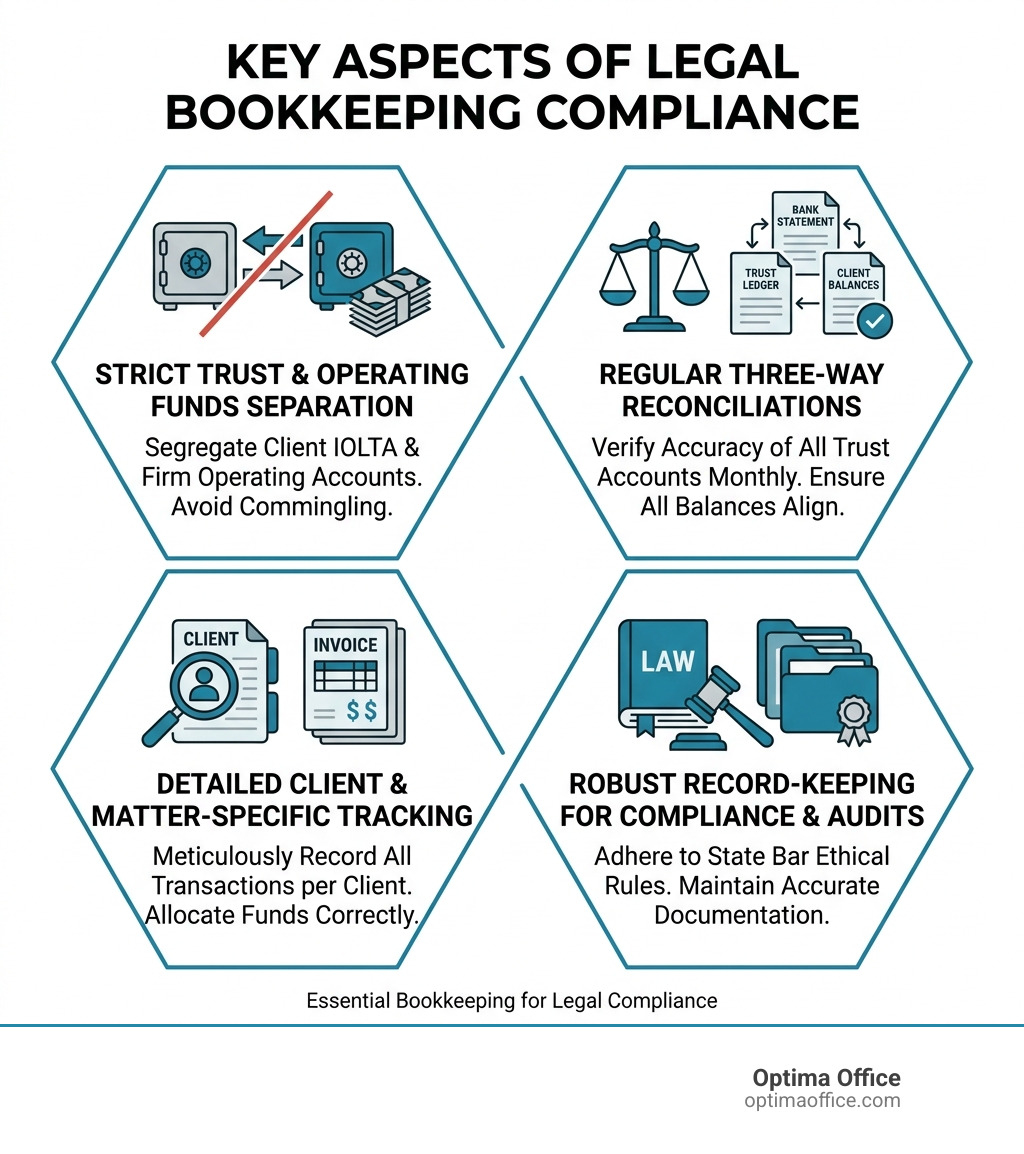
- Maintain strict separation between client trust funds and operating funds.
- Perform regular three-way reconciliations of trust accounts.
- Track client and matter-specific transactions accurately.
- Prevent commingling and improper allocation of funds.
- Follow state bar ethical rules and record-keeping requirements.
- Prepare accurate documentation for audits, taxes, and strategic financial reporting.
Attorneys spend their careers navigating complex legal issues for clients, but many firms struggle to manage the financial complexity inside their own practice. That can lead to missed revenue, delayed invoicing, unclear profitability, compliance exposure, and unnecessary stress.
Law firms with strong financial management practices are better positioned to collect what they bill, understand which matters are profitable, and make better growth decisions. Ignoring these financial operations can create problems that keep firm owners awake at night, including slow book closes, messy trust records, unclear cash flow, and the risk of bar sanctions.
Understanding the Foundations of Bookkeeping for Lawyers
At its core, bookkeeping for lawyers is a specialized discipline that goes far beyond simple income and expense tracking. A retail store or consulting firm may focus mainly on cash flow, expenses, and profit margins. A law firm must also operate under a fiduciary duty when holding client funds.
The most critical piece of legal bookkeeping is trust accounting. When a client provides a retainer or a settlement check is received, that money may not belong to the firm yet. It must be held in a dedicated trust account, often an Interest on Lawyers Trust Account, also known as an IOLTA.
In California, client trust account rules are especially strict. These accounts are designed to keep client funds separate from operating funds, which helps protect clients and reduce the risk of commingling.
Effective bookkeeping for lawyers requires clean ledgers, clear processes, and real-time visibility into client funds. Without that structure, it becomes dangerously easy to lose track of which dollar belongs to which client. That is how law firms end up facing one of the most serious financial issues in legal practice: commingling.
Before diving in, take our free Financial GAP Assessment to pinpoint where your firm may be losing money, missing revenue, or creating unnecessary financial risk.

Key Differences Between Bookkeeping and Accounting for Lawyers
Many people use “bookkeeping” and “accounting” interchangeably, but they serve different functions inside a law firm.
Bookkeeping is the day-to-day process of recording financial transactions. It includes classifying expenses, recording payments, logging client costs, updating trust ledgers, and keeping accurate records of money moving in and out of the firm.
Accounting is the strategic interpretation of that financial data. An accountant, controller, or Chief Financial Officer uses bookkeeping records to evaluate financial health, prepare tax reporting, analyze profitability, and guide future planning.
The simplest way to think about it is this: bookkeeping tells you what happened. Accounting tells you what it means.
For a growing law firm, both functions matter. Bookkeeping keeps the firm compliant and organized day to day. Accounting and financial leadership help the firm make smarter decisions about hiring, pricing, profitability, and growth. If your firm needs broader finance support, Optima Office’s outsourced accounting services can help strengthen the full financial function.
Why Specialized Bookkeeping for Lawyers is Essential for Compliance
Legal professionals are held to a higher standard when managing client funds. A standard bookkeeping approach is usually not enough because law firm financial records must account for trust balances, matter-specific expenses, client ledgers, and strict documentation requirements.
State bar audits are not just theoretical. They can happen when a firm shows signs of financial mismanagement or fails to maintain proper records. Proper bookkeeping for lawyers creates the audit trail needed to show that client funds were handled correctly.
Specialized bookkeeping also protects the firm’s license and reputation. Clean records help prove that client funds were not used for operating expenses, that trust balances were reconciled properly, and that funds were transferred only when earned.
Compliance is the baseline. Trust is the real asset.
Essential Financial Terms and Compliance Procedures
To manage law firm finances well, firm owners need to understand the terms and procedures that keep legal bookkeeping compliant. These are not just technical details. They are the controls that protect your clients, your license, and your business.
Mastering Three-Way Reconciliation
Three-way reconciliation is the gold standard of trust accounting. Unlike a standard bank reconciliation, which compares your bank statement to your records, three-way reconciliation adds a third layer.
Every month, these three numbers should match:
- The bank balance: The actual cash shown on the trust account bank statement.
- The trust ledger: The total trust balance recorded in the firm’s general ledger.
- The client ledgers: The total of all individual client trust balances.
If these numbers do not match, there is a reconciliation discrepancy. That discrepancy could come from a bank error, a data entry mistake, an uncleared transaction, or an unauthorized withdrawal.
Regular reconciliation helps catch issues before they become ethical or financial problems. For law firms, this process should not be treated as optional. It should be built into the monthly financial close.
Managing IOLTA and Client Trust Accounts
Managing an Interest on Lawyers Trust Account requires a zero-tolerance approach to errors. These accounts are designed to hold client funds separately from the firm’s operating money.
The primary rule is simple: do not commingle funds. Law firms should not deposit operating revenue into a trust account, and they should not pay firm expenses directly from a trust account.
When a retainer is earned, meaning the firm has completed the work and issued the invoice, those funds should be transferred from the trust account to the operating account. Leaving earned fees in a trust account for too long can also create a commingling issue because firm money is being mixed with client money.
Trust accounting requires discipline. Every transaction should be documented, assigned to the correct client or matter, and supported by clear records.
Best Practices for Law Firm Financial Management
Strong financial management helps law firms protect compliance and improve profitability. A firm may deliver excellent legal work, but if billing, collections, expenses, and trust accounting are weak, the business will feel the pressure.
The best law firm bookkeeping systems are consistent, matter-based, and easy to review. They help attorneys understand what has been billed, what has been collected, what is still outstanding, and which matters are actually profitable.
Streamlining Invoicing and Collections
The longer a law firm waits to invoice, the harder it becomes to collect in full. Billing should be consistent, accurate, and timely.
Weekly or monthly invoicing is usually best for maintaining cash flow. Modern bookkeeping systems can help automate invoices, payment reminders, and reporting, reducing the manual work that often slows firms down.
Time tracking should also connect directly with invoicing whenever possible. Small tasks add up. If attorneys forget to record short calls, emails, research time, or document reviews, the firm loses revenue.
Better invoicing does not just improve cash flow. It creates a more professional client experience and gives firm owners a clearer view of revenue performance.
Accurate Expense Tracking and Matter-Based Accounting
Law firms often incur client-related costs, including court filing fees, expert witness fees, travel expenses, research tools, and other matter-specific expenses. These should be tracked carefully so the firm knows what should be reimbursed by the client.
Matter-based accounting treats each case or client matter as its own financial unit. This allows the firm to see the revenue, expenses, and profitability connected to each matter.
Without matter-based tracking, firms may accidentally absorb costs that should have been reimbursed. Over time, those small leaks can turn into a major profitability issue.
Accurate expense tracking also supports cleaner reporting, better pricing decisions, and stronger financial planning.
Avoiding Common Bookkeeping Pitfalls and Ethical Violations
Even well-intentioned attorneys can make financial mistakes if their bookkeeping systems are weak. Most problems are not caused by bad intent. They are caused by unclear processes, rushed transactions, poor documentation, or a lack of specialized financial support.
The most dangerous errors are the ones that affect trust accounts. A single mistake can create compliance issues, damage client trust, and put the firm’s license at risk.
Preventing Negative Trust Balances
A negative balance in a client trust ledger is a serious warning sign. It can indicate that one client’s funds were used to cover another client’s expense.
This often happens when a firm issues a payment before incoming funds have fully cleared. It can also happen when trust balances are not updated in real time.
To prevent this, law firms should use systems with built-in controls that block transactions that would create a negative trust balance. Firms should also review trust balances before disbursements and avoid relying on bank balances alone.
The bank balance may show money in the account, but that does not mean the money belongs to the client or matter being paid.
Maintaining Proper Record Retention
Law firms must maintain accurate records for trust accounts, client funds, and financial transactions. Record retention rules can vary by state, so law firms should confirm the specific requirements that apply to their jurisdiction.
Important records may include:
- Bank statements
- Cancelled checks
- Client ledgers
- Retainer agreements
- Records of disbursements
- Records of receipts
- Trust account reconciliation reports
- Invoices and payment records
Secure digital storage is no longer just a convenience. It is part of audit readiness.
If your firm is ever asked to produce records, you should be able to access them quickly and confidently. Scrambling to rebuild records after the fact is risky, stressful, and avoidable.

Scaling Your Practice with Specialized Financial Support
As a law firm grows from a solo practice into a multi-attorney firm, financial complexity increases quickly. More attorneys means more billable time, more expenses, more client funds, more payroll, and more reporting needs.
At some point, basic bookkeeping is not enough. The firm may need controller-level oversight, better forecasting, stronger cash flow planning, and deeper profitability analysis.
The Role of Fractional Leadership in Growth
A fractional controller or fractional Chief Financial Officer provides higher-level financial oversight without the cost of a full-time executive hire.
For law firms, this support can include:
- Strategic forecasting based on current caseload and expected revenue
- Cash flow management for hiring, expansion, or office growth
- Profitability analysis by practice area, attorney, client, or matter
- Budgeting and financial planning
- Internal controls for trust and operating accounts
- Better financial reporting for leadership decisions
A fractional financial leader helps the firm move from reactive bookkeeping to proactive financial management. If your firm needs stronger oversight beyond day-to-day bookkeeping, Optima Office’s fractional CFO services can provide strategic support without the overhead of a full-time hire.
Leveraging Technology for Efficiency
Modern law firms need integrated systems that reduce manual entry and improve visibility.
Many firms use legal practice management platforms such as Clio, PracticePanther, or CosmoLex alongside accounting systems like QuickBooks or Xero. When these tools are connected properly, data can flow from time entry to invoice to payment to financial report with fewer errors.
The right systems can help law firms reduce duplicate work, improve collections, track matter-level profitability, and maintain cleaner records. The wrong setup can create confusion, duplicate data, and reporting gaps.
Frequently Asked Questions about Legal Bookkeeping
How often should a law firm perform three-way reconciliations?
Law firms should perform three-way reconciliations at least monthly. High-volume firms may benefit from weekly reviews to catch errors earlier.
Consistent reconciliation makes month-end close, year-end reporting, and audit preparation much easier.
What is the most common bookkeeping mistake that leads to bar sanctions?
Commingling client funds with firm operating funds is one of the most common and serious bookkeeping mistakes. This can happen when a lawyer pays business expenses directly from a trust account or leaves earned fees in the trust account too long.
The issue is not always intentional. But even accidental commingling can create major ethical and compliance problems.
Is it better for a small law firm to use cash or accrual accounting?
Many small law firms use cash-basis accounting because it is simpler and reflects money when it is actually received or paid. This can make it easier to understand immediate cash flow.
As firms grow, accrual accounting may provide a better long-term view of financial health because it records revenue and expenses when they are earned or incurred, not just when cash changes hands.
The right method depends on the firm’s size, goals, tax situation, and reporting needs. This is a decision worth reviewing with an accounting professional.
Get a clear picture of your firm’s financial blind spots in minutes with our free Financial GAP Assessment so you know what to fix first to protect compliance and improve profitability.
Future-Proofing Your Firm’s Financial Health
Achieving a profitable and compliant law firm requires more than legal expertise. It requires financial discipline, reliable systems, and clear reporting.
By implementing stronger bookkeeping for lawyers, including three-way reconciliation, trust account controls, matter-based accounting, and consistent invoicing, your firm can protect client funds, improve cash flow, and build a stronger foundation for growth.
At Optima Office, we understand the financial complexity facing Southern California law firms. Based in San Diego, we provide bookkeeping, accounting, controller, and fractional Chief Financial Officer support for firms that need accurate records and stronger financial leadership.
Do not let disorganized books hold your practice back or put your license at risk. Explore Optima Office’s bookkeeping services to see how a professional financial team can help your firm protect compliance, improve profitability, and grow with confidence.