

CFO advisory services give growing businesses access to senior financial strategy without the cost or commitment of hiring a full-time Chief Financial Officer. For small and mid-sized companies, this support can help improve cash flow, strengthen forecasting, prepare for capital events, modernize reporting, and guide better executive decisions. If your company has outgrown basic accounting but is not ready for a full-time finance executive, Optima Office’s fractional CFO services can help you get the financial leadership you need at the right stage of growth.
Today’s Chief Financial Officer does far more than manage the balance sheet. Modern finance leaders help operationalize strategy, manage risk, improve reporting, support growth, and turn financial data into decisions leadership can actually use.
That level of expertise is not always realistic as a full-time hire. CFO advisory services fill that gap by giving businesses flexible access to experienced financial leadership, whether they need ongoing support, project-based guidance, or interim executive coverage during a transition.
Defining the Role of CFO Advisory Services
CFO advisory services provide strategic financial leadership and specialized expertise on a flexible basis. This support may be ongoing, project-based, or tied to a specific event such as a capital raise, audit, acquisition, turnaround, or finance system upgrade.

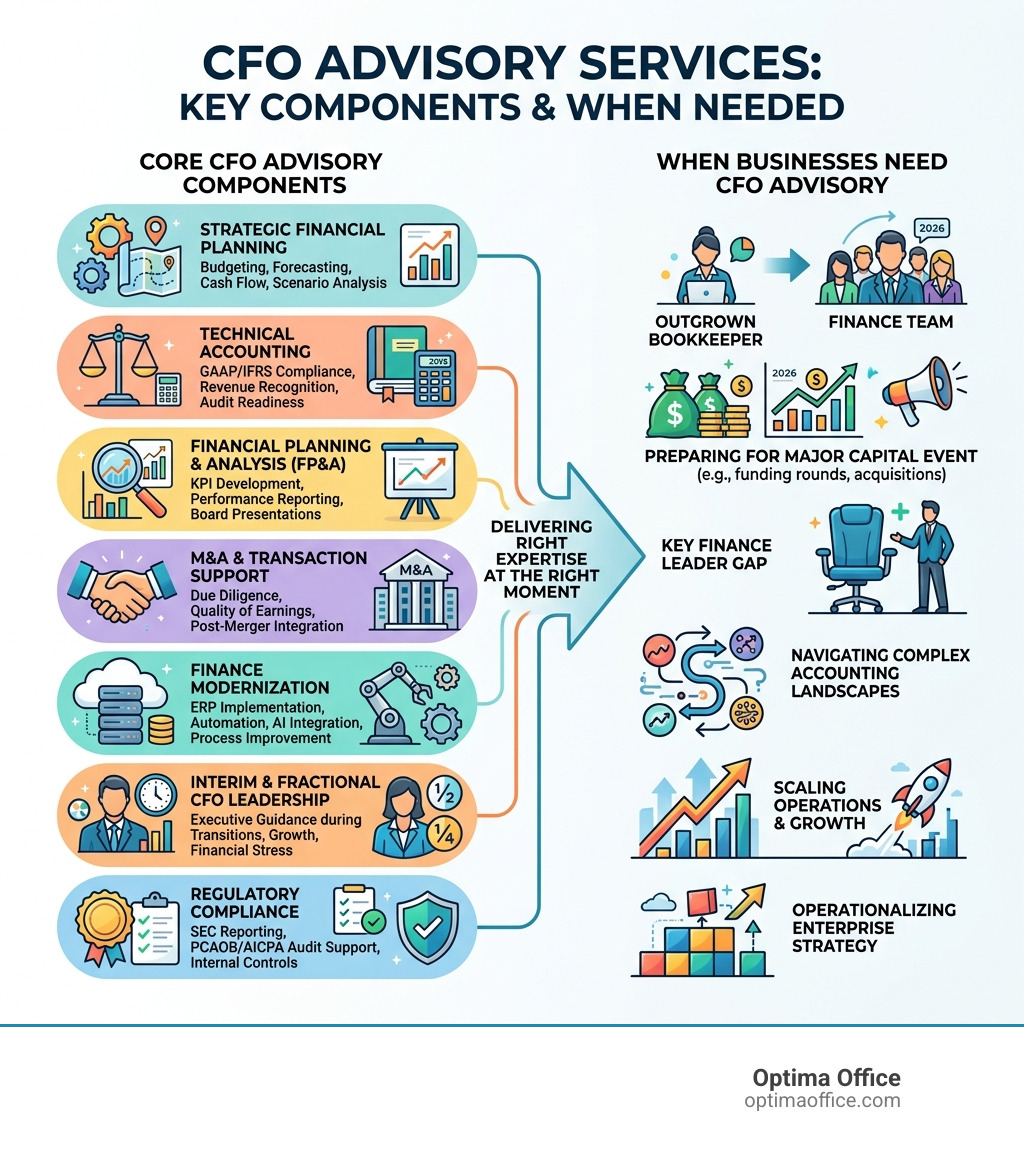
Here is what CFO advisory services typically include:
- Strategic financial planning: Budgeting, forecasting, cash flow management, and scenario planning.
- Financial reporting: Board-ready reports, key performance indicators, and executive dashboards.
- Technical accounting support: Revenue recognition, audit readiness, compliance support, and complex accounting guidance.
- Mergers and acquisitions support: Due diligence, valuation modeling, quality of earnings preparation, and post-transaction integration.
- Finance modernization: System upgrades, automation, artificial intelligence integration, and process improvement.
- Interim or fractional CFO leadership: Executive-level support during growth, transition, or financial pressure.
- Internal controls: Processes that help reduce errors, improve accountability, and protect financial integrity.
CFO advisory services are especially useful when a company has outgrown its current finance structure. That may happen when the business has a strong bookkeeper or controller, but leadership still lacks forward-looking analysis, strategic planning, and executive-level financial guidance.
Core Components of CFO Advisory Services
The role of the Chief Financial Officer has expanded from a back-office finance function into a strategic leadership role. CFO advisory services help companies access that leadership without adding a permanent executive too early.
A bookkeeper records transactions. A controller manages accounting processes, financial controls, and the monthly close. A CFO advisor looks ahead and helps leadership understand what the numbers mean for growth, cash flow, risk, and long-term strategy.
This distinction matters. Historical reporting shows what already happened. CFO advisory services help determine what should happen next.
A strong CFO advisor can help answer critical questions, such as:
- Can we afford to hire?
- Is our pricing model protecting margins?
- How much cash runway do we have?
- Which services or departments are most profitable?
- Are we ready for a lender, investor, or buyer review?
- What financial risks could slow growth?
That is the value of advisory support. It turns financial data into leadership clarity.
Situational Financial Leadership
The need for senior financial leadership rarely announces itself in advance. It tends to show up during a cash crunch, a lender review, a major hiring decision, or an acquisition opportunity. These situations require more than bookkeeping accuracy. They require strategic financial judgment.

CFO advisory services give business owners access to experienced financial leaders who have handled these situations before. Instead of relying on guesswork, leadership gets a second set of executive eyes on major financial decisions.
This is especially valuable during periods of uncertainty. When the stakes are high, financial leadership should not be improvised.
Strategic Benefits for Middle-Market and Growing Businesses
For many middle-market and growing businesses, the challenge is timing. The company is too complex for basic bookkeeping alone, but not quite ready for a full-time finance executive.
That is where CFO advisory services become practical. They provide senior financial guidance without forcing the business into a fixed executive salary before the need is consistent enough to justify it.
The benefits go beyond cost savings. A CFO advisor can help leadership see the business more clearly, reduce risk, improve profitability, and make better decisions with better data.
How CFO Advisory Services Drive ROI
Return on investment is not just about spending less than a full-time hire. It is about making smarter decisions that protect cash, improve efficiency, and support profitable growth.
CFO advisory services can help improve return on investment by:
- Strengthening cash flow forecasting
- Reducing financial surprises
- Improving margin visibility
- Identifying waste or trapped capital
- Creating cleaner reporting for leadership
- Supporting better lender or investor conversations
- Helping the company avoid costly mistakes during audits, transactions, or system changes
A full-time CFO can be the right move for larger companies with constant executive finance needs. But for many small and mid-sized businesses, advisory or fractional CFO support delivers the right level of expertise with more flexibility.
| Feature | Full-Time CFO | CFO Advisory / Fractional CFO |
|---|---|---|
| Annual Cost | $250k – $400k+ | $3k – $10k per month (typical) |
| Benefits/Equity | High | None |
| Deployment | 3-6 months to hire | 3-5 days (with Optima) |
| Focus | Daily Operations | Strategy & High-Value Projects |
| Scalability | Fixed | Flexible (up or down) |
Identifying the Need for External Expertise
Many companies wait too long to bring in CFO advisory support. By the time they ask for help, cash flow is already tight, financial reports are already unreliable, or leadership is already making major decisions without enough visibility.
Common signs your business may need CFO advisory services include:
- Month-end close takes too long.
- Financial statements are inconsistent or hard to trust.
- Leadership cannot clearly explain cash flow trends.
- Revenue is growing, but profit is not improving.
- The business is preparing for a capital raise, sale, or acquisition.
- Lenders, investors, or board members are asking for stronger reporting.
- The company is entering a new market or launching a new service line.
- Your current finance team is overwhelmed.
- You need financial modeling, but no one internally owns it.
- You are making major decisions from incomplete data.
External expertise can also help during talent gaps. If a finance leader leaves or the company cannot find the right full-time hire quickly, interim CFO advisory support can stabilize the function and keep leadership moving.

Modernizing Finance Through Technology and AI Integration
Finance modernization is one of the biggest opportunities for growing businesses, but technology alone does not fix a broken financial process.
Before implementing new software, dashboards, automation, or artificial intelligence tools, the company needs clean data, clear workflows, and a strategy for how financial information should move through the business.
CFO advisory services help companies modernize finance with discipline. The goal is not to add tools for the sake of adding tools. The goal is to create faster reporting, cleaner data, better controls, and more useful decision-making.
Implementing Intelligent Automation
Intelligent automation can reduce repetitive finance tasks, improve accuracy, and give leadership faster access to key information. But automation only works when the underlying process is sound.
A CFO advisor can help identify which tasks should be automated and which still require human oversight.
Common automation opportunities include:
- Invoice processing
- Accounts payable approvals
- Expense categorization
- Cash flow reporting
- Forecast updates
- Dashboard reporting
- Data consolidation
- Month-end close workflows
The best automation strategy starts with process improvement. If a company automates a messy workflow, it simply creates faster confusion.
A strong CFO advisor helps clean up the process first, then recommends the right technology to support it.
Optimizing ERP and Systems Integration
An Enterprise Resource Planning system, or ERP, can improve visibility across finance, operations, inventory, sales, and other business functions. But if the system is poorly designed or disconnected from the way the business operates, it can create more problems than it solves.
Finance systems should not operate in isolation. They need to connect with payroll, operations, customer relationship management, billing, and reporting tools where appropriate.
CFO advisory services can help companies evaluate, implement, or optimize systems such as QuickBooks Online, NetSuite, Sage Intacct, Microsoft Dynamics, SAP, or other platforms. The right advisor can also help clean up the chart of accounts, improve reporting structures, and create dashboards that leadership can actually use.
Clean systems create clean data. Clean data creates better decisions.
Navigating Complex Transactions and Regulatory Compliance
Major business events create financial pressure. Whether a company is preparing for an acquisition, raising capital, undergoing an audit, or managing a restructuring, leadership needs accurate data and strong financial controls.
CFO advisory services provide the transactional and compliance support needed to move through those moments with more confidence.
This support is especially valuable because the financial function is often tested hardest during high-stakes events. Investors, buyers, lenders, and auditors will look closely at the numbers. If the records are disorganized, the process slows down and confidence drops.
Preparing for Capital Events and Exits
Capital events require preparation. That may include fundraising, debt financing, private equity investment, mergers, acquisitions, or an eventual sale of the business.
A CFO advisor can support this process by helping with:
- Financial modeling
- Cash flow forecasts
- Investor reporting
- Valuation support
- Pitch deck financials
- Due diligence preparation
- Quality of earnings support
- Data room organization
- Scenario planning
- Post-transaction integration
The financial story must be clear. Buyers and investors want to understand how the business makes money, where the risks are, and whether growth is sustainable.
Weak financial reporting can delay a deal, lower confidence, or reduce valuation. Strong reporting gives leadership a better position in the conversation.
Ensuring Regulatory and Audit Readiness
Audit readiness is not something to build after the audit begins. It should be part of the financial operating rhythm.
CFO advisory services can help strengthen internal controls, organize documentation, improve reporting accuracy, and prepare the company for auditor, lender, investor, or board review.
For companies moving into more complex reporting environments, this may include support with Generally Accepted Accounting Principles, revenue recognition, financial statement preparation, and internal control documentation.
The more complex the business becomes, the more important it is to have disciplined financial processes. Clean records are not just an accounting preference. They are a leadership asset.
Selecting a Partner for CFO Advisory Services
Choosing the right CFO advisory partner is about more than credentials. The partner needs to understand your business model, your stage of growth, your leadership style, and the specific financial decisions you are trying to make.
A good advisor should not only produce reports. They should help you interpret those reports and turn them into action.
At Optima Office, we provide fractional CFO, controller, accounting, bookkeeping, and HR support for growing businesses. That integrated model matters because finance does not operate in a vacuum. Hiring, payroll, benefits, operations, and growth strategy all affect the numbers.
When selecting a CFO advisory partner, look for:
- Relevant experience: Have they worked with companies at your size and stage?
- Strategic judgment: Can they help leadership make decisions, not just read reports?
- Operational understanding: Do they understand how finance connects to the rest of the business?
- Technical expertise: Can they support audits, compliance, transactions, or system changes if needed?
- Communication skills: Can they explain complex financial issues clearly?
- Scalability: Can support increase or decrease based on business needs?
- Cultural fit: Will they work well with your existing leadership team?
The right partner should bring structure, clarity, and confidence. Not more complexity.
Frequently Asked Questions about CFO Advisory Services
How do CFO advisory services differ from traditional accounting?
Traditional accounting is usually focused on historical financial activity. It helps ensure transactions are recorded, statements are prepared, and tax or compliance requirements are supported.
CFO advisory services are forward-looking. They use financial data to guide strategy, forecasting, cash flow planning, growth decisions, risk management, and executive reporting.
Both functions matter. Accounting keeps the records accurate. CFO advisory helps leadership use those records to make better decisions.
When should a company consider engaging a CFO advisory firm?
A company should consider CFO advisory services when financial complexity starts outpacing the current team’s capacity.
Common triggers include rapid growth, cash flow pressure, delayed reporting, fundraising preparation, audit readiness, acquisition planning, system upgrades, leadership transition, or unclear profitability.
If your finance team can handle the daily tasks but struggles with forecasting, strategy, board reporting, or complex financial decisions, CFO advisory support may be the right next step.
What is the typical ROI of a CFO advisory engagement?
The return on CFO advisory services often comes from better cash flow management, improved profitability, stronger reporting, reduced financial risk, and smarter executive decisions.
Some businesses also see savings compared with hiring a full-time CFO before they are ready. Others see value through avoided mistakes, stronger lender or investor conversations, better pricing decisions, and improved operational efficiency.
The exact return depends on the company’s size, challenges, and goals. The clearest sign of value is when leadership can make faster, better decisions because the financial picture is no longer unclear.
Driving Enterprise Growth with Integrated Financial Leadership
The shift from tactical financial management to strategic financial leadership is essential for any business that wants to grow with control. Clean books matter, but they are only the foundation. Leadership also needs forecasting, analysis, planning, and financial guidance that connects directly to business goals.
CFO advisory services help companies navigate complexity with more confidence. Whether you are preparing for a capital raise, improving cash flow, modernizing finance systems, planning an acquisition, or trying to understand profitability, the right advisor can bring structure to the decision-making process.
At Optima Office, we help growing businesses build stronger financial leadership through customized CFO, controller, accounting, and bookkeeping support. Our team can help you move beyond reactive reporting and create a finance function that supports smarter growth.
Ready to strengthen your financial strategy? Explore Optima Office’s fractional CFO services to see how CFO advisory support can help your business improve cash flow, reduce risk, and make stronger decisions.