


Accurate bookkeeping in San Diego gives business owners the financial clarity they need to stay compliant, manage cash flow, and make stronger decisions. For small and mid-sized companies, bookkeeping is not just about tracking transactions. It is the system that keeps your finances tax-ready, audit-ready, and useful for growth planning.
If your business needs cleaner books, stronger reporting, or support after a bookkeeping backlog, Optima Office’s bookkeeping services can help you build a more reliable financial foundation.
Businesses rely on bookkeeping for more than basic recordkeeping. Messy books can delay tax filings, weaken investor conversations, hide profitability issues, and create cash flow blind spots. When a bookkeeper leaves unexpectedly or years of backlogged records pile up, the cost of getting things wrong compounds fast.
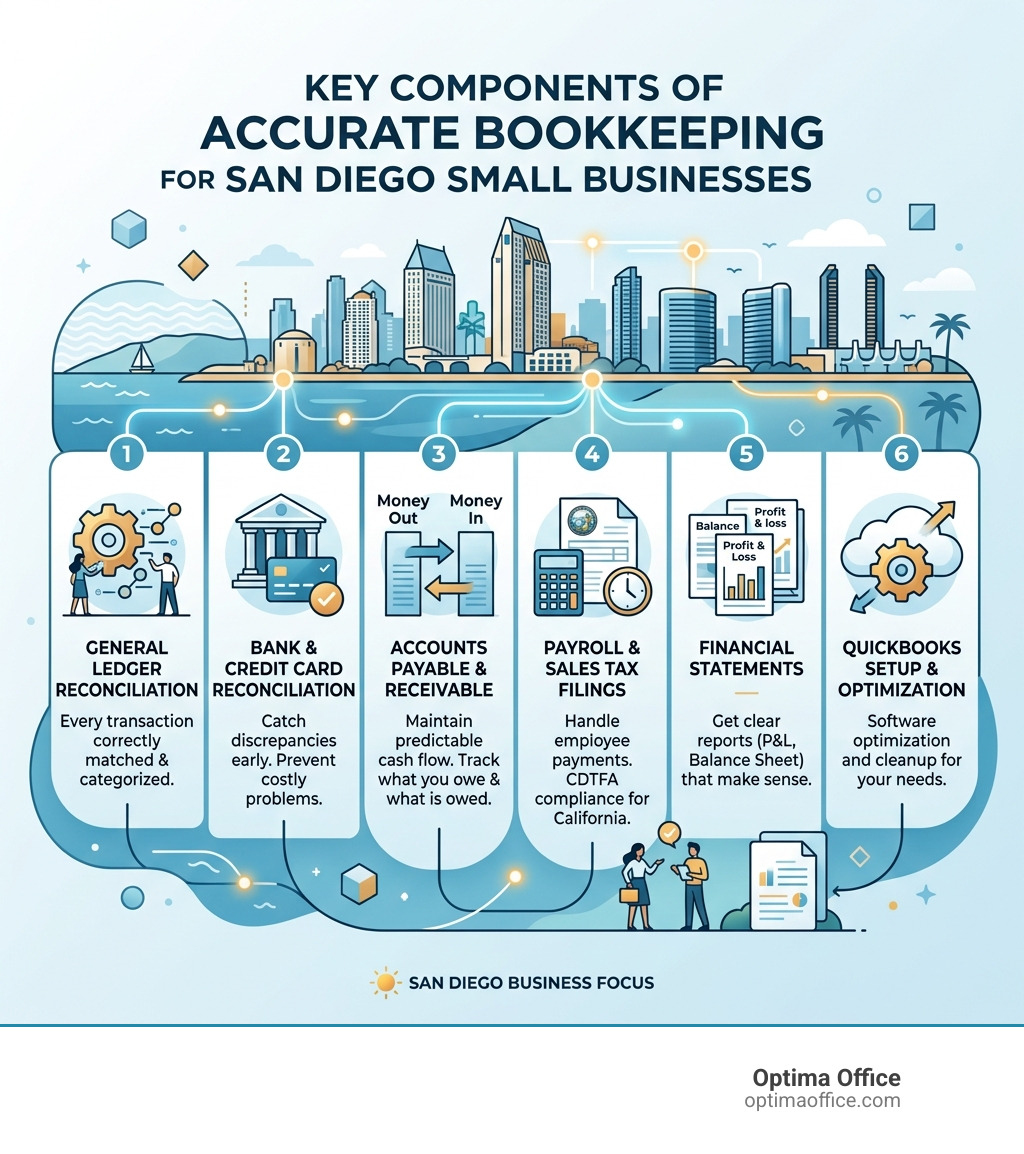
What accurate bookkeeping in San Diego includes:
- General ledger reconciliation: Keeping every transaction matched, categorized, and recorded correctly.
- Bank and credit card reconciliation: Catching duplicate charges, posting errors, and missing transactions before they distort reporting.
- Accounts payable and receivable management: Helping cash flow stay predictable.
- Payroll processing and sales tax filings: Supporting accurate payroll and California tax compliance.
- Financial statements: Providing balance sheets, profit and loss statements, and cash flow reports that business owners can actually use.
- QuickBooks setup, optimization, and cleanup: Making sure your bookkeeping software supports the way your business operates.
This guide explains what accurate bookkeeping looks like in practice, which services matter most for San Diego businesses, and how to build a financial management system that can scale with you.
Why Accurate Bookkeeping Matters for San Diego Businesses
When business owners think about financial health, they often focus on profit alone. In reality, the strength of a company depends on the integrity of its financial data. Clean books help leaders understand cash flow, evaluate risk, and make decisions with confidence.
Tax compliance is one of the most immediate benefits. San Diego businesses must meet local, state, and federal requirements, and inaccurate records can lead to missed deductions, penalties, interest, or avoidable filing issues. Audit readiness matters too. Whether the review is internal, external, or tax-related, organized books make the process more efficient and less disruptive.
Accurate data also supports better decisions. Current books show where cash is tied up, which projects generate margin, and where expenses are rising. That level of visibility turns bookkeeping from a back-office task into a management tool.
Essential Components of Accurate Bookkeeping in San Diego
To maintain accuracy, several core functions must work together. The general ledger is the master record of financial activity, and every transaction must be categorized correctly. Regular bank reconciliation validates that record by matching internal entries against bank and credit card statements.
This helps identify duplicate charges, posting errors, or missing transactions before they distort reporting. Without this discipline, financial statements can become unreliable, and leadership may end up making decisions from incomplete or inaccurate numbers.
A complete set of books should provide:
- Balance sheets: A snapshot of what the company owns and owes at a specific point in time.
- Profit and loss statements: A summary of revenue, costs, and expenses during a specific period.
- Cash flow reports: A clear view of how cash moves in and out of the business.
Long-Term Benefits for Small Businesses
Many Southern California businesses begin with a do-it-yourself approach, but complexity eventually outpaces that model. As operations grow, professional bookkeeping becomes necessary because transaction volume, payroll, vendor payments, tax obligations, and reporting needs become harder to manage casually.
Strong financial management also improves credibility with lenders and investors. If you are pursuing financing or preparing for investor conversations, your financials will likely be reviewed early. Sloppy records suggest weak oversight. Accurate books show control, discipline, and lower operating risk.
That gives owners more than clean reports. It gives them time back. Instead of reconciling receipts or chasing missing transactions, they can focus on leading growth.

Core Financial Management Services
Modern bookkeeping is far more than data entry. It includes the systems, processes, and controls that keep your financial operations running smoothly. For growing companies, outsourced bookkeeping can provide professional support without the cost of building a full internal finance department.
A strong bookkeeping partner helps keep transactions current, bills organized, invoices moving, payroll accurate, and reports useful. That matters because small financial issues rarely stay small for long. Missed invoices, late payments, uncategorized expenses, and unreconciled accounts can all create bigger problems if they are not addressed quickly.
Managing Accounts Payable and Receivable
Most business problems eventually trace back to cash flow. Managing accounts payable helps ensure bills are paid on time, vendor relationships stay strong, and the business avoids unnecessary late fees or credit issues.
Accounts receivable management is just as important. It helps the company get paid for work already completed through timely invoicing, accurate payment matching, and consistent follow-up. When accounts receivable is weak, revenue may look strong on paper while cash remains tight in the bank.
Efficient accounts payable and accounts receivable processes help prevent the cash crunch that often affects growing businesses. Clear workflows, invoice reminders, and bill payment systems create more predictable cash flow and make it easier to plan future investments.
Payroll and Compliance Expertise
Payroll is one of the most sensitive areas of business operations. A single mistake in payroll taxes, employee classification, or filing deadlines can create expensive consequences.
Comprehensive payroll support may include:
- Direct deposit setup: Helping employees get paid reliably and on time.
- Tax filings: Supporting accurate federal and state payroll tax submissions.
- Labor law compliance: Helping businesses stay aligned with California employment requirements.
- Local compliance: Addressing regional requirements that may affect the workforce.
Payroll also connects closely to bookkeeping because labor is often one of the largest expenses in a business. Accurate payroll records help leadership understand labor costs, margins, and staffing decisions with more clarity.
Leveraging Modern Tools for Financial Clarity
Accurate bookkeeping in San Diego now depends on reliable software, automation, and clean workflows that reduce manual errors and improve visibility.
Modern bookkeeping tools allow business owners and finance teams to see more current financial data. That means you do not have to wait until the end of the month, quarter, or year to understand how the business is performing.
Technology is valuable, but only when it is set up correctly. A messy chart of accounts, inconsistent categorization, or disconnected systems can still produce confusing reports. The goal is not just to use software. The goal is to build a system that produces reliable financial information.
Optimizing Your Accurate Bookkeeping San Diego Workflow
QuickBooks Online has become a standard accounting platform for many small and mid-sized businesses because it offers cloud-based access and strong integration options. Business owners and bookkeeping teams can view financial data from different locations, which makes collaboration easier.
However, accounting software is only as strong as its setup. The chart of accounts, transaction rules, integrations, permissions, and reporting structure all need to reflect how the business actually operates.
At Optima Office, we understand that growing companies need more than someone to “do the books.” They need a financial support system that can handle daily reconciliations, monthly reporting, cleanup projects, and strategic planning. Our team provides a customized mix of bookkeeping, accounting, controller, and fractional CFO services based on the company’s needs.
Security Protocols and Data Integrity
With financial data moving to the cloud, security has to be part of the bookkeeping process. Professional bookkeeping teams use controls that help protect sensitive financial information, including multi-factor authentication, restricted access levels, secure document sharing, and clear approval workflows.
Data integrity matters just as much as access security. If the wrong people can edit records, approve payments, or change vendor information without oversight, the business faces unnecessary risk.
Well-built systems create a clear digital trail. That makes records easier to review, easier to audit, and easier to trust.
Overcoming Backlogs With Cleanup and Compliance
It is common for fast-growing San Diego businesses to fall behind on bookkeeping. Maybe the owner was focused on sales. Maybe a previous bookkeeper left unexpectedly. Maybe transactions were recorded inconsistently for months or even years.
No matter how the backlog happened, unrecorded transactions and unreconciled accounts create risk. They can delay tax filings, distort profitability, weaken cash flow planning, and make it hard to know where the business actually stands.
Cleanup bookkeeping brings the records back into order so the company can move forward with confidence.
Rapid Cleanup for Tax Readiness
Financial cleanup is the process of untangling backlogged or inaccurate records. This may include reviewing historical bank statements, categorizing old transactions, reconciling accounts, correcting duplicate entries, and cleaning up the chart of accounts.
A cleanup project may include:
- Transaction categorization: Reviewing old bank and credit card activity to properly label income and expenses.
- Bank reconciliations: Matching software balances against historical bank statements.
- Catch-up bookkeeping: Bringing past records current so reporting becomes usable again.
- Error correction: Fixing duplicate entries, misclassified expenses, and missing transactions.
- Tax preparation support: Organizing records so tax professionals have cleaner information to work from.
This work is essential for tax readiness. It also creates a clean foundation for future reporting, planning, and growth.
Specialized Industry Compliance
Different industries have different bookkeeping requirements. A strong bookkeeping system should reflect how the company earns revenue, manages costs, handles compliance, and reports performance.
For example:
- Construction businesses: Need job costing, project profitability tracking, and careful management of vendor payments and subcontractor costs. For businesses in this space, construction accounting support can help strengthen project-level visibility.
- Nonprofit organizations: Need fund accounting, grant tracking, restricted fund reporting, and board-ready financials. Nonprofit accounting support can help organizations maintain transparency and accountability.
- Professional services firms: Need clean revenue tracking, payroll visibility, profitability by client or project, and reliable reporting. Professional services accounting can help firms connect financial data to smarter business decisions.
Industry-specific bookkeeping matters because generic reports often miss the details that leadership actually needs.
Frequently Asked Questions About San Diego Bookkeeping
What Is the Difference Between a Bookkeeper and a Controller?
A bookkeeper focuses on daily financial tasks, including transaction entry, bank reconciliations, accounts payable, accounts receivable, and basic reporting. The bookkeeper helps make sure the financial data going into the system is accurate.
A controller provides a higher level of oversight. Controllers review reports, manage accounting processes, support internal controls, and help ensure financial practices are consistent and reliable. If your business has grown beyond basic bookkeeping, Optima Office’s financial controller services may be the next step.
Why Does My Business Need More Than Just a Basic Bookkeeper?
A basic bookkeeper may keep transactions organized, but a growing business often needs more strategic financial insight. As your company scales, you may face more complex questions around cash flow, profitability, payroll, tax planning, budgeting, and financial reporting.
A stronger finance team can help turn bookkeeping data into decisions. That may include controller support, fractional CFO guidance, or outsourced accounting services depending on your stage of growth.
How Much Do Professional Bookkeeping Services Cost in San Diego?
The cost of professional bookkeeping services in San Diego depends on transaction volume, number of accounts, payroll complexity, reporting needs, cleanup requirements, and industry-specific compliance.
While bookkeeping may look like an added expense, accurate records often pay for themselves by helping prevent tax penalties, identify wasted spending, support deductions, and improve business decisions.
Building a Stronger Financial Foundation
Accurate bookkeeping gives San Diego businesses the structure they need to manage cash flow, prepare for taxes, support financing conversations, and scale with confidence. Clean books are not just about historical records. They are the foundation for better decisions.
At Optima Office, we help companies move beyond basic bookkeeping with customized accounting, controller, and fractional CFO support. Whether you need cleanup bookkeeping, monthly reconciliations, financial reporting, or a stronger long-term finance function, our team can help you build the right level of support.
Explore Optima Office’s bookkeeping services to see how accurate bookkeeping can help your business protect cash flow, reduce risk, and make every decision from cleaner numbers.