
Accounting outsourcing is the practice of contracting your financial tasks like bookkeeping, payroll, tax preparation, and financial reporting to an external specialist team instead of managing them in-house. It helps businesses reduce costs, improve accuracy, and focus on what they do best.
Quick Answer: What You Need to Know About Accounting Outsourcing
- Cost Savings: Many businesses spend less than they would on hiring full-time staff.
- Core Services: Bookkeeping, accounts payable/receivable, payroll, tax preparation, financial reporting.
- Key Benefits: Access to professional expertise, more reliable, audit-ready financial data, and more time for strategic work.
- Who Benefits Most: Small to mid-sized businesses dealing with turnover, lacking financial leadership, or experiencing rapid growth.
- Technology Edge: Cloud-based platforms provide real-time visibility and automation.
- Security: Reputable providers offer strong data protection and compliance controls.
If you are spending too much time managing your books, your controller just left, or your board is demanding financial reports you cannot easily produce, you are not alone. The finance and accounting outsourcing market is growing quickly, and industry research projects it to roughly double by the early 2030s — and there is a clear reason.
Most business owners did not start their companies to wrestle with QuickBooks or chase down unpaid invoices. They started to build something meaningful. Outsourcing the finance function can transform the accounting system, improve reporting, and save hours each month.
A shortage of skilled accounting staff is one of the most common reasons businesses consider outsourcing. Between talent shortages, wage pressures, and increasingly complex regulations, the traditional in-house accounting model is breaking down for many small and mid-sized companies.
This guide explains the real benefits beyond cost savings, what services you can outsource, how to choose the right provider, and how to keep your financial data secure, so you can outsource your books without losing control of your business.
The Core Benefits: More Than Just Cost Savings
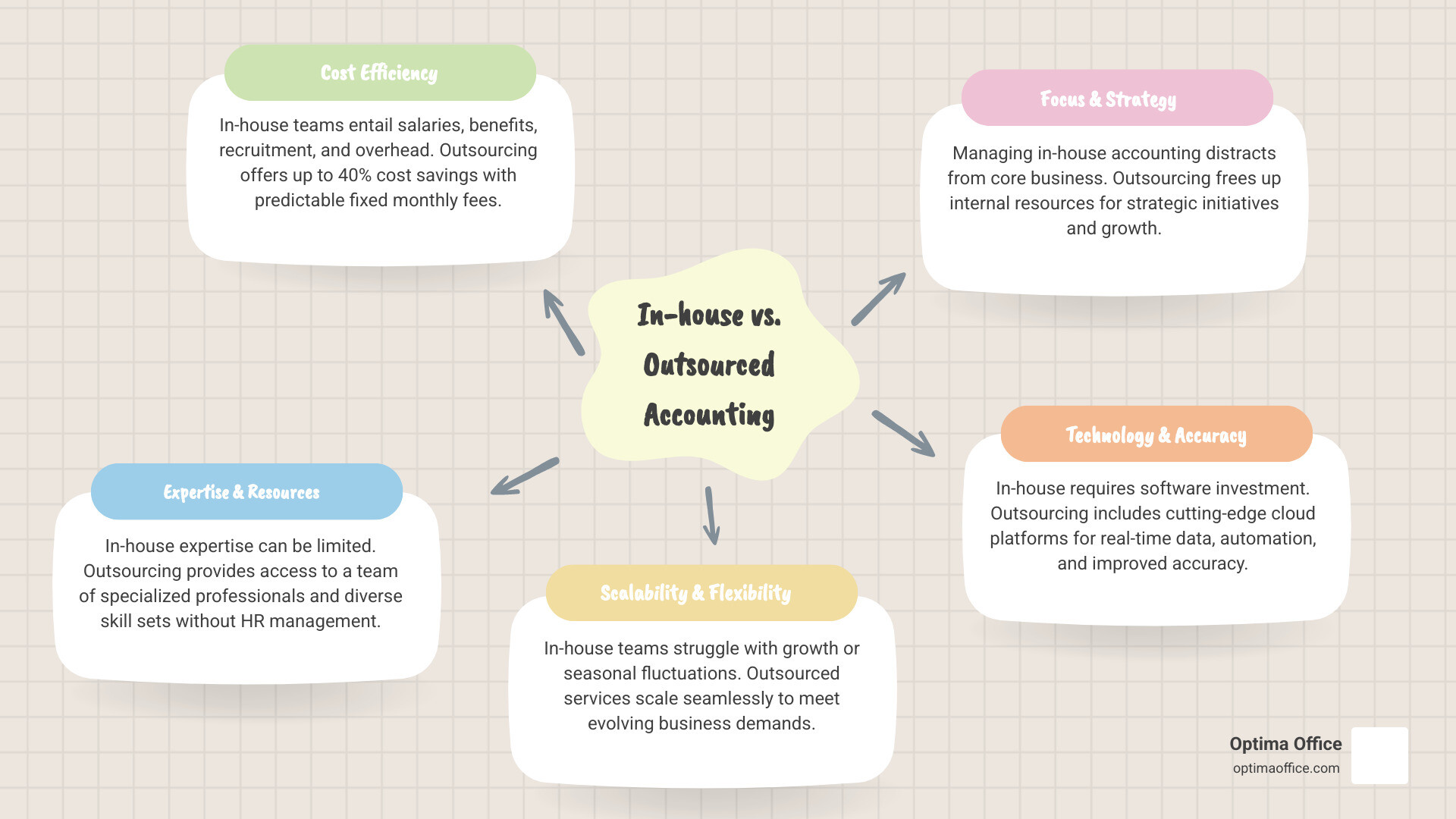
Many businesses turn to accounting outsourcing for cost savings. The true value, however, lies in the strategic advantages that support growth and resilience.

Reduce Costs and Improve Efficiency
Hiring an in-house accounting team is expensive. Beyond salary, you have payroll taxes, benefits, recruitment costs, and overhead. Accounting outsourcing converts many of these costs into a predictable monthly fee, which often costs less than full-time staff.
This model also increases efficiency. Specialized teams use streamlined workflows and cloud technology to automate manual tasks. The result is faster, more accurate financial reporting, with books that are up-to-date and audit-ready. Outsourcing offers scalability as well, allowing you to adjust services based on business needs during growth or slower periods.
Focus on Your Core Business
Business owners should focus on strategy and growth, not daily reconciliations. Outsourcing day-to-day financial tasks frees up time and mental energy for higher-value work, and many businesses find they can focus more on core operations after outsourcing.
By delegating bookkeeping, payroll, and accounts payable, your team can concentrate on innovation, customer acquisition, and strategic planning. With an outsourced team, you also gain access to specialized skills, from controllers to CFOs, without the cost of hiring them full-time.
A Spectrum of Services: What to Outsource
One of the strengths of accounting outsourcing is its versatility. It is not a one-size-fits-all solution, but a flexible framework that can be customized to your unique business needs, from startups needing basic bookkeeping to established enterprises requiring high-level financial strategy.

You can pick and choose the specific services that make the most sense for your company, creating a scalable package that grows with you.
Common outsourced accounting services include:
- Bookkeeping: Daily transaction recording, general ledger maintenance.
- Accounts Payable (AP): Invoice processing, vendor payments.
- Accounts Receivable (AR): Customer invoicing, collections, cash forecasting.
- Bank Reconciliation: Matching bank statements with internal records.
- Payroll Processing: Employee payments, deductions, and tax filings.
- Tax Preparation & Planning: Preparing and filing tax returns and identifying tax-saving opportunities.
- Financial Reporting: Generating P&L, Balance Sheet, and Cash Flow statements.
- Budgeting & Forecasting: Developing financial plans and predicting future performance.
- Cash Flow Management: Optimizing cash inflows and outflows.
- Virtual CFO/Controller Services: Strategic financial planning and risk management.
- Audit Support: Preparing documentation and assisting with audits.
- Compliance Reporting: Ensuring adherence to industry regulations.
Foundational Bookkeeping and Compliance
Meticulous bookkeeping and compliance are at the heart of any sound financial operation. These tasks are crucial but can be time-consuming and error-prone without experienced professionals.
An outsourced team ensures that daily transactions are accurately recorded, the general ledger is maintained, and bank accounts are reconciled. This provides clear financial visibility and supports informed decisions. Handling supplier invoices (Accounts Payable) and tracking customer payments (Accounts Receivable) externally can also help improve cash flow.
Payroll processing and tax preparation demand precision and adherence to changing regulations. Errors can result in penalties and compliance issues. External specialists manage wages, deductions, payroll tax forms, and tax filings so you remain compliant and can optimize your tax position.
By entrusting these foundational tasks to experts, you gain peace of mind and a solid base for growth.
Strategic Financial Oversight
While foundational services keep your financial engine running, strategic financial oversight moves your business toward its long-term goals. Many small and mid-sized companies cannot justify a full-time CFO or Controller but still need senior-level guidance.
Outsourced management accounting turns financial data into actionable insights with detailed reporting such as profit and loss statements, balance sheets, and cash flow statements. Budgeting and forecasting support realistic financial plans and help predict future cash needs.
For businesses seeking integrated leadership, virtual CFO services provide strategic financial planning, risk management, and support for owners and stakeholders. This gives you access to experienced financial executives on a fractional basis.
The Future is Here: Technology and Trends in Outsourced Accounting
The accounting outsourcing market is evolving quickly, driven by technology — especially cloud accounting software and the growing use of AI and automation.
The Role of Technology and Automation
Modern accounting outsourcing relies heavily on technology. Cloud platforms like QuickBooks and Xero have changed financial management, offering real-time insights from anywhere.
Automation reduces manual data entry and helps minimize errors. AI tools support tasks like transaction coding, anomaly detection, and predictive analytics. Clients gain access to a modern tech stack without having to build it themselves.
Navigating Regulations and Future Trends
Staying compliant with changing tax laws and regulations, especially in complex environments like California, is challenging. Accounting outsourcing gives you access to professionals who monitor regulatory updates and help you avoid penalties.
The future of outsourcing will feature deeper use of AI, better integrations between systems, and more real-time collaboration. As the market grows, businesses that leverage these tools can expect more efficient processes and clearer financial insight.
The Blueprint for Successful Accounting Outsourcing
Choosing to outsource your accounting is a significant decision, and doing it well requires a thoughtful approach. It is not just about handing off tasks; it is about creating a strategic partnership that aligns with your business goals.
When you evaluate providers in San Diego and Southern California, it is important to look beyond the surface and assess a potential partner’s expertise, technology, security protocols, and scalability. This selection process is your first line of defense in risk mitigation and helps ensure you choose a provider that can operate as an extension of your team.
Consider this table when evaluating potential accounting outsourcing partners:
| Key Factor | Description | What to Look For |
|---|---|---|
| Expertise & Specialization | The provider’s knowledge of your industry and specific accounting needs. | Certifications (CPA, etc.), industry-specific experience, client testimonials, and case studies. |
| Technology & Software | The tools and platforms they use to manage your finances. | Proficiency in modern cloud accounting software, secure data-sharing platforms, and automation capabilities. |
| Communication & Reporting | How they will communicate with you and provide financial insights. | A dedicated point of contact, regular meeting schedules, clear and customizable reporting, and proactive communication. |
| Security & Compliance | How they protect your sensitive financial data. | Robust data encryption, secure servers, documented disaster recovery plans, and adherence to relevant regulations. |
| Scalability & Flexibility | Their ability to adapt as your business grows or changes. | Tiered service packages, ability to add or remove services, and a track record of supporting growing businesses. |
| Pricing & Contracts | The cost structure and terms of the agreement. | Transparent, all-inclusive pricing (avoiding hidden fees), clear contract terms, and a straightforward cancellation policy. |
Frequently Asked Questions About Accounting Outsourcing
How much can a business actually save by outsourcing accounting?
Many businesses spend less by outsourcing their accounting than they would on full-time staff, since outsourcing converts salaries, benefits, payroll taxes, and recruitment overhead into a single predictable monthly fee.
What size business benefits most from outsourced accounting?
Small and mid-sized businesses and nonprofits tend to benefit most — particularly companies with about $3M to $50M in annual revenue, and those dealing with staff turnover, no in-house financial leadership, or rapid growth that has outpaced their current bookkeeping setup.
What accounting functions can be outsourced?
Common services include bookkeeping, accounts payable and receivable, bank reconciliation, payroll processing, tax planning support (coordinated with your CPA), financial reporting, budgeting and forecasting, cash flow management, virtual CFO/controller services, audit support, and compliance reporting. Businesses can mix and match services rather than outsourcing everything at once.
Does outsourcing mean losing control over our financial data?
No. Reputable providers use cloud-based platforms like QuickBooks and Xero that give business owners real-time visibility into their own books, along with documented security protocols, data encryption, and disaster recovery plans.
Can outsourcing replace the need for a CFO or financial controller?
Yes, on a fractional basis. Virtual CFO and controller services provide strategic financial planning, risk management, and senior-level financial leadership without the cost of a full-time executive hire — useful for companies that can’t yet justify a full-time CFO salary.
How do we choose the right outsourced accounting provider?
Evaluate potential partners on expertise and industry specialization, the technology and cloud platforms they use, their communication and reporting cadence, their security and compliance protocols, their ability to scale services up or down, and whether their pricing is transparent with clear contract terms.
Get Better Outsourced Accounting Services with Optima
Accounting outsourcing is more than a cost-cutting measure; it is a strategic move for growth. From lowering overhead to gaining the freedom to focus on your core business, outsourcing provides access to specialized expertise in an increasingly complex financial landscape.
For small and mid-sized businesses in San Diego and Southern California, talent shortages and rising costs make the traditional in-house model difficult. With Optima Office, you get the benefits of a complete finance and HR department for a fraction of the cost of hiring internally. Our outsourced controllers, fractional CFOs, and accountants bring the right expertise and can be deployed quickly.
Outsourcing your accounting allows you to maximize profits, minimize risk, and support long-term growth without losing visibility or control.