

As financial management evolves in 2026, artificial intelligence is reshaping how leadership teams navigate reporting, forecasting, and operational growth. Over 44% of mid-market organizations have integrated generative capabilities, while total technology allocations have increased by 65% across modern enterprise workflows. Despite this momentum, business owners and CFOs frequently face implementation barriers when transitioning from basic automation to fully autonomous execution. This comprehensive guide outlines how modern finance operations leverage advanced technology to streamline close processes, optimize capital, and drive strategic decision-making.
AI in Finance and Accounting Core Applications and Use Cases

Modern finance operations are rapidly moving past basic data entry automation into sophisticated analytical workflows. Deploying ai in finance and accounting allows organizations to transition from historic record-keeping to proactive decision support. Today, finance teams leverage artificial intelligence across three primary areas: reporting, strategic forecasting, and cash management.
Enhancing Financial Reporting Dashboards and Close Processes with AI in Finance and Accounting
The traditional month-end close process is historically labor-intensive, error-prone, and concentrated into a stressful multi-day sprint. By implementing modern artificial intelligence tools, finance teams can shift toward a continuous close framework. Automated anomaly detection algorithms scan general ledger entries in real time, surfacing unexpected variances and double entries long before the books are officially scheduled to close.
These intelligent systems match bank transactions against outstanding invoices and receipts with high precision, flagging only complex exceptions for human review. Utilizing automated reporting infrastructure streamlines data gathering from multiple business management applications into unified financial views. Consequently, finance professionals reduce manual data-crunching time by 20% to 30%, giving them back valuable hours to investigate underlying variances rather than manually copying spreadsheet rows.
Strategic Planning, FP&A, and Predictive Forecasting
Financial Planning and Analysis (FP&A) thrives on accurate predictive insights, yet traditional spreadsheet projections often suffer from static assumptions. AI-driven predictive modeling continuously integrates operational metrics, historical trends, and external macroeconomic data to produce rolling projections. These tools automatically draft variance commentary, explaining exactly why actual revenues or operational expenses deviated from the budgeted baseline.
Scenario planning becomes significantly faster when powered by advanced language and predictive models. CFOs and financial analysts can quickly simulate complex decisions, such as adjusted pricing structures or supply chain disruptions, to evaluate their projected impact on EBITDA and cash runway. This shifts the internal perception of the finance team from back-office scorekeepers to essential strategic growth partners.
Working Capital Management and Cost Optimization
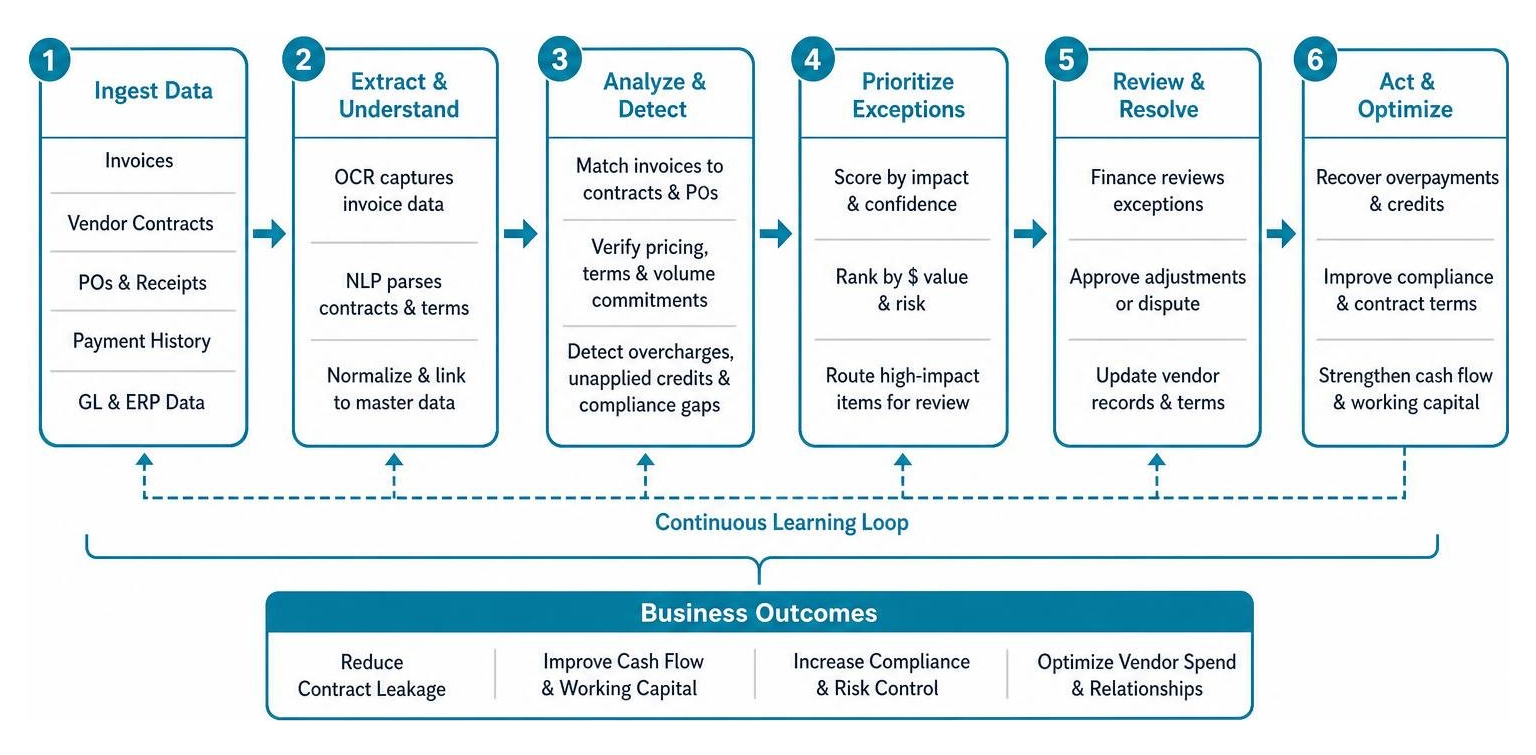
Managing working capital requires total visibility into cash inflows, payment terms, and vendor spend. Machine learning algorithms analyze historical customer payment patterns to accurately project cash collections and flag accounts receivable that carry a high probability of late payment or default. On the accounts payable side, computer vision and natural language processing extract line-item detail from incoming invoices with exceptional speed.
Beyond basic invoice processing, autonomous systems audit multi-page vendor contracts against actual billing data to detect cumulative volume discounts, unapplied credits, or improper fee escalations. For example, enterprise implementations have successfully identified vendor contract leakage equal to 4% of total spend by catching compliance errors before payments were processed. Furthermore, using large language models to categorize indirect corporate expenditures into granular taxonomies helps companies eliminate operational waste and optimize spend across vendor categories.
AI Strategy: Leaders vs. Beginners, Governance, and Decision Frameworks

A clear structural divide exists between organizations successfully capturing value from modern technology and those stalled in endless pilot programs. While nearly 72% of businesses are actively piloting or using artificial intelligence in financial reporting, execution maturity varies wildly. Organizations that establish formal strategies and risk management frameworks achieve far greater returns on their investments.
Mitigating Security, Data Privacy, and GenAI Risks
While advanced financial technology brings immense operational speed, it also creates distinct security exposures that require robust internal controls. Generative tools increase corporate exposure to sophisticated phishing and financial fraud, with industry projections estimating AI-enabled fraud losses in the US could reach $40 billion by 2027. Additionally, 96% of finance leaders express concern regarding data integrity when unvalidated inputs enter automated workflows.
Mitigating these risks requires establishing clear governance protocols prior to software deployment. Businesses must mandate that employee inputs do not train public language models, preventing confidential balance sheet details from leaking into public training datasets. Independent audits of underlying data infrastructure, rigorous vendor security reviews, and strict human oversight loops ensure financial outputs remain complete, compliant, and auditable.
Build vs. Buy: Selecting Solutions for AI in Finance and Accounting
When evaluating modern software platforms, leadership teams face a critical choice between purchasing established commercial solutions or building custom applications. For the vast majority of small to mid-sized businesses, purchasing specialized commercial platforms represents the most cost-effective path forward. Commercial software vendors possess deep vertical focus, embedded accounting logic, and pre-built compliance workflows for established standards like ASC 842 and ASC 606.
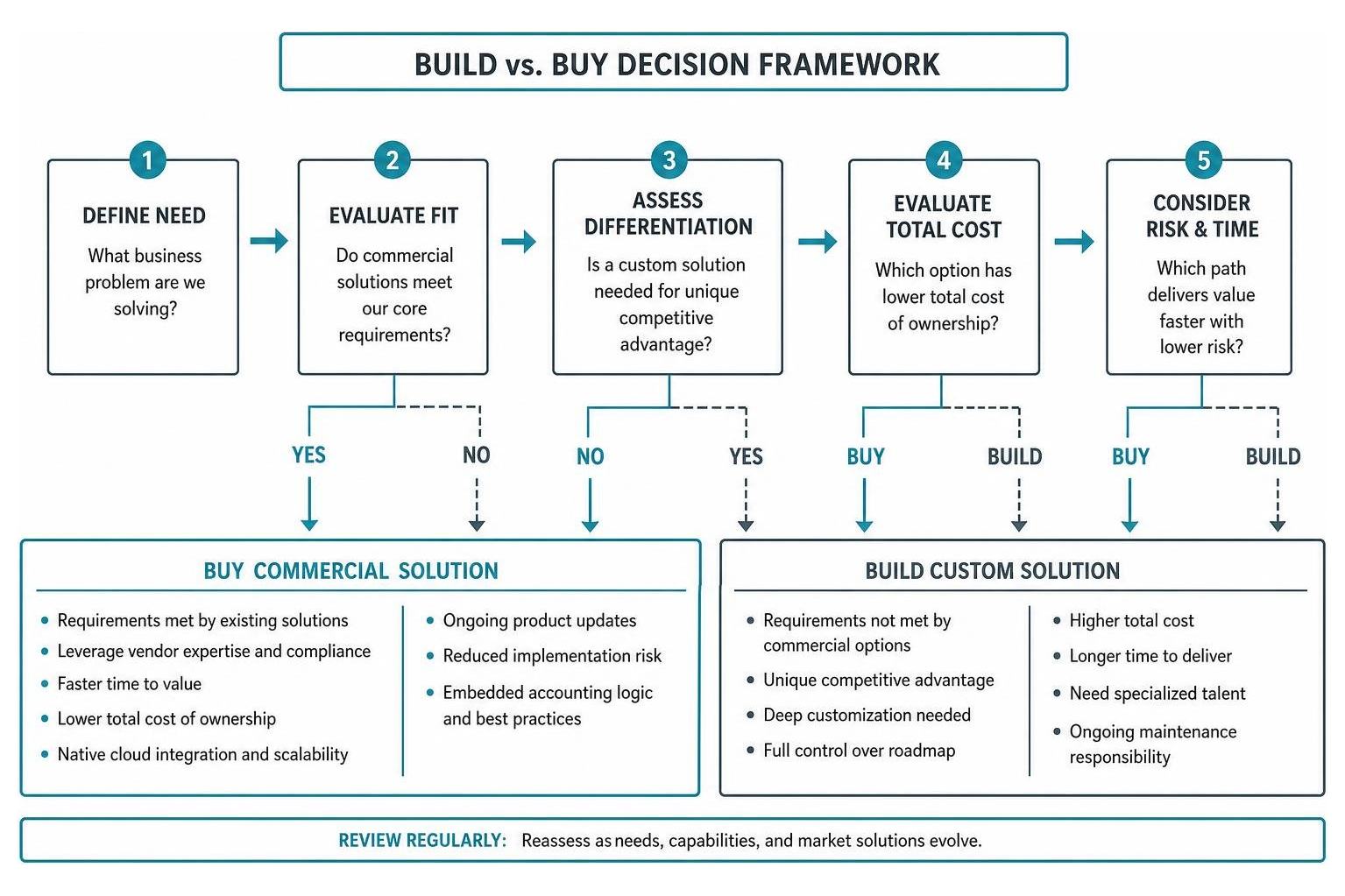
Building custom solutions requires significant ongoing capital investment, specialized data engineering talent, and constant technical maintenance. Custom language models also risk producing probabilistic output errors if they lack vertical financial design. Purchasing commercial tools allows organizations to launch capabilities quickly, ensure native cloud integration, and lower total ownership costs while maintaining administrative flexibility.
Overcoming Adoption Barriers: Talent, Data Quality, and Change Management

Despite rising capital allocations toward modern technology, scaling automated workflows across an entire business remains difficult. Surveys show that 57% of executives cite limited technical skills as their primary adoption barrier, while 53% report concerns over data security vulnerabilities. Overcoming these hurdles requires a disciplined focus on data hygiene, team education, and targeted change management.
- Standardize processes first: Clean and streamline core manual workflows before applying complex software tools to avoid automating inefficient operations.
- Audit foundational data: Deduplicate, clean, and standardize historical accounting records to eliminate erroneous inputs.
- Implement domain-by-domain: Roll out software transformation across specific modules—such as accounts payable—rather than attempting a firm-wide launch all at once.
- Focus on team upskilling: Train existing accounting staff on prompt structure, data validation, and automated platform management.
- Maintain human oversight: Establish structured review procedures where financial professionals validate output accuracy before finalizing client or executive reports.
Addressing the Financial Talent Shortage with Technology
The accounting profession faces an ongoing structural shortage of credentialed professionals, making recruitment and staff retention primary operational risks for business leaders. Modernizing technology architectures helps bridge this talent gap by automating high-volume administrative tasks, allowing accounting professionals to focus on strategic client advisory functions. By delegating repetitive data processing to intelligent platforms, organizations maximize the impact of their existing teams. This strategic realignment ensures that financial staff remain engaged in high-value analysis rather than manual data entry.
Research indicates that 99% of CFOs prioritizing technology updates agree that modern tools are vital for attracting and retaining top-tier financial talent. Furthermore, 57% of financial executives prioritize hiring professionals with technical software skills to build a forward-thinking finance function. Integrating smart automation mitigates burnout, increases job satisfaction, and optimizes operational productivity without requiring immediate headcount expansion.
Change Management and Team Upskilling
Technology deployments frequently stall due to organizational resistance and inadequate communication rather than technical flaws. Research shows that 91% of organizations feel unprepared to deploy generative technology responsibly, and 44% of employees report they do not understand the underlying purpose of organizational shifts. Leadership must actively bridge this communication gap to ensure successful long-term adoption.
To build trust, business owners and CFOs should communicate clearly how automated tools enhance individual job roles rather than replace human workers. Training programs should focus heavily on human-in-the-loop review processes, prompt structures, and critical analytical evaluation of software outputs. By empowering finance professionals to become expert platform managers, businesses build a resilient culture that embraces technological change.
The Future Trajectory: Agentic AI and Autonomous Workflows
The technological horizon for modern finance operations is shifting from simple text generation to dynamic, autonomous execution. Emerging autonomous agents possess contextual awareness, allowing them to independently pursue high-level objectives, execute multi-step analytical workflows, and make contextual decisions across different software systems with minimal manual oversight. These advanced tools evaluate operational data in real time to trigger appropriate cross-platform accounting actions without direct intervention. As a result, finance departments can maintain continuous operational velocity while preserving internal controls.

In empirical operational studies, deploying autonomous agents to handle multi-step financial reporting workflows reduced execution time from over 10 minutes per report down to two and a half minutes—a massive 75% reduction in processing time compared to manual execution. By utilizing structured reasoning prompts and automated cross-system actions, autonomous agents can detect incoming documents, log details in central general ledgers, execute complex mathematical reconciliations, and draft summary reports for human review. This dramatic increase in speed allows controllers to focus on verifying anomalous transactions rather than manually assembling ledger entries. Furthermore, automated logging creates an unalterable audit trail across all connected business applications.
As these tools mature between 2026 and 2030, the primary role of business controllers and CFOs will transition entirely from execution to strategic oversight and business partnering. Managing these complex technical environments requires specialized guidance, robust risk management frameworks, and deeply aligned financial leadership. Executive leaders must continually evaluate emerging technical capabilities to maintain an efficient back-office operating model. Forward-thinking firms that embrace agentic automation will establish significant competitive advantages in operational agility.
Frequently Asked Questions About AI in Finance
Can Generative AI models be trusted to perform financial math?
Standard large language models generate text based on probabilistic patterns rather than exact mathematical processing. Consequently, unassisted general language models cannot be trusted to perform complex financial math without verification. Finance teams must utilize specialized vertical platforms, integrated python interpreters, or embedded spreadsheet engines where artificial intelligence models generate execution logic while underlying spreadsheet tools handle precise calculations.
What is the difference between Vertical AI and Agentic AI in accounting?
Vertical platforms are software solutions engineered specifically around industry domain logic, accounting standards, and regulatory frameworks to handle defined tasks like lease accounting or revenue recognition. Autonomous agents represent a broader technological jump because they dynamically pursue open-ended operational goals across disparate systems. These intelligent agents navigate multiple software applications independently and execute complex end-to-end workflows while adapting to unexpected data exceptions along the way. While vertical solutions excel at predictable standard processes, agentic frameworks offer the flexibility needed for multi-system financial operations.
How can resource-constrained companies implement AI effectively?
Small and mid-sized businesses can capture high-value technological benefits without massive capital expenditure by taking a targeted, phased approach. Rather than attempting custom internal software development, smaller firms should leverage native cloud financial platforms that feature built-in machine learning features. Partnering with external financial advisors also provides immediate access to expert technical oversight and enterprise-grade software stacks without the heavy overhead of full-time internal hires.
Building a Scalable, AI-Enabled Finance Operation
Navigating the rapid evolution of ai in finance and accounting requires a clear strategic balance between advanced technology and proven human expertise. Modern artificial intelligence platforms deliver unmatched operational speed, precise anomaly detection, and real-time financial reporting dashboards, yet their success relies entirely on strong underlying processes, accurate data structures, and experienced oversight. Business leaders who combine intelligent tools with expert financial management position their organizations to lower overhead, mitigate financial risk, and unlock sustainable long-term profitability.
At Optima Office, we bring business owners and executive teams the precise blend of strategic leadership and operational expertise required to thrive in a digital-first economy. Whether you need fractional financial executive guidance, controller oversight, accounting support, or human resources advisory, our team deploys rapidly to build a scalable back-office architecture tailored to your goals. To learn how our custom outsourced finance solutions can modernize your operations and accelerate enterprise growth, contact our expert advisors today.
Author: Optima Office