

Interim CFO services are short-term engagements where an experienced finance executive steps into your organization to provide strategic financial leadership, typically for 3 to 12 months, during a transition, crisis, or period of rapid growth.
Here’s a quick look at what they cover:
- Who they’re for: SMBs facing a leadership gap, financial crisis, M&A activity, or rapid scaling
- What they do: Strategic oversight, cash flow management, board reporting, financial planning, and due diligence
- How long they last: Usually 3 to 12 months, full-time
- What they cost: Typically 30% to 70% less than hiring a permanent CFO
- How fast they deploy: Often in as little as two weeks
If your CFO just left, your books are a mess, or investors are asking questions you can’t answer, an interim CFO can step in fast and stabilize things.
Running a business between $3 million and $15 million in revenue is hard enough. When your financial leadership disappears, or was never there to begin with, the pressure compounds quickly. Boards want reports. Lenders want clean numbers. And you’re still trying to run the business.
That’s exactly the gap interim CFO services are designed to fill.
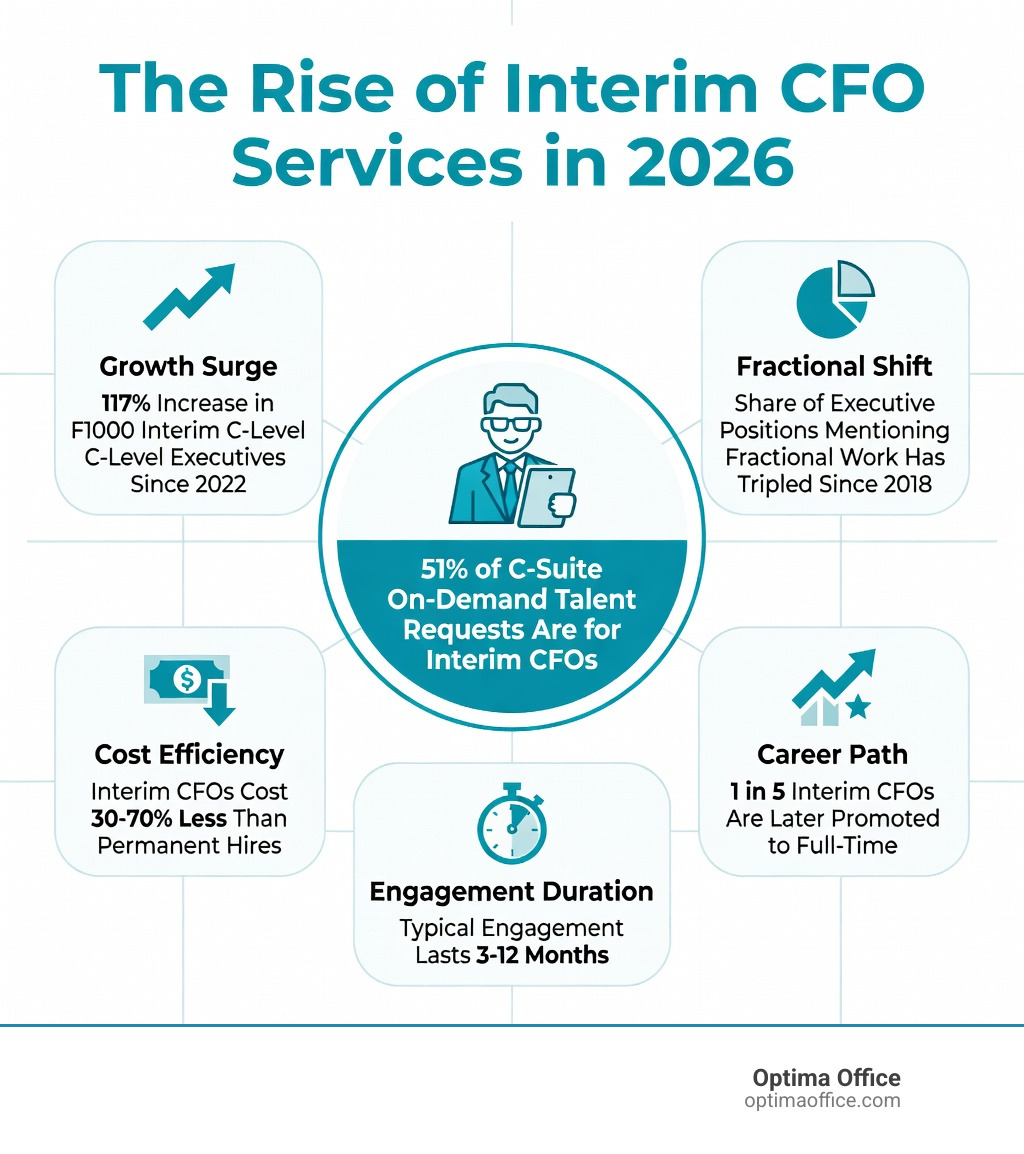
Back in 2025, requests for interim CFOs made up 51% of all C-suite on-demand talent requests, more than any other executive role. And it’s not hard to see why. Market volatility, unexpected leadership turnover, and the growing complexity of the CFO role have pushed more businesses toward flexible, high-impact financial leadership.
The modern CFO isn’t just watching the books anymore. Two-thirds of CFOs say their responsibilities have grown significantly since the pandemic, taking on everything from risk management and data analytics to strategic planning and investor relations. That’s a lot to ask of a role that many small businesses don’t even have filled.
The good news? You don’t have to hire someone full-time to get that level of expertise.
What Are Interim CFO Services?
At its core, interim CFO services provide a temporary, high-level financial gatekeeper who doubles as a strategic partner. Unlike a permanent hire, an interim CFO is brought in for a specific mission: to bridge a gap, navigate a crisis, or lead a transformation.
According to CFO Dive, 51% of C-suite leadership requests for on-demand talent are now for interim CFOs. This highlights a massive shift in how businesses handle economic uncertainty. Instead of rushing a permanent hire and risking a “bad fit,” companies are opting for “just-in-time” resourcing.
While they are often grouped together, it is important to distinguish between different types of fractional CFO services and interim roles.
| Feature | Interim CFO | Fractional CFO | Permanent CFO |
|---|---|---|---|
| Commitment | Full-time (Temporary) | Part-time (Ongoing) | Full-time (Indefinite) |
| Duration | 3–12 months | Long-term/Multi-year | Indefinite |
| Primary Focus | Transition, Crisis, M&A | Strategic Growth, Scaling | Long-term Vision, Ops |
| Cost | Project/Daily Rate | Monthly Retainer | High Salary + Equity + Benefits |
| Best For | Sudden gaps or major projects | Small-to-mid sized growth | Large, stable enterprises |
Key Differences: Interim vs. Fractional vs. Permanent CFOs
The biggest point of confusion we see is the difference between fractional and traditional CFOs.
An interim CFO is usually a full-time commitment for a short-term duration. They are “all-in” for those few months, often working on-site or deeply embedded in the team to fix a specific problem.
A fractional CFO is a part-time strategic partner. They might spend 10 to 20 hours a month with you, providing high-level guidance while your internal team handles the day-to-day. This is a common model for startups that need big-picture thinking but don’t have the budget for a $250,000+ salary.

The Evolution of the Modern Finance Leader
The role of the CFO has undergone a radical transformation. As Raconteur notes, the position has evolved from a “number cruncher” to a “strategic co-pilot.”
Today’s finance leaders are expected to handle cross-functional demands, from IT infrastructure to HR strategy. Research shows that two-thirds of CFOs have had new responsibilities added to their plates since the pandemic began. When you hire an interim leader, you aren’t just getting someone to balance the ledger; you’re getting a driver of strategic growth and risk mitigation.
When Your Business Needs Interim CFO Services
Knowing when to pull the trigger on an interim hire is half the battle. We often see businesses wait until they are in the middle of a “financial fire” before looking for help. While interims are great at putting out fires, they are even better at preventing them.
Telltale signs you need a fractional CFO or interim leader may include:
- Your current CFO suddenly resigned, leaving a massive leadership vacuum.
- You are preparing for an M&A, merger or acquisition, and your books aren’t “due-diligence ready.”
- You’ve hit a growth plateau and don’t understand your unit economics.
- Lenders or investors are demanding more sophisticated reporting than your controller can provide.

Strategic Triggers for Hiring Interim CFO
Several high-stakes events act as “strategic triggers” for interim CFO services:
- Executive Departure: When a permanent CFO leaves, the search for a replacement can take 6 to 9 months. An interim leader ensures you don’t rush the hire.
- Turnaround Strategy: If the business is facing declining revenues or debt issues, an objective outsider can make the tough calls that internal staff might be too close to.
- System Implementation: Upgrading to a complex ERP, like NetSuite or Sage, often requires specialized oversight that your day-to-day team doesn’t have time for.
- Post-Merger Integration: Combining two finance departments is a logistical nightmare. An interim CFO can harmonize processes and data migration.
In many cases, an interim CFO will work alongside a financial controller to ensure the tactical accounting remains accurate while the strategic work moves forward.
Industry-Specific Applications for Temporary Leadership
Different industries have unique “pain points” that interim CFO services address:
- Tech Startups: Need help with burn rate optimization and Series B or C fundraising preparation.
- Manufacturing: Focus on supply chain untangling, inventory costing, and margin analysis.
- Life Sciences: Often require specialized knowledge for grant management and clinical trial budgeting.
- Professional Services: Benefit from fractional accounting support to manage utilization rates and project profitability.
Key Benefits and Long-Term Value of Temporary Finance Leadership
Why go temporary? Beyond the immediate relief of having a professional in the seat, there is significant long-term value.
One of the most interesting statistics from the University of Tennessee is that one in five interim CFOs are promoted to full-time status. This “try before you buy” model allows both the company and the executive to ensure a cultural and strategic fit before committing to a multi-year contract.
Other advantages of fractional CFOs and interim CFOs include:
- Objectivity: They aren’t involved in office politics. They see the data for what it is.
- Speed of Deployment: At Optima Office, we can often have a team member deployed in as little as 3 to 5 days.
- Mentorship: They can train your existing junior staff, leaving your finance department stronger than they found it.
Specific Services Provided by Interim CFOs
An interim CFO doesn’t just sit in your meetings. They are “athletes” who connect the dots between operations, finance, and IT. Typical services include:
- Cash Flow Management: Implementing 13-week rolling forecasts to ensure you never run out of runway.
- Due Diligence: Preparing data rooms for potential buyers or investors.
- Board Reporting: Creating clear, high-level dashboards that tell the story of the business.
For many mid-sized firms, we recommend controller support for the CFO, ensuring that the high-level strategy is backed by rock-solid data.
Adding Value Beyond the Engagement
How do interim CFOs add value after they leave? They do it by “projectizing” the finance function. This includes:
- Process Optimization: Shortening the monthly close from 15 days to 5 days.
- Workflow Restructuring: Implementing automated tools for AP and AR.
- Staff Mentoring: Coaching the Controller to eventually step into a CFO-lite role.
As businesses expand their finance capabilities, they often find that integrating outsourced accounting services creates a seamless flow of information that lasts for years. This preparation makes the transition to a permanent hire much smoother, as the new CFO will inherit a well-oiled machine rather than a box of receipts.
How to Choose and Onboard the Right Interim CFO
Choosing the right leader is critical. You aren’t just looking for a resume; you’re looking for a “fit.” Since 2018, the share of new executive positions that mention fractional work has tripled, meaning there is a lot of talent out there, but not all of it is right for your specific culture.
When vetting, look for these three things:
- Industry Experience: Have they navigated a $10 million manufacturing firm through a crisis before?
- Technical Acumen: Are they comfortable with your tech stack, such as QuickBooks or NetSuite?
- Cultural Fit: Can they communicate effectively with your existing team and board?
The Cost and ROI of Interim CFO Services
Cost is usually the first question we get. Interim CFO services are typically 30% to 70% less expensive than a permanent CFO. Why? Because you aren’t paying for:
- Recruiter fees, often 25% to 30% of first-year salary
- Benefits and 401(k) matches
- Equity grants and sign-on bonuses
- Severance risk
According to Revelio Labs, the rise of the “side hustle” for executives has made high-level talent more accessible and affordable than ever. Value-based pricing models, hourly versus retainer, can also be tailored to your budget.
The Onboarding Process for Rapid Impact
A successful engagement starts with a strong 90-day roadmap. Because our team specialty in fractional CFO roles focuses on rapid impact, we follow a strict onboarding process:
- Financial Assessment: A deep dive into the last 12 to 24 months of financial statements.
- Stakeholder Meetings: Interviews with the CEO, Board, and department heads to identify “blind spots.”
- Data Access and Internal Controls: Securing systems and evaluating who has “the keys” to the money.
- Goal Setting: Defining exactly what success looks like at the end of the 6-month or 12-month term.
FAQs About Our Interim CFO Services
How Long Does an Interim CFO Engagement Typically Last?
Most assignments last between 3 and 12 months. The duration depends on the complexity of the financial issues and the pace of the search for a permanent replacement. If the goal is a company sale, the engagement may last until the deal closes.
Do Interim CFOs Handle Day-to-Day Bookkeeping too?
Generally, no. An interim CFO provides strategic oversight and leadership. They guide the department and evaluate internal controls but don’t usually enter invoices. However, through fractional accounting integration, they can oversee a team of bookkeepers and controllers provided by the same firm to ensure total alignment.
What Qualifications Should I Look for in an Interim CFO Leader?
Look for a CPA or MBA with at least 15 to 20 years of senior financial experience. Interestingly, 90% of clients prioritize operations and organizational leadership over just “pure finance” skills. They need to be able to partner with the CEO to drive the whole business, not just the spreadsheets.
Need to Close the Leadership Gap with an Interim CFO?
At Optima Office, we understand that small and mid-sized companies need a mixture of accounting and HR talent to thrive, but often lack the funds to hire full-time staff at every level. Our mission is to provide that “complete finance department” experience for a fraction of the cost.
With our rapid team deployment, often in just 3 to 5 days, and our proprietary five-point system, we ensure you get the right expertise and personality fit to solve problems quickly. Whether you are navigating a sudden CFO leadership gap, we are here to help you maximize profits and minimize risk.
Don’t let a leadership gap stall your momentum. We can help fill that role with an interim CFO, regardless where you’re located.
To learn more about how we can help you, please contact us today to book a quick discovery call with one of our experts.