
What It Really Means to Enhance Business Performance
Enhancing business performance is not a single fix. It is an ongoing effort to improve how your organization operates, grows, and competes.
Here are the core strategies to improve business outcomes:
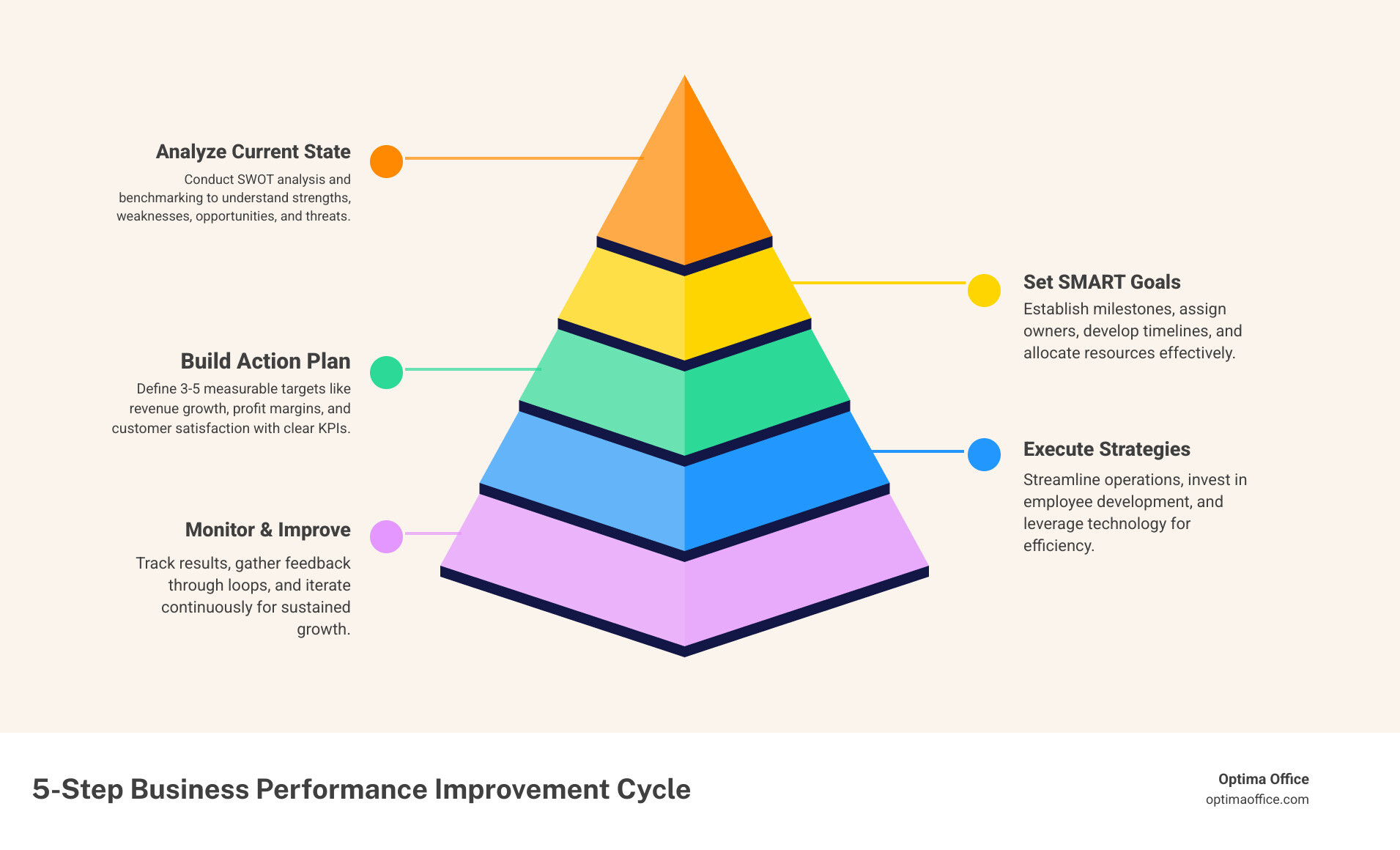
- Analyze your current situation – Use a SWOT analysis to identify strengths, weaknesses, opportunities, and threats
- Set SMART goals and track KPIs – Focus on 3-5 measurable targets like revenue, profit margin, and customer satisfaction
- Streamline operations – Map processes, eliminate waste, and automate repetitive tasks
- Invest in your people – Employee development drives a 24% rise in engagement and 34% higher retention
- Leverage technology – AI and automation tools can boost productivity by up to 30%
- Manage risk proactively – Build contingency plans before disruptions hit
- Build stronger customer relationships – Feedback loops and consistent communication drive loyalty and repeat revenue
For most small and mid-sized businesses, the gap between where you are and where you want to be comes down to three things: clarity, consistency, and the right support structure.
The challenge is that most business owners are too deep in day-to-day operations to see the full picture. Books that don’t close on time, HR fires to put out, and no reliable financial data to guide decisions – these aren’t just inconveniences. They actively hold back growth.
According to research, two-thirds of salespeople don’t reach their annual targets. Operational inefficiencies silently drain margins. And without the right financial leadership, even a profitable business can feel like it’s running blind.
The good news? Performance improvement is achievable – with the right framework and the right team behind you.
Foundational Steps to Enhance Business Performance
Before we can start sprinting toward the finish line, we need to know exactly where we’re standing. You wouldn’t start a road trip across Southern California without checking the GPS, right? The same applies to your business. To enhance business performance, you must begin with a cold, hard look at the “now.”

Current State Analysis: The SWOT Methodology
A comprehensive analysis of your current situation is the bedrock of any improvement strategy. We recommend starting with a SWOT analysis. It sounds like a tactical police unit, but it’s actually a very peaceful (and powerful) way to categorize your business reality:
- Strengths: What do we do better than anyone else in San Diego? Maybe it’s our proprietary software or our stellar customer service.
- Weaknesses: Where are we dropping the ball? High employee turnover or outdated accounting systems are common culprits.
- Opportunities: Are there new markets in Southern California we haven’t tapped into? Could AI help us scale?
- Threats: What external factors, like rising interest rates or new competitors, could pull us under?
By identifying these areas, you can stop guessing and start acting. But don’t stop at your own four walls. Use market research and benchmarking to see how you stack up against industry standards. If your competitors are closing books in five days and you’re taking twenty, that’s a clear area for improvement.
At Optima Office, our strategic business advisory services help leaders navigate this diagnostic phase. We often find that businesses try to fix everything at once. The secret? Pick 3-5 major goals. Anything more, and you’re spreading your resources too thin to make a real impact.
Leveraging Data and KPIs to Enhance Business Performance
Once you have your focus, you need a way to measure success. This is where SMART goals and Key Performance Indicators (KPIs) come in. If a goal isn’t Specific, Measurable, Ambitious, Realistic, and Time-bound, it’s just a wish.
To effectively track progress, we suggest monitoring these core KPIs:
| KPI Category | What to Track | Why It Matters |
|---|---|---|
| Financial | Revenue & Profit Margins | Ensures the business is actually making money, not just busy. |
| Customer | Satisfaction & Retention | Loyal customers are cheaper to keep than new ones are to find. |
| Employee | Retention & Engagement | High turnover is an invisible tax on your productivity. |
| Operational | Process Cycle Time | Identifies bottlenecks in your service or production. |
Using purpose-built technology for performance data is a game-changer. Moving away from messy spreadsheets to integrated systems gives you “one version of the truth.” When your financial data talks to your HR data, you get the clarity needed to enhance business performance without the guesswork.
Developing a Clear Action Plan
A goal without a plan is just a daydream. Your action plan should detail exactly who is doing what, by when, and with what resources. We believe in setting milestones—think of them as mini-celebrations on the way to your big objective.
One of the biggest hurdles for leaders in San Diego is the feeling of being “buried” in the business. If you’re feeling the weight of the world on your shoulders, check out our guide on how to avoid feeling overwhelmed as a leader. Effective performance improvement requires a leader who can delegate and focus on high-level strategy, not someone who is manually approving every office supply order.
Streamlining Operations and Continuous Improvement
Efficiency is the “secret sauce” of high-performing companies. It’s about doing more with less—not by working your team to the bone, but by working smarter.
Process Mapping and Waste Elimination
Have you ever looked at a process in your office and thought, “Why do we do it this way?” Often, the answer is “Because we’ve always done it this way.” That’s a dangerous mindset.
Start by mapping your processes. Literally draw them out. You’ll likely find duplicates, unnecessary approvals, and “dead air” where nothing is happening. We’ve seen how transformative this can be; for instance, in our case study on uncovering $140k in operational potential, we found that just by tightening leadership and operational oversight, massive savings were hidden in plain sight.
The Continuous Improvement Toolkit
You don’t need to be a massive manufacturing plant to use industrial-strength improvement methodologies. Small and mid-sized businesses can adapt these tools to enhance business performance:
- Six Sigma (DMAIC): Define, Measure, Analyze, Improve, and Control. This is great for fixing existing processes that are broken.
- Lean: Focuses on eliminating “Muda” (waste). In an office setting, waste might be waiting for email replies or over-processing a simple report.
- Kaizen: The philosophy of “continuous improvement” through small, daily changes.
- PDCA Cycle: Plan, Do, Check, Act. It’s a low-risk way to experiment with new ideas on a small scale before rolling them out company-wide.
- 5 Whys: When a problem occurs, ask “Why?” five times to get to the root cause. (e.g., Why was the report late? The data wasn’t ready. Why? The system crashed. Why? It hasn’t been updated…)
For more practical tips, we often refer to the 7 Ways to Improve Business Performance which emphasizes that a holistic approach—combining culture, data, and risk management—is the only way to see lasting results.
Boosting Productivity through Culture and Technology
Your business is only as fast as your people and your tools. If your team is disengaged or your tech is from the stone age, you’re trying to win a race with a flat tire.
The Human Element: Culture and Development
Investing in your employees isn’t just a “nice” thing to do; it’s a financial imperative. Research shows that organizations prioritizing development see a 24% rise in engagement and a 34% higher retention rate. Furthermore, targeted training can raise productivity by up to 30%.
Employee well-being and performance go hand in hand. According to Gallup research, happy employees take less sick leave and stay at their jobs longer. At Optima Office, we provide outsourced HR advisory to help businesses build these learning cultures. When you foster an environment where people feel valued, they don’t just work—they innovate.
Using Technology and AI to Enhance Business Performance
We are living in the era of the “productivity frontier.” Technology, especially AI and automation, is no longer optional. It’s the engine that will enhance business performance for the next decade.
- Automation: Use tools to handle repetitive tasks like data entry, claims processing, or even initial candidate screening in HR. This can lead to a 30% increase in output.
- Generative AI: Recent insights into the economic potential of generative AI show that it can boost knowledge worker productivity by 10-30%. Think of it as a super-powered assistant for your finance and marketing teams.
- Data-Driven Decisions: Stop making decisions based on “gut feelings.” Use data analytics platforms to spot trends before they become problems.
Sales Strategies for High Performance
Sales is the lifeblood of any business, yet a study by Aberdeen Group found that 2/3 of salespeople do not reach their annual targets. To fix this, you need more than just a “pep talk.”
- Multichannel Prospecting: Don’t just rely on cold calls. Use a mix of email, LinkedIn, and video sequences.
- Variable Pay Transparency: Employees are more motivated when they can see their commissions in real-time. In fact, 61.9% of employees using commission software exceeded targets, compared to only 30.1% of those using spreadsheets.
- Sales Playbooks: Centralize your scripts, objection handling, and strategies on a platform like Notion so everyone is playing from the same sheet music.
- Expert Guidance: Follow thought leaders like Josh Braun and Kyle Coleman for modern, empathetic sales tactics that actually convert.
Managing Risk and Ensuring Business Continuity
You can’t enhance business performance if a single disruption can take you offline. High-performing businesses are resilient businesses.
Risk Identification and Contingency Planning
Risk management isn’t about being pessimistic; it’s about being prepared. Identify potential threats—supply chain issues, data breaches, or the loss of a key leader—and build a plan. For example, if a primary supplier in Southern California goes down, do you have a backup ready?
The Role of Financial Leadership
Many small businesses struggle because they lack high-level financial oversight. They have a bookkeeper, but they don’t have a strategist. This is where the debate of fractional CFO vs. traditional CFO comes in. A fractional CFO provides the same strategic “heavy lifting” as a full-time executive but at a fraction of the cost.
These leaders help with financial balance and discipline, ensuring that your growth is sustainable and that you have the cash reserves to weather any storm. They turn your financial statements from a history lesson into a roadmap for the future.
Frequently Asked Questions about Business Performance
What common mistakes hinder business performance improvements?
The most frequent “performance killers” we see include:
- No Baseline: Trying to improve without knowing your starting numbers.
- Unrealistic Objectives: Setting goals so high they demotivate the team.
- Spreadsheet Reliance: Using Excel for complex tasks like commission tracking or real-time financial reporting, which leads to errors.
- Ignoring Feedback: Not listening to the employees who are actually doing the work.
- Lack of Follow-through: Starting an initiative with a “bang” and letting it fizzle out after a month.
How can small businesses apply Six Sigma or Lean?
You don’t need a black belt to use these tools.
- Adapt DMAIC: Use it for one small process, like how you onboard a new client.
- Use the 5 Whys: Next time a customer complains, don’t just apologize—ask “why” until you find the process failure.
- Focus on Waste: Look for “Muda” (useless activity), “Muri” (overburdening your team), and “Mura” (uneven workloads).
Why is employee engagement linked to profitability?
It’s simple math: Engaged employees are 21% more profitable. They are more productive, provide better customer service, and are less likely to quit. When you reduce turnover, you save thousands in recruiting and training costs. Plus, happy teams are more innovative—they find the small efficiencies that a disengaged worker would simply ignore.
Conclusion
To enhance business performance is to commit to a journey, not a destination. It requires a mindset of continuous improvement, a culture that values its people, and the technology to work efficiently. Whether it’s through streamlining your operations with Lean methodologies or leveraging the power of AI, every small step contributes to long-term scalable growth.
At Optima Office, we understand that mid-sized companies in San Diego and across Southern California need high-level expertise without the high-level price tag. Our mission is to provide that integrated finance and HR leadership through fractional roles. With our rapid team deployment, we can have the right experts in place within 3 to 5 days to help you solve problems and maximize profits.
Ready to take your organization to the next level? Explore our outsourced accounting services and let’s build a performance playbook tailored to your business. Together, we can turn your challenges into your greatest competitive advantages.