
Outsourcing HR benefits is the practice of handing off benefits administration — think health insurance, retirement plans, open enrollment, and compliance — to a third-party provider instead of managing it all in-house.
If you’re weighing your options, here’s what you need to know upfront:
Top reasons businesses outsource HR benefits:
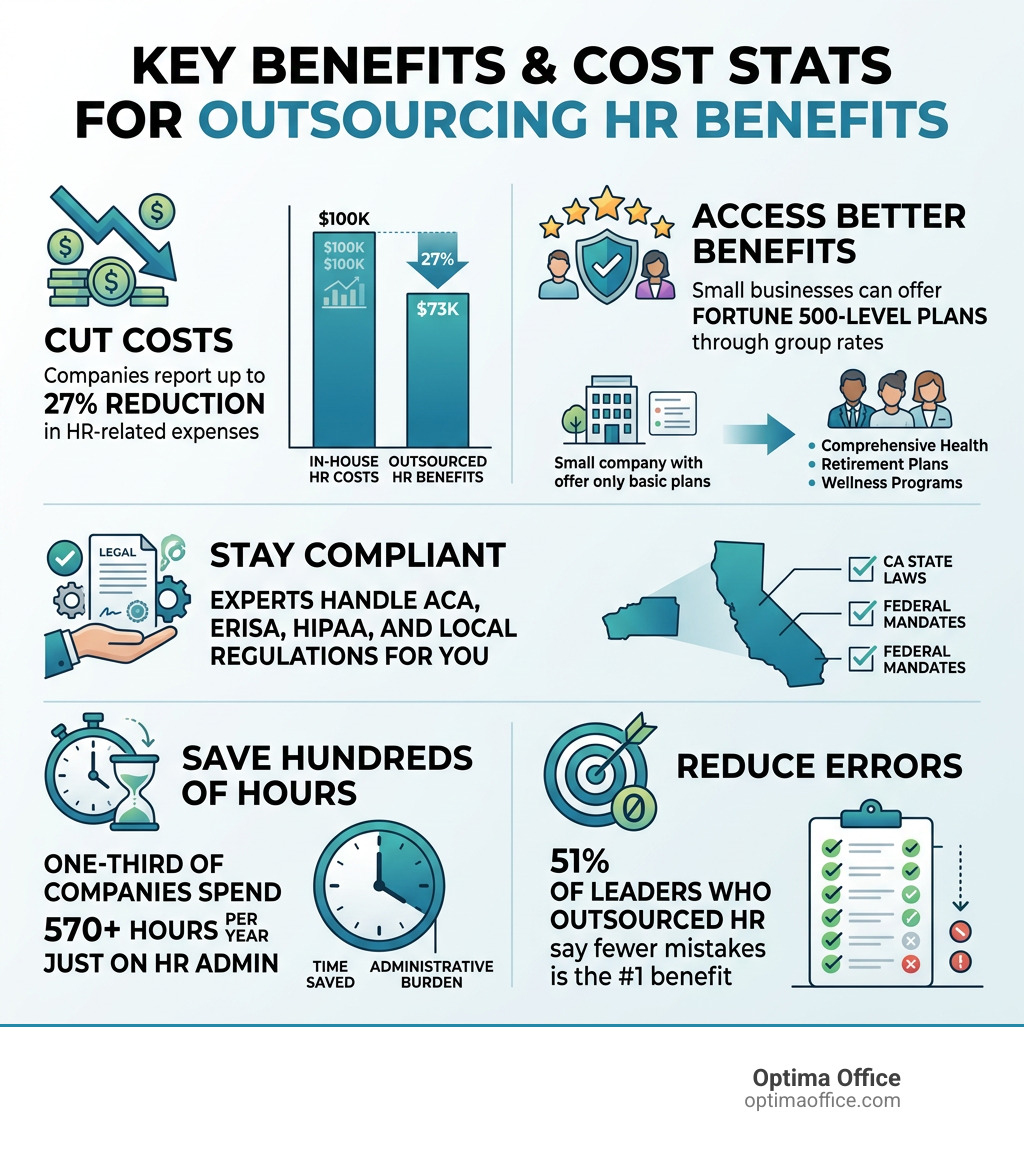
- Cut costs — Companies report up to 27% reduction in HR-related expenses
- Access better benefits — Small businesses can offer Fortune 500-level plans through group rates
- Stay compliant — Experts handle ACA, ERISA, HIPAA, and local regulations for you
- Save hundreds of hours — One-third of companies spend 570+ hours per year just on HR admin
- Reduce errors — 51% of leaders who outsourced HR say fewer mistakes is the #1 benefit
Here’s the reality: HR isn’t getting simpler.
For small and mid-sized businesses — especially those without a dedicated HR team — managing benefits has become a serious drain. Federal regulations change. Open enrollment deadlines loom. Employees have questions you don’t have time to answer.
And the cost of doing it in-house is steep. HR administration runs nearly $350,000 per year for companies with just 50–99 employees. For companies with 100–499 employees, that figure climbs past $400,000.
It’s not just the money. It’s the stress, the risk, and the distraction from actually running your business.
That’s exactly why 57% of organizations now rely on third-party providers to support HR processes, according to Deloitte’s 2024 Global Outsourcing Survey. And the trend is accelerating — the global HR outsourcing market hit $51.7 billion in 2024 and is projected to reach $72.6 billion by 2027.
For businesses in high-cost metros like San Diego and Southern California, where labor costs are already high and compliance requirements are intense, the case for outsourcing HR benefits is especially strong.
Outsourcing hr benefits basics:
What is Outsourcing HR Benefits and How Does It Work?
At its core, outsourcing hr benefits is a strategic partnership where a business hires an external firm to handle the heavy lifting of employee perks. While Human Resources services cover a wide range of people-management tasks, benefits administration is often the most technical and high-stakes area to delegate.
When we talk about benefits, we aren’t just talking about picking a health plan once a year. It involves the daily management of medical, dental, and vision insurance, retirement accounts like 401(k)s, life insurance, disability coverage, and even “soft” benefits like wellness programs or commuter perks.
The “how” depends on your business needs. You might choose to hand over every single HR task to a provider, or you might opt for a selective approach where you keep your internal culture-building in-house but let the experts handle the complex outsourced-hr logistics. This flexibility allows us to meet businesses exactly where they are, whether they have five employees or five hundred.
The Difference Between PEO, ASO, and HRO Models
Choosing the right partner requires understanding the “alphabet soup” of the outsourcing world. Each model offers a different level of control and liability.
- PEO (Professional Employer Organization): This is a co-employment model. Under a PEO, the provider becomes the “employer of record” for tax and insurance purposes. This allows small businesses to join a massive pool of employees to access “Fortune 500-caliber” benefits at significantly lower rates. According to the National Association of Professional Employer Organizations, there are over 500 PEOs in the U.S. serving 200,000+ businesses.
- ASO (Administrative Services Organization): Unlike a PEO, an ASO does not involve co-employment. You remain the sole employer. The ASO acts as your back-office team, handling the paperwork and processing, but you still sponsor your own benefit plans.
- HRO (Human Resources Outsourcing): This is often a more customized, selective model. You might hire an HRO specifically to manage your benefits or recruitment while keeping payroll internal.
| Feature | PEO Model | ASO Model |
|---|---|---|
| Co-employment | Yes | No |
| Benefit Sponsorship | Provider-sponsored (Group rates) | Employer-sponsored |
| Tax Filing | Under Provider’s FEIN | Under Employer’s FEIN |
| Control | Shared | High |
| Best For | Accessing better rates & full compliance | Companies wanting to keep their own plans |
Common Functions Included in the Strategy
When we take over the benefits burden, we don’t just “set it and forget it.” A comprehensive strategy includes:
- Open Enrollment: Managing the chaotic period where employees select their plans, including education and tech support.
- COBRA Administration: Ensuring that former employees receive the required notifications and coverage options to avoid massive legal fines.
- FMLA & Leave Management: Tracking complex family and medical leave requirements.
- Retirement Plan Management: Handling the 401(k) contributions and compliance testing.
- Claims Assistance: Acting as the middleman between your employees and the insurance carriers.
Top 5 Advantages of Outsourcing HR Benefits for Growing Teams
For a growing business in Southern California, the “DIY” approach to benefits is often a recipe for burnout. When you unlock your business potential, you shift from reactive firefighting to proactive growth.
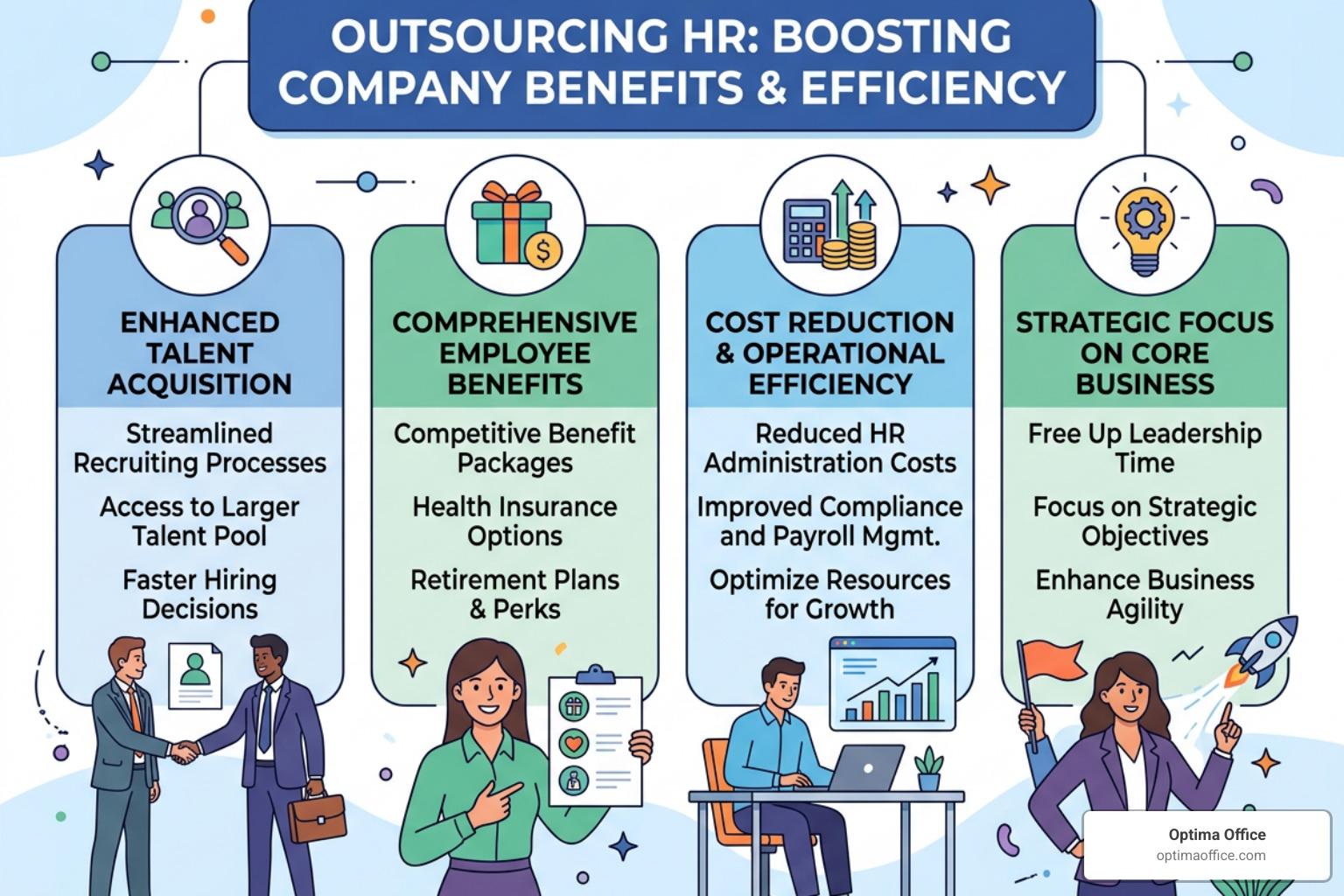
The primary advantage is simple: Cost reduction. Research shows that companies outsourcing HR functions report an average cost reduction of up to 27%. But the benefits go far beyond the bottom line. You gain instant access to experienced HR talent that would cost a fortune to hire full-time. Instead of one overworked generalist, you get a team of specialists.
Accessing Fortune 500-Level Outsourcing HR Benefits
One of the biggest hurdles for small businesses is the “size penalty.” If you only have 20 employees, insurance carriers often hit you with high premiums and mediocre plans. By outsourcing hr benefits through a model like a PEO, you gain the “strength in numbers” of a much larger organization.
This allows you to offer your team the kind of perks usually reserved for corporate giants—comprehensive health plans, robust dental/vision, and sophisticated retirement options. This is a massive win for employee retention. Employees who consider their HR department as effective are significantly less likely to be actively searching for another job.
Improving Compliance and Reducing Risk
The regulatory landscape is a minefield. Between the Affordable Care Act (ACA), ERISA, and HIPAA, one small paperwork error can lead to six-figure penalties. In California, local labor laws and regulations add even more complexity.
Outsourcing ensures that you have experts who live and breathe hr-compliance. They monitor changing laws in real-time, update your policies, and ensure every filing is submitted correctly and on time. 51% of leaders cite “fewer mistakes” as the top benefit of this move—and in HR, a mistake is never just a mistake; it’s a liability.
Evaluating the Cost Savings of Outsourced vs. In-House Management
Let’s talk numbers. Many business owners hesitate to outsource because they see it as an extra line item. However, the “hidden costs” of in-house management are staggering.
One-third of companies spend at least 11 hours a week (that’s 570 hours annually) on HR administration. If you calculate the salary of the executive or manager doing that work, the cost can reach up to $413,000 annually. Furthermore, HR salaries in the U.S. reached their highest level in 20 years in 2023. Hiring a full-time, high-level HR Director in San Diego is a massive investment.
When you look at the cost of outsourcing HR, you’re often paying a fraction of a single full-time salary while getting the expertise of an entire department. You’re trading a high, fixed overhead for a scalable, predictable monthly fee.
When is the Right Time to Outsource?
How do you know you’ve reached the breaking point? Look for these signs:
- Administrative Burnout: Your managers are spending more time on spreadsheets than on strategy.
- Rapid Growth: You’re hiring quickly and can’t keep up with the onboarding and benefits paperwork.
- High Turnover: If you have the highest turnover rate in your industry, your benefits package might be the culprit.
- Compliance Fear: You aren’t 100% sure you’re compliant with the latest ACA or California-specific leave laws.
Leveraging Technology in Outsourcing HR Benefits
Technology is the secret sauce of modern HR. Many small businesses are stuck using outdated tech that doesn’t talk to their payroll system. According to Gartner’s 2025 HR Priorities Report, 55% of HR leaders say their current technologies no longer meet business needs.
By outsourcing hr benefits, you gain access to enterprise-class cloud platforms. These systems offer:
- Employee Self-Service: Let employees update their own addresses or download tax forms.
- Mobile Access: Crucial for the modern, remote-friendly workforce.
- AI Integration: 87% of HR leaders are turning to outsourcing to accelerate AI adoption, which helps in predicting turnover and optimizing benefit spend.
Potential Risks and How to Choose the Right Provider
We wouldn’t be experts if we didn’t mention the potential downsides. Outsourcing isn’t a magic wand; it requires the right partner. Some businesses worry about a “loss of control” or a “less personalized” feel for their employees. There are also valid concerns about data security and confidentiality.
The key is to find a provider that feels like an extension of your team, not a distant call center. This is why we emphasize “personality fit” in our proprietary five-point system. You need a partner who understands the unique culture of Southern California businesses and can provide serving-clients-remotely support without losing the human touch.
Key Criteria for Selecting an Outsourcing Partner
Don’t just sign with the biggest name in the industry. Look for these specific traits:
- Scalability: Can they handle you when you grow from 20 to 200 employees?
- Reputation: Check their track record specifically with hr-services in your industry.
- Local Expertise: Do they understand the specific “fun” of California labor laws?
- Transparency: Are there hidden fees for every phone call, or is it a flat, predictable rate?
Ensuring a Smooth Implementation Process
The transition shouldn’t be painful. A quality provider will have a clear communication plan to explain the change to your employees. This includes:
- Data Migration: Securely moving your records from old spreadsheets to new, secure systems.
- Employee Training: Showing your team how to use the new benefits portal.
- Ongoing Support: Ensuring there is a clear point of contact for when things go wrong (because in HR, things eventually do).
Frequently Asked Questions about Outsourcing HR Benefits
How much does it typically cost compared to in-house staff?
While costs vary, outsourcing hr benefits is almost always more cost-effective for small and mid-sized businesses. Instead of paying a $120k+ salary plus benefits and taxes for one HR manager, you might pay a per-employee-per-month fee that amounts to a fraction of that cost. Most companies see an ROI within the first year through reduced administrative hours and lower insurance premiums.
Can outsourcing improve employee satisfaction and retention?
Absolutely. When employees have access to better health plans, a user-friendly portal, and experts who can actually answer their questions, their satisfaction goes up. HR is often ranked as the least-satisfied business function. By removing the “clutter” of bad administration, you create a better workplace.
How does it ensure compliance with ACA and HIPAA?
Outsourcing firms employ specialists whose entire job is to track these regulations. They use automated systems to ensure ACA reporting is accurate and maintain high-level encryption to keep health data HIPAA-compliant. This moves the “compliance burden” off your shoulders and onto theirs.
Conclusion
At Optima Office, we believe that you shouldn’t have to choose between growing your business and taking care of your people. Based right here in San Diego, we provide the fractional HR and financial leadership that small and mid-sized companies need to thrive.
Our mission is to provide exceptional accounting and HR services while building positive relationships within our team and local communities. With our proprietary five-point system, we ensure that the HR professionals we deploy aren’t just experts—they are the right fit for your unique company culture.
Stop stressing over the paperwork and start focusing on your mission. Whether you need a fractional CFO to guide your strategy or a dedicated team to handle outsourcing hr benefits, we are here to help you maximize profits and minimize risk.
Ready to streamline your operations? Explore our comprehensive HR services or meet your Optima HR team today.