
Why Small Business Bookkeeping Is the Foundation of Business Growth
Small business bookkeeping is the ongoing process of recording, organizing, and tracking every financial transaction your business makes — from invoices sent to expenses paid.
If you’re looking for a quick overview of what it involves and why it matters, here it is:
What small business bookkeeping covers:
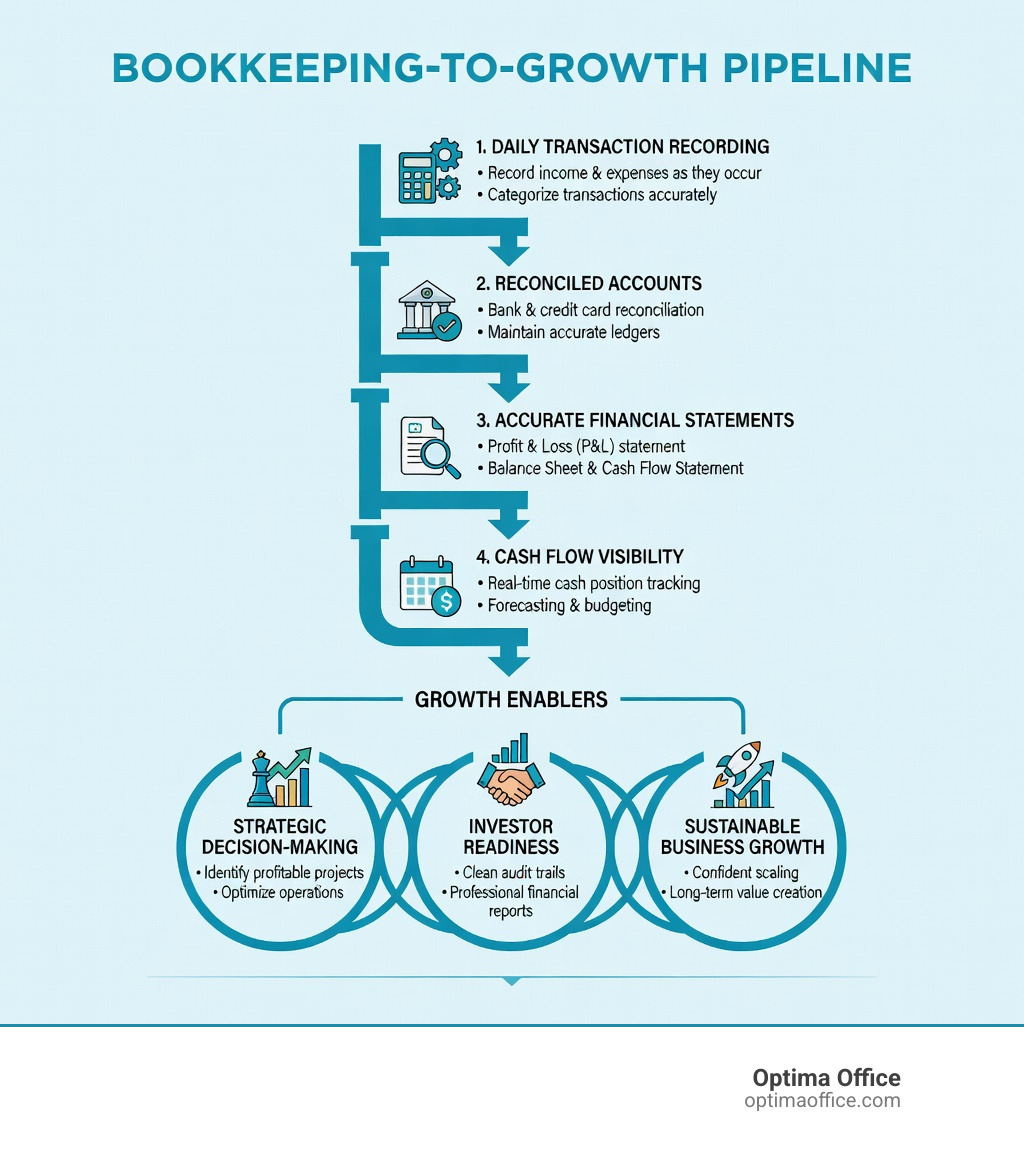
- Recording income and expenses as they occur
- Reconciling bank and credit card statements
- Managing accounts payable and accounts receivable
- Preparing key financial statements (profit & loss, balance sheet, cash flow)
- Keeping records organized for tax compliance and audits
- Supporting payroll processing and reporting
Running a business at the $3M–$15M revenue level means your finances are no longer simple. You’re likely managing payroll, multiple revenue streams, vendor relationships, and growing compliance requirements — all at once.
And yet, for many business owners at this stage, the books are an afterthought.
That’s a costly mistake. Research consistently shows that 82% of small businesses fail due to cash flow problems — not because they lacked customers or ambition, but because they lacked financial visibility.
When your bookkeeping is disorganized, you can’t see which clients or projects are actually profitable. You can’t close your books on time. You can’t give investors, lenders, or board members the reports they need. And you certainly can’t make confident decisions about growth.
Good bookkeeping isn’t just about compliance — it’s the foundation every smart business decision is built on.
Whether you’ve outgrown your current bookkeeper, lost a key accounting staff member, or simply realized your financial systems aren’t keeping pace with your business, this guide will walk you through everything you need to know — and help you find the right solution.
Understanding the Foundations of small business bookkeeping

At its core, small business bookkeeping is about managing information. It is the systematic recording of financial data that allows us to see exactly where money is coming from and where it is going. Without this foundation, a business is essentially flying blind.
To build a sturdy system, we must first understand the “Chart of Accounts.” Think of this as the filing cabinet for your business finances. It’s a categorized list of every type of transaction, from revenue and rent to software subscriptions and travel. Every time money moves, it needs a specific “home” in this chart.
We also rely on the accounting equation: Assets = Liabilities + Equity. This simple formula ensures that your books remain balanced. If you buy a new piece of equipment (an asset) using a loan (a liability), the equation stays in check.
Key Differences Between Bookkeeping and Accounting
Many people use these terms interchangeably, but they serve different purposes. Bookkeeping is the “how” of financial management—the daily data entry, receipt collection, and transaction recording. Accounting is the “what”—the analysis, interpretation, and strategic planning based on those records.
Understanding the bookkeeper and controller difference is vital for scaling businesses. While a bookkeeper ensures the data is accurate, a controller or CFO provides the high-level oversight needed to interpret that data for tax preparation and growth strategies. In many cases, your business needs more than just a bookkeeper to navigate complex financial landscapes.
Choosing the Right Accounting Method
One of the first decisions we help our clients make is choosing between the Single-Entry and Double-Entry systems, and the Cash vs. Accrual methods.
- Single-Entry vs. Double-Entry: Single-entry is like a checkbook register—fine for a side hustle, but insufficient for a growing company. Double-entry is the industry standard, where every transaction affects at least two accounts (a debit and a credit), providing a built-in system of checks and balances.
- Cash vs. Accrual: Cash-based bookkeeping records transactions only when money actually changes hands. It’s simple but can be misleading. Accrual-based bookkeeping records income when it’s earned and expenses when they’re billed. This offers a much more accurate long-term picture of your business health.
Choosing the right method has significant tax implications. For instance, electing an S Corp status can lead to substantial entity formation tax savings for profitable sole proprietors, but managing that transition requires the precision of accrual-based records. For a deeper dive into these concepts, you can explore this guide on What Is Business Accounting?.
The Essential small business bookkeeping Process and Statements
To keep your business running smoothly, we recommend following a structured cadence of tasks. Consistency is the secret sauce of bookkeeping for businesses.
| Frequency | Key Bookkeeping Tasks |
|---|---|
| Daily | Record all incoming payments; track daily expenses; file receipts. |
| Weekly | Reconcile bank and credit card feeds; review accounts receivable (who owes you); pay vendor bills. |
| Monthly | Perform full bank reconciliation; process payroll; generate P&L and Balance Sheet; review “Budget vs. Actuals.” |
| Quarterly | File quarterly payroll tax reports; pay estimated income taxes; review sales tax nexus. |
| Annually | Close the books; prepare 1099s and W-2s; review fixed assets; prepare for tax filing. |
Following a comprehensive small business bookkeeping checklist ensures that nothing slips through the cracks, especially during the high-pressure year-end close.
Setting Up a small business bookkeeping System
A modern system relies on integration. We start by ensuring you have a dedicated business bank account—mixing personal and business funds is a recipe for disaster. From there, we connect your bank feeds to cloud-based software.
If your business handles high-volume sales, understanding QuickBooks Payments eligibility and credit criteria is essential for streamlining your cash inflows. We also implement internal controls, such as separating the person who handles cash from the person who reconciles the bank statement, to prevent fraud.
Critical Financial Statements to Review
We don’t just record numbers; we look for the story they tell. There are three “Big Statements” you should review every month:
- Profit and Loss (P&L): Shows your revenue minus expenses. Are you actually making money?
- Balance Sheet: Lists what you own (assets), what you owe (liabilities), and the value of the business (equity).
- Cash Flow Statement: Tracks the actual movement of cash. You can be “profitable” on paper but still run out of money if your cash is tied up in unpaid invoices.
For businesses that aren’t ready for a full-time hire, fractional bookkeeping services provide the expertise to generate and interpret these reports without the overhead of a full-time salary.
Avoiding Common Pitfalls and Leveraging Automation
Even the most seasoned entrepreneurs can fall into traps. One of the most frequent is the bookkeeper expensive mistake: failing to communicate or hiring a bookkeeper who only “does the data” without understanding the business context.
Other common errors include:
- Falling behind on data entry: Trying to catch up on six months of receipts in April is a nightmare.
- Ignoring payroll tax compliance: The IRS is strict about deposit schedules. Failure to deposit payroll taxes can result in penalties of up to 15%.
- Not backing up records: While paper receipts are a liability, digital records should be stored in the cloud for at least six years to satisfy IRS audit requirements.
Bookkeeping Tasks by Business Type
Different industries have unique needs. A freelancer might focus heavily on 1099 requirements and billable hours. An e-commerce business, however, must deal with complex inventory tracking and real-time Cost of Goods Sold (COGS) syncing. Consultants often need sophisticated billing systems to track project-based profitability. No matter the type, professional bookkeeping services can be tailored to these specific workflows.
Streamlining with 2025 Bookkeeping Software
The days of manual ledgers are over. Today’s software uses AI categorization to “learn” your spending habits and automatically suggest the right account for each transaction. Cloud accounting allows us to collaborate with our clients in real-time, providing a level of visibility that was impossible a decade ago. We’ve seen that outsourcing bookkeeping saves time and cost because the software handles the repetitive “grunt work,” leaving the humans to focus on strategy.
Scaling Your Operations: When to Hire Professional Services
There comes a point where DIY bookkeeping becomes a hindrance to growth. If you are spending 10 hours a week on spreadsheets instead of closing deals, it’s time to look at outsourced accounting services.
The role of bookkeepers, controllers, and CFOs shifts as you grow. While a bookkeeper handles the past (recording what happened), a CFO looks at the future (forecasting what will happen). We believe in overcoming the stigma of outsourcing—it isn’t a sign of weakness; it’s a strategic move to gain fractional leadership that scales with you.
The Cost of Professional small business bookkeeping Services
The cost of professional help is often much lower than the cost of a major mistake. While local San Diego accountants might charge upwards of $100 per hour, fractional services offer a more flexible model. You might pay a monthly retainer that covers exactly what you need, whether that’s basic bookkeeping or outsourced CFO services. The goal is to outsource your books, not your brain—keep the strategic control while delegating the technical execution.
Identifying the Right Time to Outsource
Ask yourself these questions:
- Are my books more than 30 days behind?
- Do I feel anxious when looking at my bank balance?
- Am I struggling with complex payroll or multi-state tax issues?
- Do I need to be “audit-ready” for potential investors?
If the answer to any of these is “yes,” outsourced accounting is likely the smartest path forward.
Frequently Asked Questions about Small Business Bookkeeping
What is the difference between cash and accrual bookkeeping?
Cash bookkeeping records transactions when money moves. Accrual bookkeeping records them when they are earned or incurred. Accrual is better for growing businesses because it matches income with the expenses that generated it, providing a clearer picture of profitability.
How much does it cost to hire a professional bookkeeper in 2025?
Costs vary based on transaction volume. Basic services for very small businesses can range from $300 to $400 per month. For mid-sized companies requiring more complex oversight, monthly fees can range from $1,000 to $2,500+. Optima Office provides a customized mix to ensure you only pay for the level of talent you actually need.
Can I manage my own bookkeeping using software?
Yes, many small business owners start this way. However, as transactions increase, the risk of errors grows. Software is a tool, not a replacement for financial expertise. Eventually, the time you spend on DIY bookkeeping is worth more than the cost of hiring a professional.
Conclusion
Your financial health is the heartbeat of your business. By moving from “surviving” your books to “leveraging” them, you unlock the door to sustainable enterprise growth. At Optima Office, we are dedicated to helping San Diego businesses thrive by providing an integrated team of accounting and HR professionals.
We don’t just provide numbers; we provide clarity, confidence, and a partnership built on your success. Our mission is to handle the complexities of your back office so you can focus on what you do best—growing your business and building your community.
Ready to take the next step in your financial journey? Contact Optima Office for Outsourced Accounting today, and let’s build a foundation for your future together.