

Startup bookkeeping services range from DIY software to full-service outsourced teams — and picking the wrong one can cost you investors, cash flow visibility, and compliance standing.
Here’s a quick comparison of the main options to help you decide fast:
| Solution Type | Best For | Avg. Cost | Key Tradeoff |
|---|---|---|---|
| Software-only (e.g., QuickBooks) | Pre-seed, simple transactions | $30–$150/mo | Low cost, high manual effort |
| Outsourced bookkeeping | Seed to Series A+ | $500–$5,000+/mo | Expert support, less control |
| Hybrid AI + human | Growth-stage startups | $750–$3,000/mo | Best of both, mid-range cost |
| In-house bookkeeper | Scaling teams with volume | $50K–$80K+/yr | Full control, high fixed cost |
| Fractional CFO + bookkeeping | Post-raise, investor-ready | Varies | Strategic insight + clean books |
Cash flow problems are behind 82% of startup failures. That’s not a bookkeeping statistic — that’s a survival statistic.
Yet many startups still treat bookkeeping as an afterthought. They patch together spreadsheets, hand things off to a generalist, or use entry-level software until the wheels fall off — usually right before a funding round or tax deadline.
The founders who scale successfully treat their books as a strategic tool, not a compliance checkbox.
Whether you’re pre-seed and keeping things lean, or post-raise and preparing for a Series A, this guide breaks down every major type of startup bookkeeping solution — so you can compare options clearly and choose what fits your stage, budget, and growth goals.
Why Professional Startup Bookkeeping Services are Critical for Growth

When you are in the “garage phase,” tracking expenses on a cocktail napkin might feel like a rite of passage. But as soon as you take outside capital or hire your first employee, the stakes skyrocket. Professional startup bookkeeping services aren’t just about data entry; they are about building a foundation that survives an audit and impresses a VC.
Cash Flow Management and Survival
As noted, 82% of startup failures are linked to cash flow mismanagement. Without real-time visibility, you are flying blind. Professional bookkeeping allows us to see exactly where money is bleeding and where it’s working. This visibility is the difference between making payroll and having to shut doors.
Investor Reporting and Credibility
Investors don’t just want to see your vision; they want to see your unit economics. If you can’t produce a clean Balance Sheet or P&L during due diligence, you look like a risk. Accurate books allow you to report on:
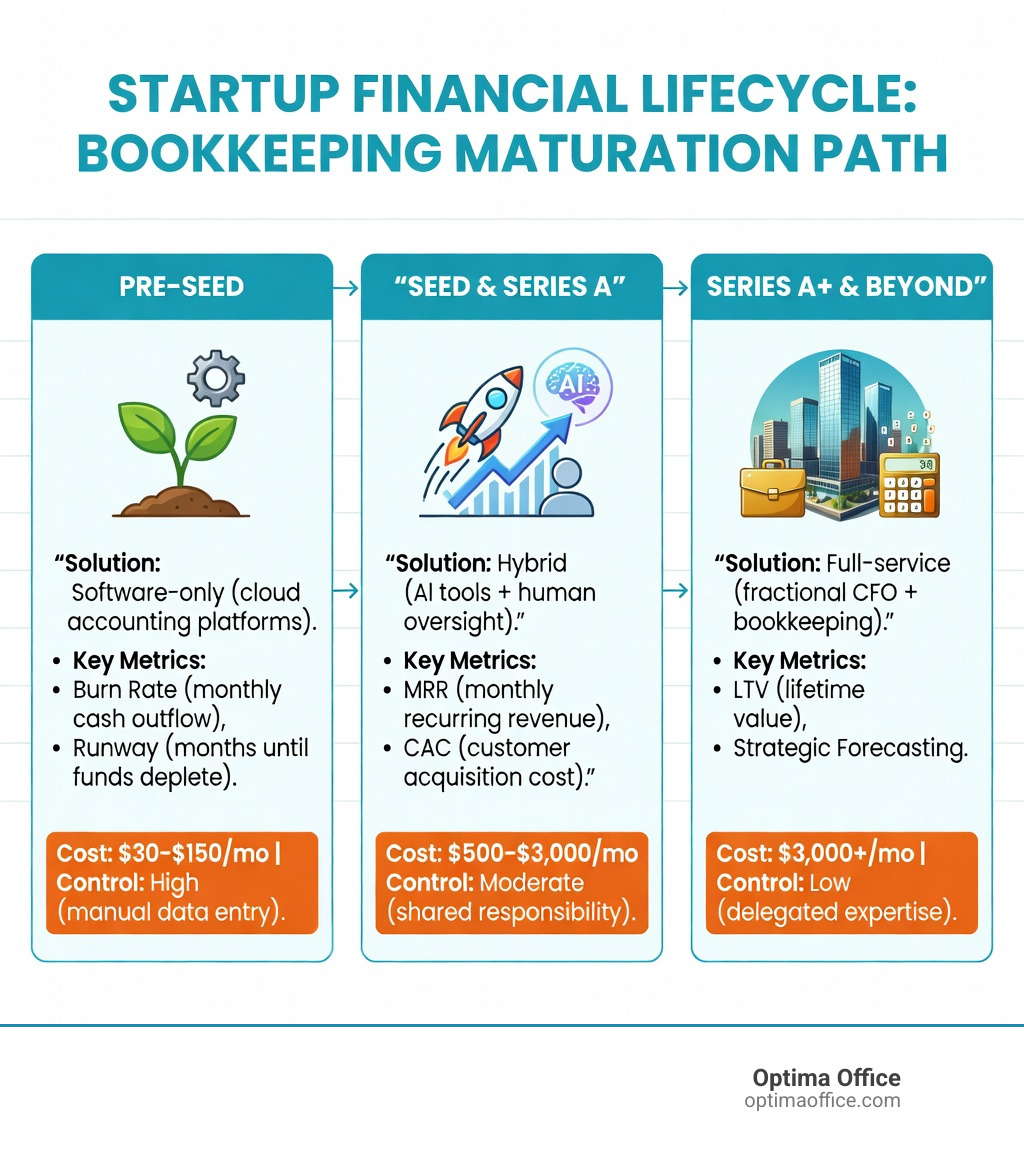
- Burn Rate: How much cash you are consuming each month.
- Runway: Exactly how many months of life your business has left before you need more funding.
- Customer Acquisition Cost (CAC) vs. Lifetime Value (LTV): The “golden ratio” of SaaS growth.
- Monthly Recurring Revenue (MRR): The heartbeat of your subscription business.
Tax Compliance and R&D Credits
For startups in Southern California, tax compliance is a multi-layered beast. Beyond federal obligations, there are state-specific filings and the dreaded Delaware Franchise Tax (if you’re incorporated there). Furthermore, professional fractional bookkeeping services can help identify R&D tax credits, which can save venture-backed startups tens of thousands of dollars—essentially “free” runway.
Comparing Types of Bookkeeping Solutions for Startups
Choosing a provider is like choosing a tech stack; you need to balance cost, speed, and reliability. Here is how the main approaches stack up:
| Feature | Software-Only | Full-Service Outsourced | Hybrid AI-Human | In-House |
|---|---|---|---|---|
| Cost | Lowest ($) | Moderate ($$$) | Moderate ($$) | Highest ($$$$) |
| Accuracy | Dependent on User | High (Professional) | High (Validated) | High |
| Scalability | Low | High | Very High | Low (Requires hiring) |
| Expertise | None | High | Moderate | Variable |
Software-Only (The DIY Approach)
Tools like Quickbooks Online or Xero are the industry standard. They offer automation, but they don’t fix human error. If you categorize a capital infusion as “revenue,” your taxes and metrics will be wrong. We often see founders spend 15+ hours a month fumbling with these tools when they should be selling.
Full-Service Outsourced
This is where we typically see the most success for growth-stage companies. You get a dedicated team of professionals who understand outsourced accounting and can scale as your transaction volume grows. You get the benefit of a full finance department for a fraction of the cost of a single full-time hire.
Hybrid AI-Human
Newer platforms use machine learning models—some trained on over $825 billion in financial activity—to categorize transactions instantly. While AI is fast, it lacks the “human touch” for complex revenue recognition or strategic advice. The best hybrid models use AI for the “grunt work” and humans for the final oversight.
Before choosing bookkeeping services, see where your startup’s finances stand—get a free Financial GAP Assessment. Get Your Free Financial GAP Assessment →
Key Features and Integrations for Scaling
When evaluating startup bookkeeping services, don’t just look at the price tag. Look at the “plumbing.” Your bookkeeping shouldn’t be a silo; it should be the hub of your business.
Real-Time Insights and Startup Expertise
A generalist bookkeeper might know how to balance a checkbook, but do they understand SaaS revenue recognition? Do they know how to handle SAFEs or convertible notes? Look for a partner who offers real-time dashboards so you can check your burn rate on a Tuesday morning, not three weeks after the month ends.
Essential Integrations for Startup Bookkeeping Services
To build an automated back office, your bookkeeping service must play nice with your tech stack:
- Payment Processors: Stripe or PayPal for seamless revenue syncing.
- Document Management: Tools like Dext allow you to snap a photo of a receipt and have it automatically pushed to your books, keeping things paperless and secure.
- Payroll: Integrating Gusto or Rippling ensures that your largest expense (people) is accurately reflected in your overhead.
- Bill Pay: Automated AP (Accounts Payable) workflows prevent duplicate payments and late fees.
For a deeper dive into managing the “people” side of this equation, check out our guide to managing HR in your startup.
Evaluating the Cost of Startup Bookkeeping Services
Pricing is usually influenced by three things: transaction volume, number of accounts, and complexity (e.g., multi-entity or international).
- Hourly Rates: Typically range from $55 to $75+ per hour for professional services.
- Flat-Fee: Many startups prefer this for budget predictability, with packages often starting around $750/month.
Learning how to build an efficient back office on a startup budget involves finding the “sweet spot” where you aren’t overpaying for a full-time CFO but aren’t losing money through poor DIY tracking.
A Step-by-Step Guide to Setting Up Your Books
Setting up your books correctly from Day 1 is significantly cheaper than paying for a “cleanup” later.
- Choose Your Accounting Method:
- Cash Basis: Records transactions when money actually changes hands. It’s simple and great for pre-seed.
- Accrual Basis: Records revenue when earned and expenses when incurred. This is required for GAAP compliance and is what investors expect to see by the time you hit Seed or Series A.
- Define Your Chart of Accounts: This is the “filing cabinet” for your money. Ensure it’s specific to your business model (e.g., separating COGS from OpEx for a SaaS company).
- Automate Data Entry: Connect your business bank accounts and credit cards to your software immediately. Never mix personal and business expenses—this is one of the most expensive bookkeeper mistakes we see founders make, as it pierces the corporate veil and creates a tax nightmare.
- Establish a Monthly Close Process: Your books should be “closed” (finalized and locked) by the 10th or 15th of the following month. This ensures your reports are timely enough to act on.
- Audit Readiness: Even if you aren’t being audited now, act like you are. Keep digital copies of every contract and receipt.
Frequently Asked Questions
How do I choose between cash and accrual accounting?
For most very early-stage startups, cash accounting is fine for simplicity. However, the moment you have significant accounts receivable (customers who owe you money) or accounts payable (bills you owe), cash accounting hides your true financial health. We recommend switching to accrual accounting as you approach your Seed round to ensure you are GAAP-compliant and investor-ready.
What are the most common bookkeeping mistakes startups make?
- Ignoring Burn Rate: Founders often focus on the bank balance instead of the “net burn.”
- Poor Categorization: Lumping all software under “Office Supplies” instead of “SaaS Subscriptions” makes it impossible to analyze your tech stack.
- Delayed Reconciliations: Waiting six months to “clean up the books” leads to forgotten transactions and lost tax deductions.
Understanding the difference between a bookkeeper and a controller can help you realize when you need more than just data entry.
How do I switch bookkeeping providers without disruption?
Switching doesn’t have to be painful. The key is a “parallel run” where the new provider handles the current month while the old provider finishes the previous month’s close. Ensure you have full ownership of your outsourced accounting services data (like your QuickBooks login) so you can simply revoke and grant access as needed.
Ready to scale your startup with clean books and strategic insights? Start with a Financial GAP Assessment today. Start Your Free Assessment →
Conclusion
The right startup bookkeeping services act as a GPS for your business. In the ecosystem of San Diego and Southern California, you can’t afford to wait weeks for financial clarity.
At Optima Office, we understand that startups need more than just a person to “do the books.” You need a strategic partner who can scale with you. Our fractional CFO, controller, and bookkeeping services are designed for rapid deployment—we can often have a team in place within 3 to 5 days. Using our proprietary five-point system, we ensure you get the right expertise and personality fit for your unique culture.
Don’t let poor financial visibility stall your growth. Whether you need a part-time bookkeeper or a high-level fractional CFO to lead your next funding round, we are here to help you maximize profits and minimize risk.
Get started with outsourced accounting today and let us handle the back office so you can focus on building the future.