HR compliance California is undergoing its most significant transformation in years, with dozens of new employment laws taking effect in 2026 that impact everything from minimum wage to workplace notices. For small and mid-sized businesses in California, staying compliant isn’t just about avoiding penalties—it’s about protecting your organization from costly litigation, wage theft claims, and employee complaints that can drain resources and damage your reputation.
Quick Answer: Key HR Compliance Requirements for California Employers in 2026:
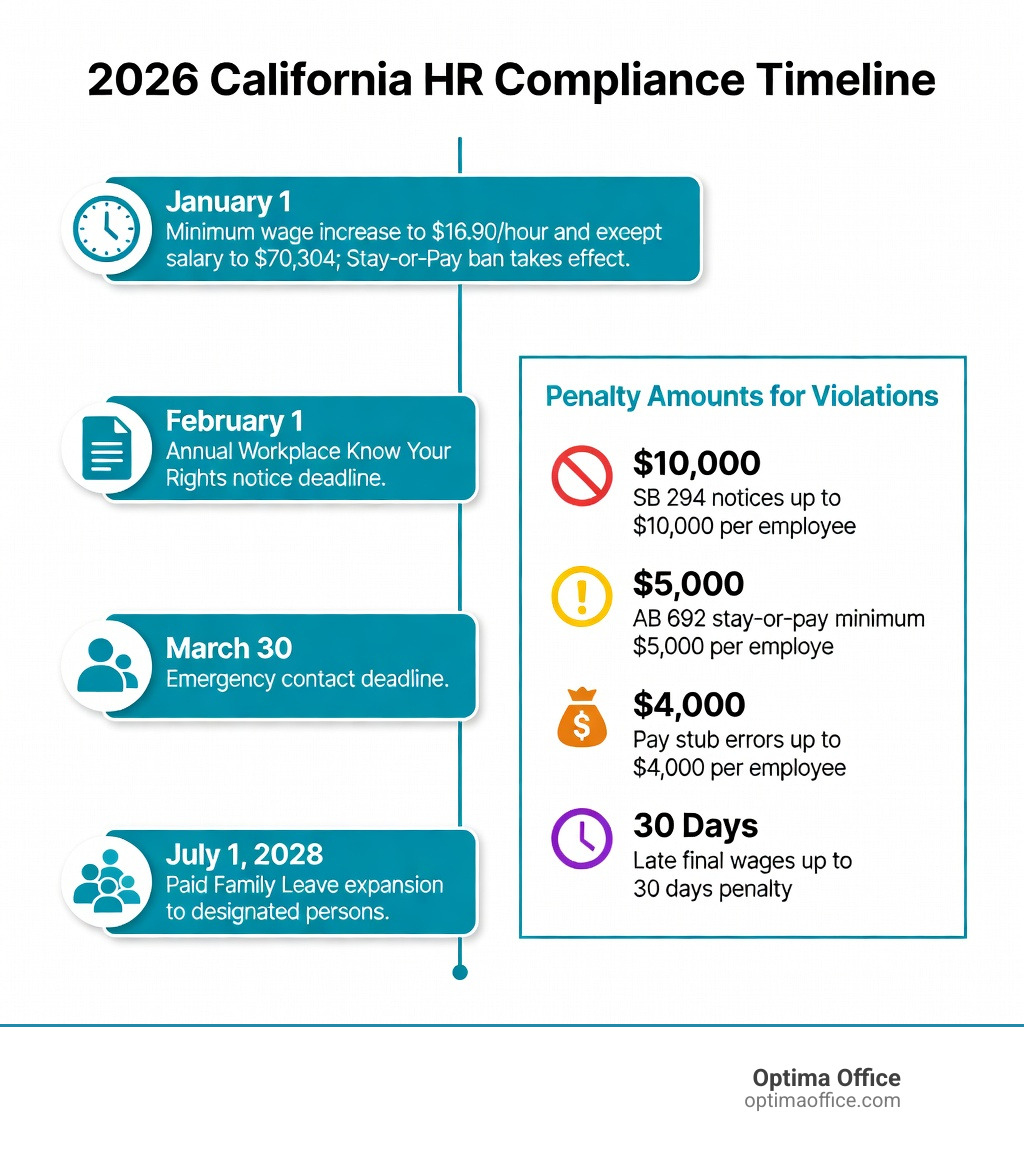
- Minimum Wage Increase: $16.90/hour statewide (exempt salary minimum: $70,304 annually)
- Workplace Know Your Rights Act (SB 294): Provide annual notices by February 1, 2026, and collect emergency contacts by March 30, 2026
- Ban on ‘Stay-or-Pay’ Clauses (AB 692): Remove repayment provisions from employment contracts (penalties start at $5,000 per worker)
- Expanded Paid Sick Leave (AB 406): Cover crime victims attending judicial proceedings
- Updated Cal-WARN Notices (SB 617): Include LWDB coordination and CalFresh information
- Pay Transparency (SB 642): Expanded definition of ‘wages’ includes bonuses and stock options
- Training Records (SB 513): Store training records in personnel files with detailed competency documentation
- Data Breach Notifications (SB 446): Notify individuals within 30 days, Attorney General within 15 days
California’s labor enforcement agencies collected over $6 million for farmworkers denied basic protections and issued citations totaling millions of dollars for wage theft, misclassification, and recall violations in 2025 alone. The message is clear: the state is aggressively enforcing worker protections.
If you’re a controller, CFO, or business owner who’s lost an HR leader, facing an employee complaint, or simply worried you’re not keeping up with California’s ever-changing requirements, you’re not alone. Many growing businesses in professional services, nonprofits, manufacturing, and healthcare struggle to navigate California’s complex regulatory landscape without dedicated HR expertise.
The cost of non-compliance is steep. Civil penalties for notice violations can reach $10,000 per employee. Pay stub errors carry fines up to $4,000 per employee. Late final paychecks trigger waiting time penalties of up to 30 days of wages. For a business with 20 employees, these violations can quickly add up to six-figure liabilities.
This guide breaks down exactly what California employers need to know and do in 2026 to stay compliant, from mandatory workplace notices to training requirements, recordkeeping obligations, and industry-specific regulations.
Before diving into California’s latest HR requirements, take 5 minutes to see where your business stands with Optima’s free HR Compliance Self-Audit.
Navigating Wage and Hour Laws in California
Keeping up with the math of hr compliance in California can feel like a full-time job. Effective January 1, 2026, the statewide minimum wage increases to $16.90 per hour. While that might seem like a straightforward adjustment for hourly staff, it has a massive ripple effect on your salaried exempt employees.
In California, to be exempt from overtime, an employee must generally earn a monthly salary equivalent to no less than two times the state minimum wage for full-time employment. With the 2026 increase, the minimum annual salary for exempt employees jumps to $70,304 ($5,858.67 per month). If you have employees currently earning $68,640, you must give them a raise by New Year’s Day or reclassify them as non-exempt, making them eligible for overtime and mandatory meal and rest breaks.
| Category | 2025 Threshold | 2026 Threshold (Effective Jan 1) |
|---|---|---|
| Minimum Wage (Hourly) | $16.50 | $16.90 |
| Exempt Salary (Annual) | $68,640 | $70,304 |
| Computer Professional (Hourly) | $55.58 | $58.85 |
| Computer Professional (Annual) | $115,763.35 | $122,573.13 |
Beyond the state rate, we must also monitor local ordinances. Cities like San Diego often have their own rates that may exceed the state minimum. To help you stay ahead, we recommend reviewing The 7 Updates California Employers Need to Know in 2026 and using available tools and resources for pay equity to ensure your compensation structures are fair and legal.
Pay Transparency and Equal Pay (SB 642)
California is doubling down on pay transparency. Under SB 642, the definition of “wages” has expanded significantly. It no longer just means the hourly rate or base salary; it now includes bonuses, stock options, and other benefits. When you post a job, the “pay scale” you provide must be a reasonable and good-faith salary or hourly range that you actually expect to pay.
Furthermore, SB 642 introduces specific protections for non-binary employees, ensuring that pay equity audits account for all gender identities. This means our internal reviews must look at total compensation to ensure no discriminatory gaps exist between employees performing substantially similar work.
The Ban on ‘Stay-or-Pay’ Provisions (AB 692)
If your employment contracts include “stay-or-pay” provisions—clauses that require an employee to repay the company for training, relocation, or signing bonuses if they leave before a certain date—you need to act fast. AB 692 effectively bans most of these provisions, viewing them as an unlawful restraint on trade and a form of debt bondage.
Starting January 1, 2026, including these clauses can result in a $5,000 penalty per worker. While there are narrow exceptions for specific apprenticeships or optional tuition reimbursement programs, the general rule is that “stay-or-pay” is out. We suggest reviewing your current contracts to remove these prohibited terms immediately. For the full legal text, you can review the Ban on “Pay-or-Stay” Provisions (AB 692).
Mandatory Notices and Recordkeeping for HR Compliance California
Documentation is the backbone of any defense against a labor audit. Several new bills have changed how we must communicate with employees and store their data. Conducting a regular HR Compliance Audit is the best way to ensure your files aren’t missing critical updates.
Workplace Know Your Rights Act (SB 294)
The Workplace Know Your Rights Act (SB 294) is one of the most significant administrative changes for 2026. Employers are now required to provide an annual notice to all employees regarding their workplace rights, including specific information about law enforcement and immigration.
- Deadline: The first notice must be distributed by February 1, 2026, and annually thereafter.
- Emergency Contacts: By March 30, 2026, we must provide employees the opportunity to designate an emergency contact specifically for situations where the employee is detained or arrested at work.
- Language Requirements: The notice must be provided in English and any other language spoken by at least 10% of your workforce (or the language used for business discussions).
Failure to comply can result in civil penalties ranging from $500 to $10,000 per employee, especially if we fail to notify an emergency contact during an incident.
Cal-WARN and Data Breach Updates
For larger employers (75+ employees), SB 617 updates the Cal-WARN notice requirements. If you are facing a mass layoff or relocation, your notices must now include coordination with the Local Workforce Development Board (LWDB) and information about CalFresh food assistance.
On the security front, SB 446 tightens the timeline for data breach notifications. If employee personal data is compromised, you now have a strict 30-day window to notify the impacted individuals and only 15 days to notify the Attorney General if more than 500 California residents are affected.
Personnel Files and Training Records (SB 513)
SB 513 introduces more rigorous standards for how we track employee development. Training records in personnel files must now include:
- The name of the employee and the trainer.
- The duration and date of the training.
- Specific competencies covered.
- Any certifications earned.
These records must be retained for at least three years. To make sure you’re not missing a step, our California HR Compliance Checklist provides a comprehensive list of what should be in every folder.
Employee Leave Rights and Workplace Safety
California continues to lead the nation in expanding employee leave rights. Whether it’s for jury duty or recovering from a crime, we must ensure our policies reflect the latest legislative changes.
Expanded Leave for Crime Victims and Jury Duty
AB 406 expands the rights of employees who are victims of crimes. Employees are now entitled to use paid sick leave or unpaid leave to attend judicial proceedings related to a crime where they (or an immediate family member) were a victim. The definition of “victim” is broad, covering everything from domestic violence to stalking. Furthermore, the law clarifies that we cannot discharge or discriminate against an employee for taking time off to serve on a jury, provided they give reasonable notice. You can read more about these protections in the Expanded Employee Leave Rights (AB 406).
Paid Family Leave Expansion (2028)
Looking slightly further ahead, we need to prepare our handbooks for the 2028 expansion of Paid Family Leave. Effective July 1, 2028, employees will be allowed to take leave to care for a “designated person”—someone who is the equivalent of a family member, even if there is no legal or biological relationship. While this is a few years away, Navigating California Employment with HR Support from Optima can help you phase in these definitions early to build a more inclusive culture.
Training Requirements for HR Compliance California
Mandatory training is no longer a “one and done” event. To maintain hr compliance california, we must stay on top of several recurring requirements:
- Sexual Harassment Prevention: Mandatory every two years for all employers with 5+ employees (1 hour for non-supervisors, 2 hours for supervisors).
- Workplace Violence Prevention (SB 553): Requires an annual training and a written prevention plan. You can find specific guidance on this at California SB 553 Workplace Safety.
- IIPP Training: All employers must have an Injury and Illness Prevention Program and train employees on specific workplace hazards.
- Janitorial Services: Biennial in-person training on sexual violence prevention is required for this industry.
For more details on protected categories and training compliance, visit the Employment Discrimination Information page.
Industry-Specific Regulations and Right to Recall
Sometimes, the rules of the game change depending on what you do. California has introduced several industry-specific measures that target hospitality, agriculture, and garment manufacturing.
Right to Recall Extensions (AB 858)
The hospitality industry, including hotels and large event centers, must continue to navigate “Right to Recall” laws. AB 858 extends these protections through 2027. If you laid off workers due to the pandemic or similar economic shifts, you must offer them their positions back based on seniority before hiring new outside candidates. This applies to various roles, including housekeeping, food service, and security. Review the Right to Recall Extension (AB 858) for specific compliance steps.
Agricultural and Specialized Minimum Wages
Agricultural workers have now fully phased into standard overtime rules. Under AB 1066 Agricultural Overtime, employers with 26 or more employees must pay 1.5x the regular rate after 8 hours a day or 40 hours a week.
Additionally, keep in mind these specialized minimum wages already in effect:
- Fast Food Workers: $20.00 per hour.
- Health Care Workers: Phased increases started in late 2024, with specific rates depending on the type of facility.
Best Practices for Maintaining HR Compliance California
Maintaining hr compliance california is a marathon, not a sprint. The best way to avoid a “surprise” from the Labor Commissioner is to build compliance into your weekly and monthly routines. Achieving HR Compliance Success requires a proactive approach rather than a reactive one.
Strategic Audits for HR Compliance California
We recommend conducting a “mini-audit” of your payroll every quarter. Wage theft isn’t always intentional; it often happens because of simple clerical errors. Check for:
- The ABC Test: Ensure your independent contractors actually meet the strict criteria (free from control, work outside your usual business, and independently established).
- Pay Stubs: California requires 11 specific items on a pay stub, including inclusive dates of the pay period and all hourly rates. Missing even one can lead to a $4,000 penalty per employee.
- Final Pay: If you fire someone, their final check is due immediately. If they quit with 72 hours’ notice, it’s due on their last day.
To get started, you can use our HR Compliance Checklist Download.
Conducting a Year-End Compliance Review
As the year winds down, use this checklist to ensure you’re ready for January 1:
- Update Handbooks: Ensure all new leave laws (like AB 406) are included.
- Manager Training: Train your front-line managers on new recall rights and the ban on stay-or-pay clauses.
- Poster Updates: Order new 2026 labor law posters that include the latest minimum wage and SB 294 notices.
- Emergency Contacts: Launch your campaign to collect the new mandated emergency contact information.
Frequently Asked Questions about California HR
What are the penalties for SB 294 notice violations?
Failure to provide the annual “Workplace Know Your Rights” notice can lead to civil penalties of up to $500 per employee for initial violations. If an incident occurs (like an arrest) and the employer failed to notify the designated emergency contact, penalties can jump to $10,000 per employee.
How does the 2026 minimum wage impact exempt employees?
Because the exempt salary threshold is tied to the state minimum wage (2x the hourly rate for full-time work), the increase to $16.90/hour raises the minimum exempt salary to $70,304 per year. Any salaried employee earning less than this amount on January 1, 2026, must be reclassified as non-exempt and paid overtime.
What is the ‘designated person’ in Paid Family Leave?
Starting in 2028, the definition of “family member” for Paid Family Leave will expand to include a “designated person.” This is any individual related by blood or whose association with the employee is the equivalent of a family relationship. Employees can identify one “designated person” per 12-month period for whom they can take leave to provide care.
Now that you know what California requires in 2026, use Optima’s free HR Compliance Self-Audit to identify exactly where your business needs to take action.
Conclusion
Navigating hr compliance california is undeniably complex, but you don’t have to do it alone. At Optima Office, we understand that small and mid-sized businesses need high-level HR expertise without the high-level price tag. Our fractional HR advisory services provide you with the same protection and strategic leadership as a full-time HR Director for a fraction of the cost.
Whether you need a one-time HR Compliance audit, a complete handbook overhaul, or ongoing support to manage the 2026 transitions, our San Diego-based team is ready to deploy within 3-5 days. We are committed to helping you minimize risk and maximize profits so you can focus on what you do best—growing your business.
Ready to secure your compliance? Contact Optima Office today for an HR consultation.