

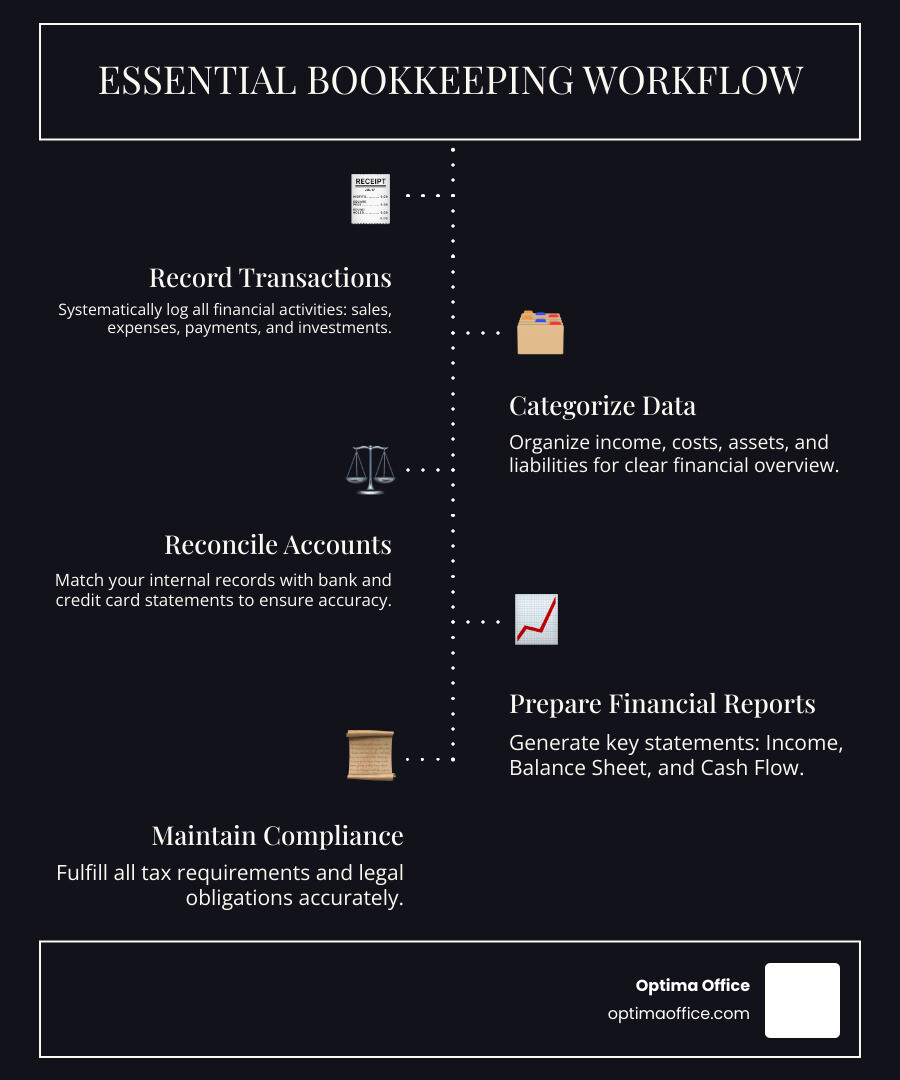
Business bookkeeping is the systematic recording of every financial transaction your company makes, from sales and expenses to payments and investments. It’s the foundation that transforms chaotic receipts and bank statements into clear, actionable financial insights.
What business bookkeeping mainly includes:
- Recording transactions: Sales, expenses, payments, and investments
- Categorizing financial data: Organizing income, costs, assets, and liabilities
- Reconciling accounts: Matching your records with bank statements
- Preparing financial reports: Balance sheets, income statements, and cash flow reports
- Maintaining compliance: Meeting tax requirements and legal obligations
The numbers don’t lie about bookkeeping’s impact on success. Small businesses that track their finances are 3x more likely to be successful, while those using accounting software are 50% more likely to have positive cash flow. Yet the average small business owner spends 10 hours per week on bookkeeping tasks, time that could be spent growing their business.
For business owners in San Diego, proper tracking is essential. Whether you’ve outgrown your bookkeeper or are tired of tax-season stress, a solid bookkeeping system is crucial for making informed decisions and avoiding costly mistakes.
Modern bookkeeping services doesn’t have to be a chore. With the right tools, you can create a system that provides the financial clarity needed to scale your business confidently.
Understanding the Foundation: Bookkeeping vs. Accounting
Think of bookkeeping and accounting as a tag team for your financial success. While often used interchangeably, understanding their unique roles is key to the financial clarity you need for smart strategic planning.
Bookkeeping captures the details; accounting transforms them into actionable insights that drive your business forward.

What Is Business Bookkeeping and Why Is It Essential?
Business bookkeeping is like keeping a detailed diary of your company’s financial life. It’s the foundation that keeps your business running smoothly.
But why does this matter so much for your success?
Recording transactions accurately gives you a clear picture of your business’s financial health. This isn’t just busy work; it’s the foundation of smart decision-making.
Tracking profitability becomes effortless with solid bookkeeping. You’ll spot which products or services bring in the most profit and make pricing decisions based on real data instead of gut feelings.
Managing cash flow is where good bookkeeping really shines. By tracking accounts receivable and payable, you can avoid surprises and ensure you can meet obligations like payroll.
Legal compliance might not be the most exciting part of running a business, but it’s essential. Proper bookkeeping ensures you meet tax requirements without scrambling at year-end, helping you avoid penalties.
Performance evaluation becomes a powerful tool when your financial data is organized. You can compare periods, spot trends, and plan for the future with insights gained from well-maintained books.
Want to see how these insights can transform your decision-making? Check out our guide on 6 Ways Accountants Help Business Owners Make Smarter Business Decisions.
The Fundamental Difference: Bookkeeping vs. Accounting
Bookkeeping is recording: the meticulous process of capturing every financial transaction. Accounting is interpreting: taking those recorded transactions and turning them into meaningful insights.
Think of it this way: bookkeeping asks, “What happened?” while accounting asks, “What does this mean, and what should we do next?”
The transactional vs. analytical difference is crucial. Bookkeepers handle daily details like data entry and categorization. They’re the detail-oriented guardians of your financial data.
Accountants take a step back to see the big picture. They analyze patterns, prepare strategic reports, create budgets, and offer advice on tax planning and business growth. While bookkeeping focuses on daily tasks, accounting provides the strategic overview that guides your business decisions.
| Aspect | Bookkeeping | Accounting |
|---|---|---|
| Primary Focus | Recording transactions | Analyzing data for insights |
| Daily Activities | Data entry, invoicing, categorization | Analysis, strategic planning, reporting |
| Key Question | What happened? | What does it mean? |
| Timing | Daily/Weekly | Periodic/Strategic |
| Output | Organized records, ledgers | Financial statements, budgets, advice |
The beauty of this system is how bookkeeping and accounting work together. Accurate bookkeeping is the foundation for insightful accounting. Without accounting, bookkeeping becomes just record-keeping without purpose.
For a deeper dive into how these roles fit into your overall financial team structure, explore our article on Bookkeeper Controller Difference.
Understanding this partnership helps you make better decisions about your financial management. Whether you handle these tasks in-house or work with professionals, knowing the difference ensures you get the right support for your business needs.
Getting Started: Core Bookkeeping Methods and Essential Records
Setting up your business bookkeeping system is like laying a foundation for a house; get it right, and everything else is easier. The key is choosing the right methods and knowing what records to keep.
Choosing Your Bookkeeping Method
When starting out, you’ll need to make two key decisions: your recording system and your accounting basis.
Your first choice is between single-entry and double-entry systems. A single-entry system is simple, like a checkbook, but most businesses quickly outgrow it. The double-entry system is more robust. Every transaction is recorded as both a debit and a credit, ensuring your books always balance and making it easier to spot errors.
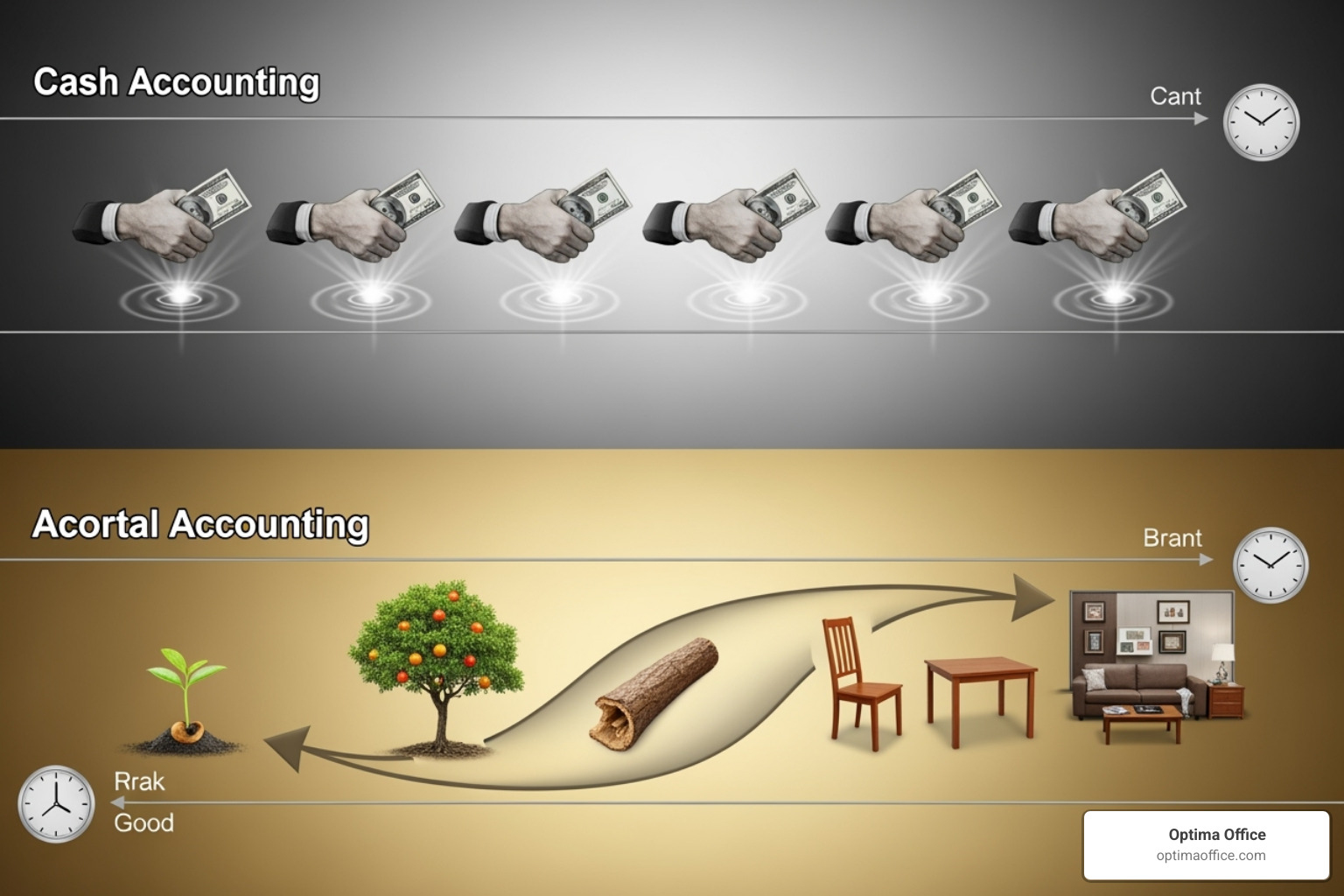
Your second decision is between cash-based and accrual-based accounting. With cash-based accounting, you record money only when it changes hands. It’s simple but can be misleading. Accrual-based accounting records income when earned and expenses when incurred, offering a truer picture of your business’s performance.
For growing businesses, we recommend a double-entry, accrual-based system. It provides the comprehensive financial picture needed for smart decision-making about your business’s future.
The Key Financial Records You Must Keep
Your financial records are essential. Once you have a system, staying organized is simple.
Source documents are your proof of transactions. Keep everything, including receipts, invoices, bank statements, credit card statements, payroll records, and any loan documents or contracts.
Your Chart of Accounts is your financial filing system. It organizes transactions into specific categories like office supplies or travel expenses. This simplifies reporting and ensures you categorize everything consistently.
Keeping digital copies of everything is just as important as the originals. The IRS generally requires you to keep records for three to seven years, depending on the type of record. Secure digital backups protect you from loss or damage.
Good record-keeping habits save countless hours during tax season and give you year-round confidence. When everything is organized, you spend less time hunting for paperwork and more time growing your business.
Your Step-by-Step Guide to Flawless Business Bookkeeping
Creating a flawless business bookkeeping system isn’t about perfection; it’s about building reliable processes that give you confidence in your numbers. The right approach transforms bookkeeping from a source of stress into a powerful tool for business growth.

Best Practices for Accurate and Reliable Bookkeeping
These best practices are your financial safety net, making the difference between books that work for you and books that work against you.
Accuracy is foundational. Double-check entries when you make them to avoid hunting for discrepancies later.
Consistency in how you categorize transactions makes your financial reports meaningful over time.
Timeliness is key. Record transactions promptly while the details are fresh to avoid mystery charges later.
The golden rule of small business finances is separating business and personal accounts. Open dedicated business bank accounts and credit cards, and use them exclusively for business expenses. Mixing funds creates confusion and tax-season headaches.
Regular reconciliation is your early warning system. Each month, match your internal records with your bank and credit card statements to spot errors, identify missing transactions, and ensure your cash balances are accurate.
Back up your records. It’s essential insurance for your business’s financial history against data loss from crashes or other accidents.
Many San Diego business owners fall into predictable traps. To learn about the most common mistakes, check out Six Common Accounting Pitfalls in San Diego’s Small Business Scene.
The 5-Step Bookkeeping Process
Follow this systematic five-step process to keep your business bookkeeping running smoothly.
- Gather documents. Collect all receipts, invoices, and bank statements for the period. Use an organized digital folder system.
- Categorize transactions. Assign every income and expense item to a category in your Chart of Accounts. This transforms a pile of receipts into organized financial data.
- Reconcile accounts. Compare your records against your bank and credit card statements to confirm accuracy and spot any fraudulent activity or bank errors.
- Prepare financial statements. Once everything balances, generate your three key reports: the Balance Sheet, the Income Statement, and the Cash Flow Statement.
- Review and analyze. Don’t just file the reports. Use them to find trends, spot unusual expenses, and identify opportunities. This is where bookkeeping transforms into business intelligence.
Leveraging Bookkeeping for Tax Preparation
Smart business bookkeeping makes tax season feel less like a marathon and more like a victory lap. When your records are organized, you’re not just surviving tax time; you’re optimizing it.
Maximizing deductions is straightforward when every business expense is properly documented. The IRS provides detailed guidance on deductible business expenses that can significantly reduce your tax liability.
Estimating tax liability throughout the year prevents unpleasant surprises. Consistent tracking helps you project your obligations and plan for quarterly estimated tax payments, which the IRS generally requires if you expect to owe at least $1,000 in tax for the year.
Audit-proofing your business happens naturally when you maintain detailed, accurate records. Should tax authorities ever inquire, organized bookkeeping records are your best defense, demonstrating compliance and substantiating every claim.
Choosing Your Tools and Team
Choosing the right business bookkeeping tools and team doesn’t have to be overwhelming. It’s about finding the right combination of software and expertise for your business.

Selecting the Right Bookkeeping Software
Modern technology has transformed business bookkeeping from a time-consuming chore into a streamlined process.
Spreadsheets are a familiar starting point, but they are error-prone and don’t scale well with a growing business. As transactions multiply, they can become unwieldy and lead to costly mistakes.
Desktop software offers more robust features than spreadsheets, but you’re often tied to one computer, which makes collaboration and remote access difficult.
Cloud-based solutions are where the magic really happens. For a subscription fee, you get powerful features like automation for repetitive tasks, real-time data accessible from anywhere, seamless collaboration, and integration with other business tools like payment processors and payroll systems. They are also highly scalable, growing with your business.
Here’s a compelling fact: small businesses using accounting software are 50% more likely to have positive cash flow and 2x more likely to get paid on time. That’s not just convenience; that’s a real impact on your bottom line.
The future is getting even more exciting with artificial intelligence. To explore this cutting-edge development, check out our guide on How to Incorporate AI into Your Accounting Practice.
When to Hire a Professional Bookkeeper
While understanding business bookkeeping is important, doing it all yourself isn’t always the smartest decision. Knowing when to hire a professional is key.
The average small business owner spends 10 hours per week on bookkeeping. Imagine what you could do with that time back: focus on marketing, connect with clients, or strategize for growth.
Professional bookkeepers bring expertise in regulations, tax requirements, and best practices. They set up systems that not only keep you compliant but also provide the financial insights you need to make smart decisions.
Look for these signs it’s time to consider professional help: your transactions are becoming complex, your records are messy, you’re unsure about your profitability, or your business is growing rapidly. If bookkeeping has become a major source of stress, it’s time to delegate.
Professional bookkeepers don’t just organize numbers; they provide accurate, timely financial reports that become the foundation for evaluating performance and planning your future. They can spot trends you might miss and give you the confidence that comes from knowing your financial house is in order.
At Optima Office, we know small and mid-sized companies need expert accounting and HR talent but often can’t afford full-time staff. Our fractional services provide a complete finance department for a fraction of the cost. We deliver a customized mix of outsourced controllers, fractional CFOs, and accountants with the right expertise to solve problems quickly, helping you maximize profits and drive growth. With our rapid deployment, your team can be in place within 3-5 days.
For more insight into this approach, explore our article on Why Fractional Bookkeeping Services Are Essential for Your Business.

FAQs About Small Business Bookkeeping
We understand that business bookkeeping can feel overwhelming. Here are answers to some of the most common questions we hear from small business owners.
Can I Do My Own Bookkeeping as a Small Business?
Yes, you can do your own bookkeeping, especially if your business is small with simple transactions. The key is consistency: commit to recording transactions regularly, staying organized, and learning the basics. Modern software makes this much easier than it used to be.
However, consider the time commitment. The average small business owner spends about 10 hours per week on bookkeeping tasks. Is that time better spent growing your business, serving customers, or developing new products?
As your business grows, what started as manageable bookkeeping can quickly become overwhelming. There’s no shame in starting with DIY bookkeeping and transitioning to professional help as you scale.
How Often Should I Do My Bookkeeping?
The short answer is that consistency beats perfection every time. You don’t need to do it daily, but a regular rhythm is essential to prevent things from piling up.
For most small businesses, we recommend recording transactions weekly. This keeps details fresh in your mind and prevents the dreaded shoebox full of receipts that needs to be sorted by tax season.
Monthly reconciliation is non-negotiable. Comparing your records with your bank and credit card statements is a financial health check-up that catches errors early and gives you a clear picture of where your business stands.
Treat bookkeeping like exercise: a little bit done regularly is far more effective, less stressful, and less error-prone than marathon sessions.
What’s the Biggest Mistake to Avoid in Bookkeeping?
Without question, the biggest mistake we see is mixing personal and business expenses. This single error creates a financial mess that’s difficult to untangle and causes headaches that extend far beyond bookkeeping.
Using business funds for personal items, or vice versa, makes it impossible to track profitability accurately and creates serious complications for taxes and potential audits.
The solution is simple but requires discipline: open dedicated business bank accounts and credit cards, and use them exclusively for business purposes.
Other critical mistakes to avoid include procrastinating on data entry, failing to back up your records, and ignoring your financial reports. Those reports aren’t just charts; they’re telling the story of your business’s financial health.
Good business bookkeeping isn’t about being perfect from day one. It’s about building sustainable habits that grow with your business and provide the financial clarity you need to make smart decisions.
The Bottom Line on Business Bookkeeping Services
You didn’t start your business to wrestle with receipts or decode bank statements. Yet the truth is, business bookkeeping isn’t just another to-do item; it’s the financial foundation that can make or break your entrepreneurial dreams.
This guide has walked through the essentials: turning chaotic data into clear insights, understanding the roles of bookkeeping and accounting, and setting up systems that work for your business.
The Key Takeaways That Can Transform Your Business
- Consistency is crucial. Businesses that track their finances are three times more likely to succeed.
- The right tools and support make all the difference. Investing in proper support pays dividends.
- Your financial records are a roadmap for strategic growth, not just for tax season.
With organized books, you can spot trends, pursue opportunities with confidence, and know your business is built on solid ground.
Financial empowerment starts with taking control of your numbers. Whether you DIY with software or find freedom by partnering with professionals, the right path is the one that fits your business and your peace of mind.
If you’re feeling overwhelmed by the financial side of your business, you’re not alone. Many entrepreneurs reach a point where their time is better spent on strategy than spreadsheets. That’s exactly why we built Optima Office.
We know small and mid-sized companies need expert financial talent without the cost of full-time hires. Our team becomes your outsourced financial department: controllers, fractional CFOs, and bookkeeping professionals who integrate seamlessly with your operations. In just 3-5 days, we can deploy the right mix of expertise to solve your specific challenges.
Your business deserves financial clarity that drives growth, not stress that keeps you up at night. If you’re ready to transform your relationship with your numbers and gain a strategic financial partner, we’re here to help.
Learn more about our outsourced accounting services and find how we can help your business thrive with the financial foundation it deserves.