
Why Smart Businesses Are Rethinking How They Handle HR
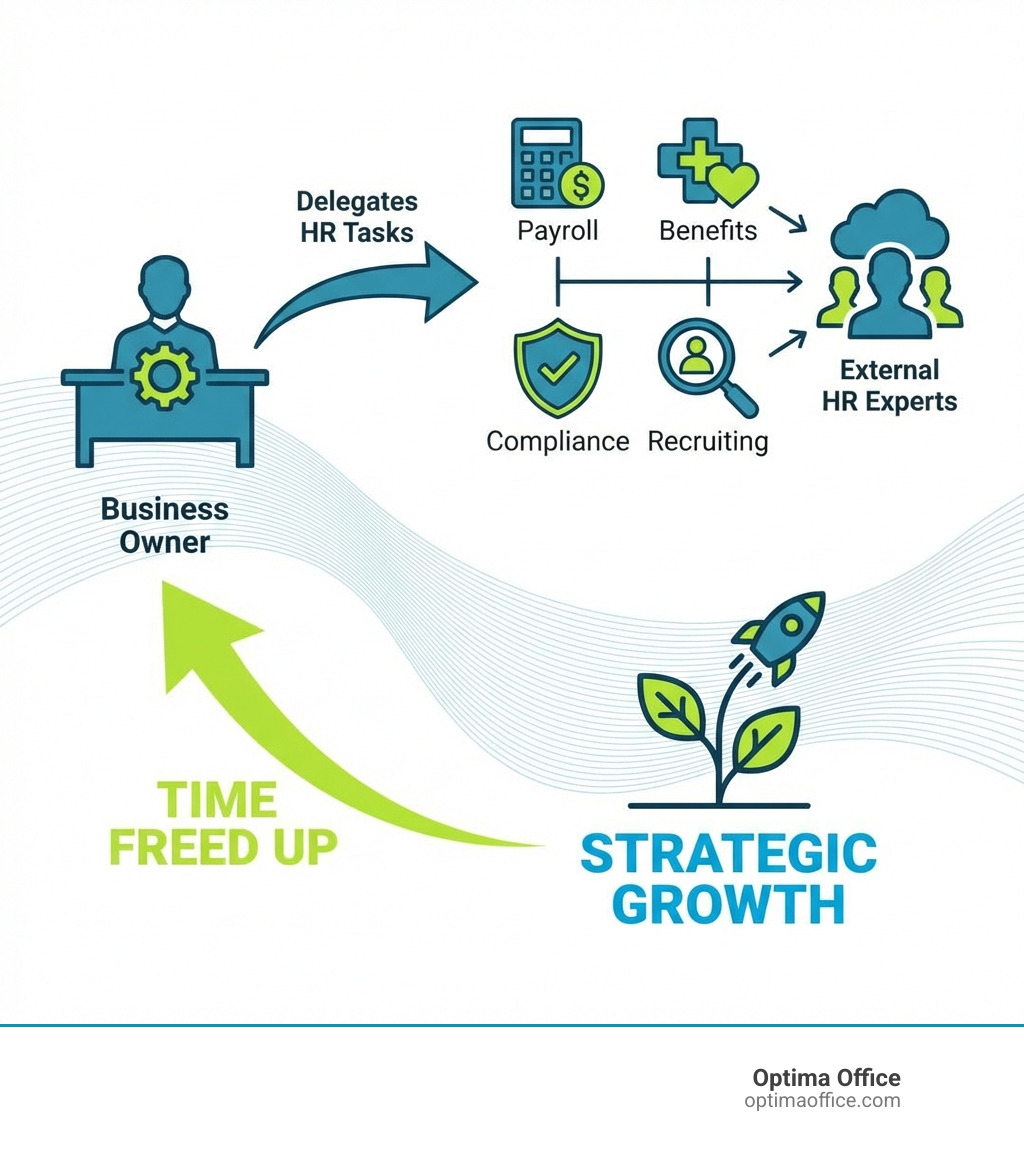
Outsourced HR means partnering with an external provider to handle some or all of your human resources functions—from payroll and benefits to compliance and employee relations.
Quick Answer: What is Outsourced HR?
- Definition: Hiring a third-party company to manage your HR tasks instead of doing everything in-house
- Common services: Payroll processing, benefits administration, compliance, recruiting, employee relations, and HR consulting
- Who uses it: 57% of business executives outsource HR functions to reduce costs, fill skills gaps, and improve efficiency
- Why it matters: Frees up your time to focus on growing your business while experts handle complex HR regulations
Is your HR department feeling overwhelmed? You’re not alone.
Nearly 75% of HR professionals say they’re working beyond capacity and stretched too thin. For small and mid-sized businesses, the challenge is even more acute. You might not have a dedicated HR team at all—just an office manager or controller juggling HR tasks alongside their other responsibilities.
The reality is stark: 42% of HR professionals cite limited time and dedicated personnel as the biggest barriers to achieving their organizational priorities. Meanwhile, employment laws keep changing, compliance risks keep growing, and your leadership team keeps spending valuable time on HR issues instead of strategic growth.
This is exactly why more than half of business executives have turned to outsourced HR. It’s not about giving up control—it’s about gaining access to expertise, technology, and processes that would be too expensive or complex to build in-house.
When an employee threatens legal action, when a PAGA wage violation notice arrives, or when your only HR-savvy person leaves the company, the cost of not having expert support becomes painfully clear. But the benefits go far beyond crisis management. Outsourced HR providers offer strategic guidance, ensure compliance, streamline operations, and often deliver better employee benefits than you could negotiate on your own.
The question isn’t whether you need HR support. It’s whether building it in-house or partnering with specialists makes more sense for your business.
The Core Benefits of Outsourcing HR for Your Business
For businesses in San Diego and across Southern California, the decision to accept outsourced HR can be a game-changer. It’s about more than just offloading tasks; it’s about strategically positioning your company for growth and stability. We’ve seen how access to specialized expertise, significant cost savings, and an improved employee experience can transform a business.

When we talk about the core benefits, we’re looking at a holistic improvement in how your business operates. Outsourcing HR allows us to help you gain better cost control, tap into a deep pool of HR expertise, mitigate compliance risks, scale your HR functions seamlessly, and ultimately, improve the experience for your most valuable asset: your employees. This shift frees up internal resources, allowing your leadership to sharpen its strategic focus on what truly drives your business forward.
Gain a Competitive Edge with Specialized Expertise
Staying ahead means having the best resources, and that includes your human resources. By partnering with an outsourced HR provider, you immediately gain access to a team of experts with deep domain knowledge. This expertise is crucial for ensuring compliance with complex and ever-changing employment laws in California, which can be a minefield for even the most diligent business owners.
A specialized HR partner offers:
- Compliance Assurance: We help you steer federal, state, and local regulations, minimizing your risk of costly penalties and legal disputes.
- Deep Domain Experience: Our team brings years of experience across various industries, offering insights and best practices that an in-house generalist might lack.
- Strategic HR Consulting: Beyond day-to-day administration, we provide strategic guidance on workforce planning, talent management, and organizational development, aligning your HR efforts with your overall business goals.
- Technology-Enabled Solutions: Access to advanced HR technology and software without the hefty investment. These tools streamline processes, improve data management, and improve reporting capabilities, leading to data-driven decision-making.
- Data-Driven Decisions: We can leverage HR analytics to provide insights into your workforce, helping you make informed decisions that optimize your team’s performance and drive business success.
A significant 57% of business executives outsource HR functions not just for cost savings, but also to fill skills gaps, bolster their workforces, and achieve performance outcomes like increased efficiency. This means that by outsourcing, you’re not just getting help; you’re gaining a strategic partner dedicated to your success.
Achieve Significant Cost Savings and ROI
One of the most compelling reasons businesses consider outsourced HR is the potential for substantial cost savings and a clear return on investment. Hiring a full-time, in-house HR manager, especially in competitive markets like Southern California, can be a significant expense. The median salary for an HR manager is around $130,000 per year, and that doesn’t even include benefits, office space, training, and the cost of HR software licenses.
With outsourced HR, you can:
- Reduce Overhead: You get access to a full suite of HR services for a fraction of the cost of building an internal department. This eliminates the need for a large HR salary, benefits packages, and the administrative burden associated with managing an in-house team.
- Control Costs Predictably: Many outsourced HR providers offer clear, predictable pricing models, often on a per-employee basis or a percentage of payroll. For instance, PEO (Professional Employer Organization) estimates can range from 2% to 4% of payroll or $1,000 to $1,500 per employee per year. This allows for better budgeting and avoids unexpected costs.
- Avoid Capital Investment in HR Tech: Instead of investing in expensive HR software, systems, and their ongoing maintenance, your outsourced partner provides access to cutting-edge technology as part of their service.
- Maximize ROI: By offloading administrative HR tasks, your internal team, including owners and managers, can dedicate their time to revenue-generating activities and strategic initiatives. This focus on core business functions directly contributes to maximizing profits and driving enterprise growth.
Outsourced HR is a strategic investment that pays dividends by reducing operational costs, minimizing risks, and freeing up your valuable internal resources.
Improve Employee Experience and Company Culture
A happy and engaged workforce is a productive workforce. Employees who are happy and satisfied at work are 12% more productive. When HR functions are handled efficiently and strategically, it directly contributes to a positive employee experience and strengthens company culture.
Outsourced HR can help us achieve this by:
- Offering Better Benefits Packages: Through co-employment models like PEOs, small and mid-sized businesses can often access Fortune 500-caliber employee benefits, including health, dental, and retirement plans, that they might not be able to afford or negotiate on their own. These comprehensive benefits are a powerful tool for attracting and retaining top talent in competitive markets.
- Streamlining Processes: From onboarding to payroll, and performance management to offboarding, an outsourced HR partner can implement efficient, technology-driven processes. This reduces administrative friction for employees, making their experience smoother and more professional.
- Enhancing Employee Satisfaction: When HR issues are handled promptly, fairly, and expertly, employees feel valued and supported. This can lead to higher morale, reduced turnover, and a more positive working environment.
- Fostering a Positive Company Culture: By ensuring consistent application of policies, providing clear communication, and offering strategic HR guidance, an outsourced HR partner helps build a strong, positive culture where employees feel heard, respected, and empowered.
By investing in outsourced HR, we’re not just managing people; we’re cultivating an environment where our employees can thrive, leading to increased productivity and a healthier bottom line.
Understanding the Different Models of Outsourced HR
The world of outsourced HR isn’t a one-size-fits-all solution. There’s a spectrum of models, each designed to meet different business needs, levels of control, and budgets. Understanding these distinctions is key to choosing the right partner for your business in San Diego or Southern California.
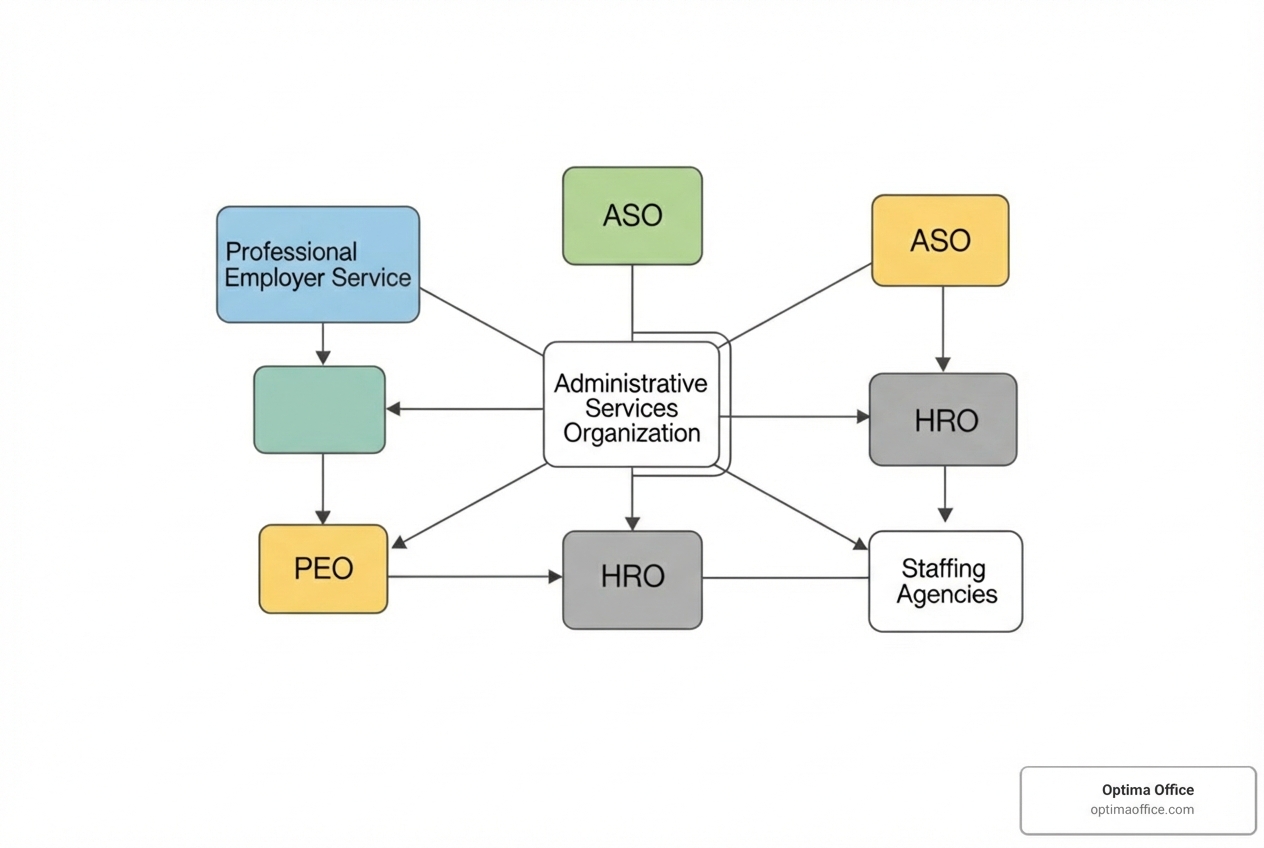
Whether you need comprehensive support for every HR function or just assistance with specific tasks, there’s an outsourced HR model that can fit your unique requirements. We help businesses steer these options, ensuring they get exactly what they need without overpaying for services they don’t.
What are the main types of outsourced HR?
Let’s break down the most common models you’ll encounter when considering outsourced HR:
-
Professional Employer Organizations (PEOs):
- What it is: A PEO acts as a co-employer, sharing employer responsibilities with your business. They handle critical HR tasks like payroll, benefits administration, compliance, and workers’ compensation.
- Benefits: Access to comprehensive benefits packages, assumption of certain HR-related liabilities, and expert guidance on complex HR issues. This model is ideal for businesses seeking a full-service, integrated solution and significant risk transfer. PEOs become the employer of record for tax and insurance purposes, but you retain full control over day-to-day management.
- Cost: PEO estimates can range from 2% to 4% of payroll or $1,000 to $1,500 per employee per year.
-
Human Resource Outsourcing (HRO):
- What it is: HRO companies offer HR services à la carte. Unlike PEOs, HROs do not typically act as co-employers. You pick and choose which HR functions you want to outsource.
- Benefits: Flexibility to select specific services, allowing you to fill gaps in your existing HR capabilities without committing to a full co-employment model. Ideal for businesses with some in-house HR capacity but needing specialized support in certain areas.
-
Business Process Outsourcing (BPO):
- What it is: BPO involves hiring a specialized contractor to handle individual, often administrative, HR tasks on a task-by-task or project basis.
- Benefits: Highly flexible for specific, transactional tasks like managing employee files, tracking onboarding requirements, or benefits administration. This is useful for businesses looking to offload specific, time-consuming processes.
-
SaaS HR Outsourcing (Software-as-a-Service):
- What it is: With SaaS outsourcing, a vendor hosts an HR application remotely (e.g., an HRIS – Human Resources Information System) and makes it available to your company via a web browser.
- Benefits: Provides access to advanced HR technology for managing employee records, time off, recruiting, onboarding, and performance, often automating tasks and reporting. While you manage the processes, the technology is outsourced.
-
Single-Source Outsourcing:
- What it is: This is when one third-party company manages all the HR functions of the employee lifecycle, from hiring and onboarding to developing employees and running payroll.
- Benefits: Offers a comprehensive, streamlined approach with a single point of contact for all your HR needs, allowing your business to focus entirely on its core operations and growth.
Understanding these models helps us tailor the perfect outsourced HR solution, ensuring your business gets the right blend of support and expertise.
Key Services You Can Outsource
When considering outsourced HR, it’s helpful to know the breadth of services available. Many companies start by outsourcing a single function, then expand as they see the benefits. Here are some of the key services typically offered by outsourced HR providers:
- Payroll and Taxes: This is one of the most commonly outsourced HR activities. It includes processing payroll, managing direct deposits, handling tax filings, and ensuring compliance with federal, state, and local payroll tax laws.
- Benefits Administration: Managing employee benefits can be complex. Outsourced providers handle enrollment, invoice reconciliation, reporting, and compliance for health insurance, retirement plans, workers’ compensation, and other employee perks.
- Talent Acquisition and Management: This can range from recruitment support (job description development, sourcing, screening) to onboarding new hires, performance management, employee training, and retention strategies.
- Compliance Management: Navigating the intricate web of employment laws (e.g., FLSA, ADA, FMLA, California-specific regulations) is a full-time job. Outsourced HR ensures your policies and practices are compliant, mitigating legal risks.
- Employee Relations: Handling employee grievances, disciplinary actions, conflict resolution, and maintaining a positive workplace culture can be sensitive. Outsourced experts provide guidance and support in these critical areas.
- HR Consulting and Advisory: Beyond administrative tasks, many providers offer strategic HR consulting, helping with workforce planning, organizational development, policy creation, and M&A support.
- HR Administration: This includes maintaining employee records, managing HRIS, processing leave requests, and other day-to-day administrative tasks that keep your HR operations running smoothly.
By strategically choosing which functions to outsource, your business can gain efficiency, reduce risk, and free up internal resources to focus on strategic growth.
In-House vs. Outsourced HR: A Comparative Analysis
The decision between building an in-house HR department and opting for outsourced HR is a critical one for any growing business. It’s not just about cost; it’s about control, expertise, scalability, and risk management. For businesses in Southern California, where regulations are often more stringent, this decision carries even more weight.
| Feature | In-House HR | Outsourced HR |
|---|---|---|
| Cost | High (salary, benefits, tech, overhead) | Lower, predictable (per-employee, % payroll) |
| Control | High (direct oversight, immediate response) | Moderate (vendor management, clear SLAs) |
| Expertise | Limited (based on individual staff) | Broad (access to team of specialists) |
| Scalability | Difficult (hiring/firing staff) | Easy (adjust services as needed) |
| Risk | High (compliance burden, potential legal issues) | Lower (shared liability, expert compliance guidance) |
| Technology | Requires significant investment and maintenance | Included, access to advanced platforms |
| Focus | Can be diverted by admin tasks | Allows internal team to focus on core business |
The best choice depends on several factors, including your business size, current growth stage, and the complexity of your industry. Startups and small businesses often find outsourced HR to be an invaluable resource, as they may lack the funds for full-time staff at every level. Larger companies might use outsourcing to augment their existing HR teams or handle specialized functions.
Weighing the Pros and Cons
Let’s dig deeper into the advantages and disadvantages of each approach:
In-House HR: The Good and the Bad
Benefits of an In-House HR Solution:
- Culture Alignment: An internal HR team is deeply embedded in your company culture, fostering strong personal relationships with employees and ensuring HR initiatives align perfectly with your mission.
- Immediate Response: They can provide immediate, in-person responses to employee issues, which can increase morale and satisfaction.
- Direct Control: You have direct oversight and control over all HR processes and decisions.
Cons of an In-House HR Solution:
- High Cost: As we’ve discussed, the median salary for an HR manager alone is substantial, plus benefits, office space, and HR software.
- Limited Expertise: A single HR generalist may not have expertise in all areas (e.g., complex compliance, benefits negotiation, talent acquisition strategy).
- Administrative Burden: Internal HR can get bogged down in administrative tasks, diverting focus from strategic initiatives.
Outsourcing HR: The Advantages and Disadvantages
Advantages of Outsourcing HR:
- Access to Specialized Knowledge: Immediate access to a team of experts covering all facets of HR, from compliance to benefits.
- Reduced Overhead Costs: Significant savings on salaries, benefits, and infrastructure compared to an in-house team.
- Scalability and Flexibility: Easily scale HR services up or down based on your business needs, without the complexities of hiring or laying off staff.
- Increased Productivity: By offloading administrative tasks, your internal team can focus on core business functions and strategic growth.
- Improved Compliance: Experts stay abreast of ever-changing employment laws, significantly reducing your compliance risk.
Cons of Outsourcing HR:
- Potential Loss of Control: You hand over some control to an external entity, requiring careful vendor management.
- Data Security Concerns: Sharing sensitive employee data with a third party introduces data security risks. A survey on third-party data security revealed that only 40% of businesses believed their providers had adequate systems to prevent breaches, and only 34% were confident they’d be notified of a breach.
- Service Fragmentation: If you outsource to multiple providers, it can lead to a fragmented employee experience or inconsistent processes.
- Potential for Hidden Costs: While often more cost-effective, it’s crucial to understand all pricing structures to avoid unexpected fees.
Understanding the Potential Risks of Outsourcing HR
While the benefits are clear, it’s important to approach outsourced HR with an understanding of potential challenges. We believe in transparency and helping our clients make fully informed decisions.
The main risks include:
- Loss of Control: While you retain strategic oversight, the day-to-day execution of HR tasks is managed by an external provider. This means clear communication and well-defined Service Level Agreements (SLAs) are paramount.
- Data Security Vulnerabilities: Sharing sensitive employee data with a third-party necessitates robust data security protocols. As mentioned, many businesses express concern about their providers’ ability to prevent breaches and notify them promptly. Always vet your provider’s security measures thoroughly.
- Service Fragmentation: If you choose to outsource different HR functions to various vendors, it can lead to disjointed processes and a less cohesive employee experience. A single-source provider or an integrated approach can mitigate this.
- Impact on Employee Morale: Employees might initially feel disconnected from an external HR team. Building strong communication channels and ensuring the outsourced team understands your company culture can help bridge this gap.
- Dependency on Provider: You become reliant on your provider’s expertise and systems. A sudden change in their service quality or business operations could impact your HR functions.
By carefully selecting your outsourced HR partner and establishing clear expectations, many of these risks can be effectively managed, ensuring a successful and beneficial partnership.
A Practical Guide to Choosing and Implementing an HR Partner
Choosing the right outsourced HR partner is a strategic decision that can significantly impact your business’s success. It’s not unlike hiring a key employee—you need to ensure a strong fit in terms of expertise, culture, and long-term vision. For businesses in the dynamic Southern California market, this process requires diligence and a clear understanding of your needs.
From initial assessment to ongoing relationship management, we guide our clients through every step, ensuring a seamless transition and a productive partnership.
How to Select the Right HR Provider
The selection process for an outsourced HR provider should be thorough and thoughtful. Here’s how we recommend approaching it:
- Conduct a Needs Assessment: Before looking outward, look inward. What are your current HR pain points? Do you need full-service support (like a PEO) or assistance with specific functions (like payroll or compliance)? Are you looking for technology-driven solutions, hands-on guidance, or both? This will help determine if piecemeal outsourcing or an all-in-one solution is needed.
- Verify Expertise and Credentials: Ensure the provider has a proven track record and a team of certified HR professionals. Ask about their experience in your industry and their familiarity with California-specific employment laws. Deep domain experience is crucial for navigating complex regulations.
- Check References and Reviews: Speak with current and former clients, especially those similar in size or industry to yours. Ask about their experience with service quality, responsiveness, and problem-solving. Online reviews can also offer valuable insights.
- Evaluate Technology and Integration: Does their HR technology integrate with your existing systems? Is it user-friendly for both your internal team and your employees? Modern HR solutions should offer technology-enabled solutions that streamline processes and provide data-driven insights.
- Assess Cultural Fit: Your outsourced HR partner will be interacting with your employees. It’s important that their approach aligns with your company’s values and culture. Do they offer a personalized, empathetic service model?
- Request a Detailed Proposal: A comprehensive proposal should clearly outline the services included, pricing structure, implementation timeline, and support model. Be wary of vague proposals.
By following these steps, you can confidently select an outsourced HR partner that truly understands your business and can contribute to your long-term success.
Legal and Contractual Considerations
Once you’ve identified a potential outsourced HR partner, the next critical step is to solidify the relationship with a robust contract. This agreement is your blueprint for the partnership, defining responsibilities, expectations, and protections for both parties. For businesses in California, where employment law is particularly complex, careful attention to legal details is paramount.
Key elements to negotiate and include in your HR outsourcing agreement:
- Service Level Agreements (SLAs): Clearly define the scope of services, performance metrics (e.g., payroll accuracy, response times for inquiries), and the consequences of not meeting these standards.
- Pricing Structures: Ensure the pricing model is transparent and covers all services. Understand if it’s a fixed fee, per-employee charge, percentage of payroll, or a combination. Clarify any potential additional costs.
- Termination Clauses: Outline the conditions under which either party can terminate the agreement, including notice periods, fees, and the process for transitioning HR functions.
- Data Ownership and Security: This is non-negotiable. The contract must explicitly state that your company retains ownership of all employee data. It should also detail the provider’s data security measures, compliance with privacy regulations (like CCPA in California), and protocols for data breaches, including notification procedures. Only 40% of businesses said their third-party providers had the right systems in place to keep breaches at bay.
- Exclusivity Clauses: Understand if the agreement restricts your ability to use other HR service providers or to bring certain HR functions back in-house.
- Compliance Responsibilities: Clearly delineate who is responsible for ensuring compliance with specific federal, state, and local employment laws and regulations. In PEO models, some compliance liability is shared, while in HRO models, it generally remains with your company, with the provider offering guidance.
- Intellectual Property: Clarify ownership of any materials, policies, or tools developed specifically for your business by the provider.
- Dispute Resolution: Establish a process for resolving conflicts or disagreements that may arise during the partnership.
We recommend assigning a dedicated internal contact person to manage the vendor relationship and regularly monitor the provider’s performance and data handling practices. A well-negotiated contract provides clarity, protects your interests, and lays the foundation for a successful, long-term outsourced HR partnership.
Conclusion
In today’s business environment, the strategic management of human resources is no longer just an administrative burden—it’s a critical driver of success. As we’ve explored, outsourced HR offers a powerful solution for businesses in San Diego and Southern California looking to streamline operations, mitigate risks, and foster a thriving workplace.
From gaining access to specialized expertise and achieving significant cost savings to enhancing the employee experience and navigating complex compliance landscapes, the benefits are clear. By understanding the different models, carefully selecting the right partner, and establishing a robust contractual agreement, your business can open up its full potential.
At Optima Office, we understand that small and mid-sized companies need a mixture of accounting and HR talent, but often lack the funds to hire full-time staff at every level. Our mission is to provide exceptional accounting and HR services while building positive relationships within our team and local communities. With our proprietary five-point system, we rapidly deploy integrated financial and HR leadership that brings the right expertise and personality fit to solve problems quickly. This allows us to help you maximize profits, minimize risk, and drive enterprise growth, truly giving you the benefits of a complete finance and HR department for a fraction of the cost of hiring internally.
We believe that by making the smart move to outsourced HR, you’re not just delegating tasks; you’re making a strategic decision that empowers your business to thrive.